
“Stable spectacle” amidst bond market turmoil: Why are high-risk AT1 bonds more resistant to falling?
The Zhitong Finance App learned that the bond market has recently experienced a wave of sell-offs, and an abnormal phenomenon has emerged: some types of bonds with the highest risk and most complex structures are the most stable.
The rolling 10-day volatility data shows that subordinated bonds issued by banks to meet regulatory requirements — additional Tier 1 capital bonds (AT1) — are 75% less volatile than investment-grade corporate bonds. In contrast, mainstream bonds, especially long-term government bonds, are being continuously impacted by multiple factors such as concerns about inflation, financial difficulties, and a flood of corporate bond supply.
The relative calm of AT1 bonds highlights investors' pursuit of returns in this asset class. Just in 2023, the troubled Credit Suisse wrote down the full amount of AT1 bonds with a face value of 17 billion US dollars, once pushing this product to the forefront. At the time, AT1 was 10 times more volatile than investment-grade corporate bonds; during the tense period in Iran earlier this year, its 10-day rolling volatility was almost double that of the latter.
“AT1 is very insensitive to interest rates and responds very little to changes in the macro background,” said Romain Miginiac, fund manager and head of research at Atlanticomnium SA. He joked that AT1 is now a “risk-free asset,” and added: “This statement may be exaggerated, but the truth is that if you look at the performance over the past 12 months, it really has stabilized to the point where it can't be any more stable.”
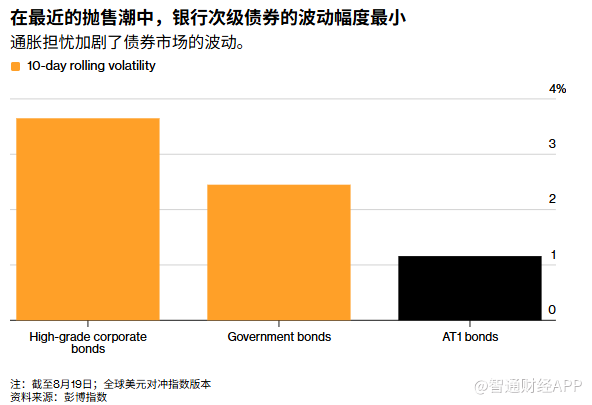
High returns but low volatility: How to explain AT1's abnormal performance?
There are good reasons behind the stability of AT1 bonds. According to a survey released by ABN Amro Bank NV (ABN Amro Bank NV) this week, coupon income alone can meet the total return target of around 80% of the investors surveyed. Shanawaz Bhimji, head of credit strategy at the bank, said that investors whose return requirements are lower than AT1's current income level “will continue to maintain high buying orders.”
Investors are pouring into this market due to the high yield of AT1 bonds issued by the world's largest banks, and as interest rates on government bonds rise, their return appeal has further increased.
Since November of last year, the number of fixed-term funds for retail investors invested in perpetual AT1 bonds has almost doubled. In addition, flexible allocation funds that are not restricted by the scope of investment are also actively buying AT1 because fund managers seek higher returns under high credit market valuations.
AT1 bonds are so-called “high beta coefficient” securities. Theoretically, their price increases higher than the overall bond market when they rise, and the decline is more drastic when falling, because they have higher risk and loss absorption characteristics. As a result, it is rare for such bonds to show resilience in the recent bond market turmoil.
The high yield partly explains this anomaly and is an important cornerstone supporting its stable demand. AT1 bonds offer more generous dividends to cover the additional risks investors bear, including the risk of interest being skipped, uncertain repayment times, and the risk that AT1 holders may be the first to suffer losses if the bank goes out of business.
According to the data, the average yield of the Bloomberg Global Emergency Convertible Bond (CoCo) Index is about 5.7%, while the yield of the investment-grade corporate bond index is less than 5%, and the yield of the government bond index is about 3.7%.
According to reports, AT1 bonds fall into the category of CoCo bonds and were born after the global financial crisis. Its central role is to absorb losses when banks are on the verge of bankruptcy, thereby reducing the financial burden on the government and taxpayers and preventing the crisis from spreading in the financial sector.
Interest spreads have fallen to historic lows, and “complacency” looms over the AT1 market
However, the risk continues to accumulate as investors pursue higher returns. The AT1 spread, a key measure of whether the issuer will repay the bond on the first redemption date, has narrowed to a record low. Last week, the global CoCo Index spread fell below 200 basis points for the first time.
Miginiac pointed out that investors are still chasing profits even when interest spreads are extremely small, which can be called “very complacent.”
The reset spread (reset spread) of a dollar-denominated AT1 bond recently issued by BNP Paribas set the narrowest record in the currency's history. Earlier, a number of US banks, such as Goldman Sachs and Bank of New York Mellon, also issued preferred shares with the narrowest post-crisis spreads this summer — a major tool used by the US banking industry to supplement AT1 capital.
Luca Evangelisti, investment manager at Jupiter Asset Management, said: “The market demand for the AT1 asset class is still very strong.” He believes that whether they are new investors or experienced CoCo holders, their buying behavior may support subsequent releases. “As we have seen so far this year, the order book may continue to be oversubscribed several times.”
But at the same time, he said that he is investing “more and more selectively” because the replacement spread is too narrow and the discount on issuing new bonds is limited.
Meanwhile, Man Group warned that AT1 investors are “thoughtlessly” pouring into the sector and are not fully measuring the risks they are taking.
However, the balance sheet of the European Bank, which is the main source of supply for AT1 bonds, has improved markedly, and investors are no longer concerned about the soundness of the industry. So far this year, the performance of European bank stocks has surpassed even the “Big Seven” in US technology. This fundamental improvement is expected to mitigate shocks in the event of future market pressure.
“The historical correlation between AT1 and broader risk aversion — whether in the field of stocks or government bonds — may not reliably guide future performance, particularly when the trigger is not directly linked to the banking industry,” said Jupiter's Evangelisti.