
Is the VIX Inexpensive Going into the Historically Volatile Fall in 2026?
I explained why we should be cautious in the stock market over the coming months in a July 17, 2026, Barchart article where I concluded with the following:
The many factors facing the U.S. stock market over the coming months, along with seasonality that favors fall corrections, could mean the VIX remains far too low on July 17, 2026. The low VIX tells us that price insurance is inexpensive in the current environment, which could be an opportunity to protect long-term investments in the U.S. stock market.
A stock market correction over the coming months is not a guarantee, but the risks are certainly rising. There are plenty of reasons for caution when approaching the stock market in July 2026.
The VIX index was just below 18.50 on July 30, 2026, and has moved lower in August 2026, presenting an opportunity.
The VIX is a sentiment barometer
In my July 17, 2026, Barchart article, I described the VIX as follows:
The VIX is a sentiment indicator that reflects the implied volatility of put and call options on the S&P 500. Implied volatility is the primary determinant of option prices. Options are a form of price insurance, and demand for insurance tends to rise during stock market corrections. During bull markets, option prices tend to decline as sellers emerge to enhance income on risk positions. Therefore, the VIX index rises when the S&P 500 declines, and it falls when the S&P 500 rises.
The S&P 500 is the most diversified U.S. stock market index, so the VIX is not only a sentiment indicator for the S&P 500, but also a barometer for other leading U.S. indices, including the Dow Jones Industrial Average, the tech-heavy NASDAQ Composite, and the small-cap Russell 2000. Historically, significant stock market moves affect all leading indices and can ripple worldwide, sending foreign indices and other asset markets lower. As the U.S. remains the world’s leading economy and military power, risk-off periods in stocks tend to trigger a flight to quality, lifting the U.S. currency and U.S. government debt securities. However, in 2026, there are no guarantees that a stock market correction will do the same.
The bottom line is that the VIX is a sentiment indicator. A rising VIX is a danger signal for stocks and all financial markets.
So far, a narrower range in 2026 than in 2025
In August 2026, the year-to-date range in the VIX index has been 21.12 points, from 14.18 to 35.30.
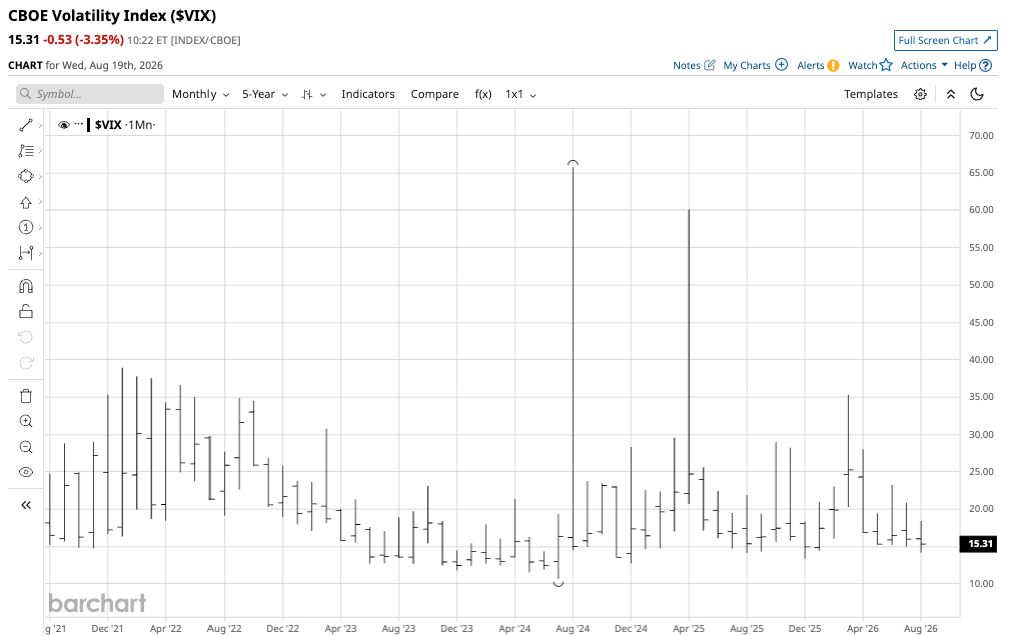
The five-year monthly chart shows that the VIX traded within a wider 46.75-point range from 13.38 to 60.13 in 2025. In 2024, the range was even wider at 55.11 points, from 10.62 to 65.73.
The 21.12-point 2026 range has been tight, but the stock market and VIX are heading into what could be a very volatile period before the start of 2027.
The many issues that could cause the VIX to spike
The first factor that could cause a spike in the VIX is the historical pattern of substantial fall stock market corrections. The 1929 crash, 1987 plunge, and 2008 financial crisis all gripped the stock market in the fall, with October being the month when stocks have suffered some of their worst declines.
Aside from seasonality, the other factors that could cause the stock market to plunge and VIX to explode higher are:
- Geopolitics: Wars in Ukraine and the Middle East are escalating, increasing uncertainty, impacting logistics for critical commodities, and causing global instability from the bifurcation of the world’s nuclear powers.
- Inflation: Wholesale and consumer prices remain elevated, with inflation above the Fed’s 2% target. Stubborn inflation erodes money’s purchasing power, sending interest rates higher. Higher rates tend to weigh on stocks. The current consensus is for a Fed Funds interest rate hike rather than a cut by the end of 2026.
- Debt: The U.S. debt is closing in on $40 trillion and continues to rise. Funding the debt at current short-term interest rates costs nearly $1.5 trillion per year. The U.S. debt could be an economic time bomb for the stock market if a debt or credit crisis develops, causing a risk-off period in markets.
- Midterm elections: The U.S. midterm elections will determine the majorities in Congress and the Senate for the coming two years. Midterm elections favor the opposition political party, which could derail the current administration’s policy initiatives. Meanwhile, fractures within the opposition party between middle-of-the-road and even progressive Democrats and the Democratic Socialists of America could split the opposition party. Meanwhile, the rise of the DSA wing of Democrats is a commentary on the future ideological direction of the U.S., shifting from capitalism to socialism, in which the government plays a far greater role and can even control the means of production, with substantial ramifications for the stock market and wealth levels. Taxation, regulations, immigration, healthcare, the U.S. Constitution, and even the basic structure of the U.S. federal government and its three branches are on the ballot as the DSA has made its policy initiatives clear.
- Surprises: As the markets learned in 1929, 1987, during the Dot.com bubble, and during the 2020 global pandemic, unforeseen events that shock the market can cause the most significant stock market volatility. The many factors facing markets during the second half of 2026 are fertile ground for creating shocking events.
The bottom line is that the coming months could be full of events and situations that could spark a risk-off period and a stock market correction, lifting the VIX index to levels seen in 2024 and 2025.
VIXY is a short-term trading tool that moves higher and lower with the VIX index
The description of the ProShares VIX Short-Term Futures ETF (VIXY) states:
At $18.55 per share, VIXY had over $176.15 million in assets under management. VIXY trades an average of over 2.425 million shares per day and charges a 0.85% management fee.
The latest rally in the VIX index took it 39.6% higher, from 14.96 on July 10, 2026, to 20.88 on July 29, 2026.
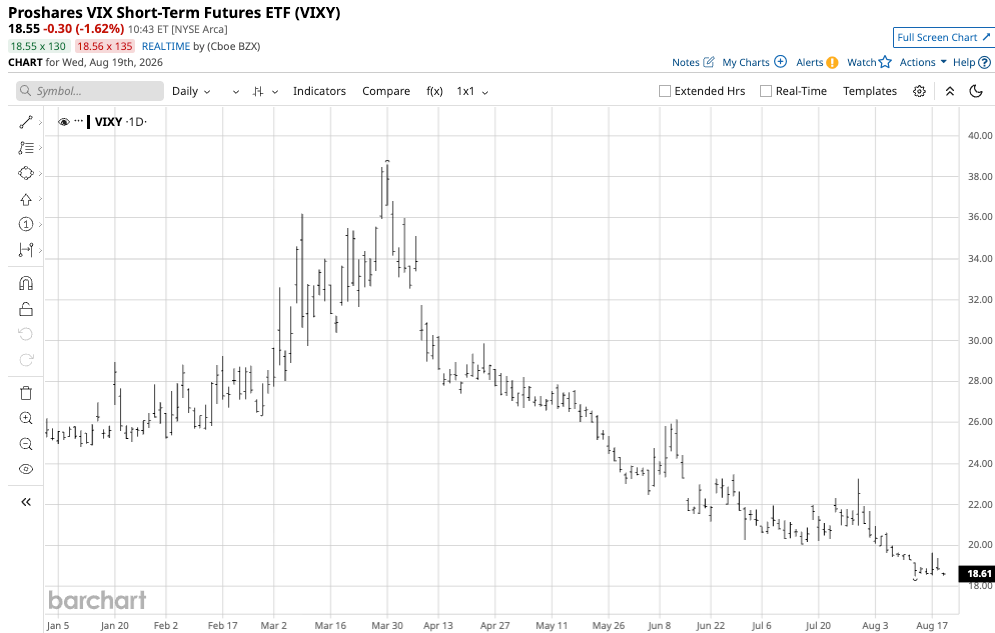
Over around the same period, VIXY rose 16.1% from $20.05 to $23.27 per share. While VIXY has far underperformed the VIX, it does track the volatility index, and a short-term explosive move in the VIX would likely be reflected in the VIXY ETF.
Meanwhile, VIXY is only appropriate for short-term risk positions on the long side of the VIX index. Positioning for a stock market correction that would push the VIX higher with the VIXY ETF requires a risk-reward plan that includes stops and profit horizons. Sticking to stops will protect capital when the VIX moves contrary to expectations. When the VIX and VIXY move higher, raising profit horizons requires a commensurate adjustment to stop levels to protect capital. Trading with VIXY involves accepting small losses in pursuit of greater gains if the VIX spikes higher.
Expect volatility to increase in September through November 2026
Seasonality, geopolitics, inflation, debt, the U.S. midterm elections, and the potential for surprises are compelling factors that could cause substantial stock market volatility over the coming months.
The VIX is a sentiment indicator that signals when market participants rush to buy price insurance for their stock portfolios. The demand for insurance is inversely correlated with the direction of the S&P 500 and other leading U.S. stock market indices. Given the trading ranges in 2024 and 2025, the VIX could be inexpensive at levels below 20, with risk-reward favoring the upside.
On the date of publication, Andrew Hecht did not have (either directly or indirectly) positions in any of the securities mentioned in this article. All information and data in this article is solely for informational purposes. For more information please view the Barchart Disclosure Policy here.