
In the face of $40 trillion in debt, is buyback just a stopgap measure? The pressure of long-term US debt sell-off was difficult to overcome, and Bezent's increased signal was treated coldly by the market
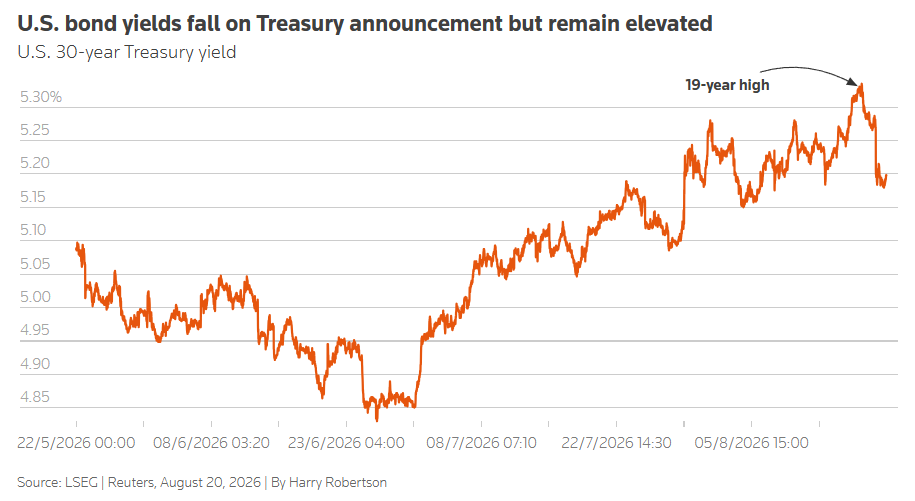
The Zhitong Finance App learned that on August 20, local time, the yield on US long-term treasury bonds rose again after a brief decline on the previous trading day. The yield on 30-year US bonds returned to around 5.27% in the intraday period, almost erasing the entire decline after the US Treasury announced an expansion of repurchases.
Although US Treasury Secretary Bessent said that repurchases may be further strengthened, investors and analysts generally believe that repurchases can only provide short-term liquidity support and cannot solve structural problems such as fiscal deficits, debt expansion, and inflation concerns that drive long-term bond yields.
On Wednesday, the US Treasury announced that it will more than double the liquidity support repurchase scale of 10-30 year treasury bonds, increasing the minimum size of each operation to at least $4 billion. Prior to the introduction of this measure, US long-term bond yields had risen to the highest level since 2007. The Treasury Department took action after long-term bonds were sold off, hoping to ease market pressure.
After the news was announced, strong long-term buying sprung up. The 30-year yield plummeted by about 9 basis points; the US dollar index fell nearly 1% in a single day, the biggest one-day decline since March.
But after just one day, the sell-off made a comeback. On Thursday (August 20), the 30-year US Treasury yield rose to 5.27% intraday, then traded around 5.25%, rising about 5.5 basis points during the day; the 10-year yield rose 4.7 basis points to around 4.70%. Earlier on Tuesday, the 30-year yield hit a 19-year high of 5.34%.
The US dollar index rebounded slightly to 98.88 on Thursday. Other markets showed mixed results: Japan's long-term yield fell sharply, Germany's 30-year yield declined only slightly from Wednesday's 15-year high, and the European market reacted relatively moderately.
Bezent says it's possible to increase the market and not buy it
US Treasury Secretary Scott Bessent said in an interview on Thursday that he may once again increase the scale of government repurchases of treasury bonds. He pointed out that the goal is to support market liquidity, especially in the long-term treasury bond sector, which was lightly traded in August, while also competing with the issuance of a large number of high-yield corporate bonds (including AI infrastructure financing).
But the market didn't think this move would be enough to reverse the trend. Luis Alvarado, co-head of global fixed income at Wells Fargo Investment Research Institute, said the Treasury's move could only provide “short-term relief” because key drivers of higher yields — such as inflation, monetary policy uncertainty, and huge fiscal deficits — still exist. “Until investors get a more clear signal about these major issues — rather than relying on minor fixes like today — the risks facing long-term trends will still be on the upside,” he said.
Jon Walsh, portfolio manager at TwentyFour Asset Management, commented: “This move may not work on its own; this intervention is at best an expedient measure.”
“Any intervention usually has limited effect in the long run. Yields often return to their original level after a period of time.” Michael Goussey, chief fixed income investment officer at Xin'an Asset Management, said. He believes that although the Ministry of Finance has other options, it may be difficult to bring about substantial changes. “The reality is that financing needs cover the entire yield curve, so this adjustment is unlikely to have a significant impact on long-term bond yields.”
One of the biggest factors driving long-term returns is the state of the US fiscal situation. According to US Treasury data, US Treasury bonds surpassed 40 trillion US dollars for the first time on August 18, and have more than doubled since Trump first took office in 2017. Expensive response measures and chronic tax and expenditure imbalances during the pandemic have continued to inflate debt.
J.P. Morgan analysts pointed out in a report that the Treasury Department's statement barely addressed the underlying issues driving up bonds, including unsustainable fiscal deficits and rising inflation expectations.
Given the Trump administration's plans to cut taxes and increase defense spending, most analysts believe it will be difficult to reduce the deficit significantly in the short term. Joe Bruzoulas, RSM's chief economist in the US, said, “Unless tax increases are implemented, government spending growth slows, or real fiscal consolidation is achieved by cutting government spending as in the 1990s, the buyback effect will only be temporary.”
Unlike QE, buybacks are “insignificant” in scale
What is particularly noteworthy is that there are also voices in the market that the current scale of repurchases is too small to reverse the direction of the long-term bond market. Keith Parton, head of global interest rates and fixed income at Columbia Threadneedle Investments, said that compared to the Federal Reserve's past quantitative easing (QE), the size of this repurchase was “insignificant.” He emphasized that for such market intervention to be effective, it must be accompanied by a shift in core government spending policies.
This measure is fundamentally different from the Federal Reserve's QE: QE directly reduces the supply and duration of long-term bonds held by the private sector through large-scale purchases, thereby reducing long-term yields; while the Ministry of Finance's repurchase program focuses more on improving bond market liquidity.
Related reports quoted market experts as saying that the scale of repurchases is insignificant compared to QE, and without additional policy changes such as fiscal expenditure adjustments, the effect may only be temporary.
Although this amount is limited in the $32 trillion US bond market, analysts believe that this move still shows the government's sensitivity to rising long-term interest rates and the tendency to interfere in the market. Interest rates on US mortgages have risen along with the rise in long-term yields, and have repeatedly been the focus of market attention.
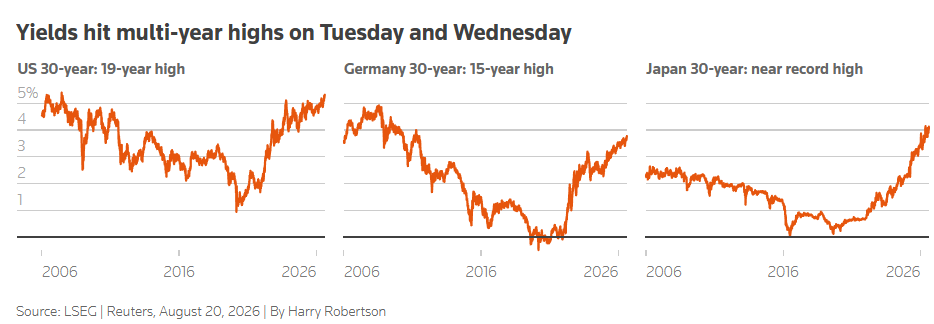
Meanwhile, global long-term borrowing costs have risen to decades-high levels, as governments have accumulated record debt due to successive crises such as the pandemic, the Iran war, aging welfare spending, and defense spending. Higher long-term borrowing costs will drive up government interest expenses and be transmitted to the entire financial market as a pricing benchmark for various types of assets such as corporate bonds, stocks, and real estate.
The German Ministry of Finance said that the Russian-Ukrainian conflict is driving up the demand for defense investment funds, thereby boosting borrowing costs. Japan's borrowing costs have also risen to a 30-year high, putting pressure on the government's fiscal and expenditure driven growth agenda.
In the US, investors are worried that the authorities may not be able to control inflation caused by the war in Iran. This unease has continued to suppress long-term debt for months. According to the analysis, the new round of long-term debt sell-off reflects investors' concerns about the prospects for controlling inflation and the surge in US public debt.
Policy signals and side effects concerns
In response, some investors also questioned whether the Federal Reserve or the Treasury currently has a greater impact on the overall credit environment; just a few weeks ago, the US Treasury bought yen in the foreign exchange market, and now it has increased the repurchase of long-term bonds, making the market more sensitive to its tendency to intervene.
Eric Robertson, head of global research at Standard Chartered Bank, said, “I wouldn't describe the rise in US bond yields as a result or intensification of irrational market conditions. The only conclusion that can be drawn is that the yield has reached a level they don't like, which suggests they are willing to try to control or interfere with natural supply and demand relationships.”
Mitsubishi UFJ Financial Group, on the other hand, pointed out that the Ministry of Finance's unplanned expansion of repurchases may give the impression that there is a lack of strategic planning; it also warns that if the government tries to control long-term yields through only market signals without fiscal consolidation, it may actually weaken demand for US assets and the US dollar.
Together, these views point to a judgment that until core issues such as finance and inflation are substantially addressed, the decline in long-term yields may not be sustainable. The Ministry of Finance's buyback tool may improve market liquidity and ease selling pressure in the short term, but it is difficult to reverse the upward trend in long-term interest rates alone.