
Japan's core CPI accelerated for two consecutive months in July, and the probability of the Bank of Japan's interest rate hike in September reached 80%
The Zhitong Finance App notes that Japan's key inflation indicators have been rising at an accelerated pace for the second month in a row. As market speculations about the fastest rate hike in September continue to heat up, this has kept the Bank of Japan on the path of raising interest rates again in the near future. Japan's Ministry of Internal Affairs and Communications said on Friday that the consumer price index (CPI) excluding fresh food rose 1.8% year on year in July, up from 1.6% in the previous month. The data is in line with economists' median estimates.
The index excluding fresh food and energy rose 1.9% year over year. The indicator was closely watched by the Bank of Japan to measure the potential level of inflation. The overall CPI also rose 1.9%.
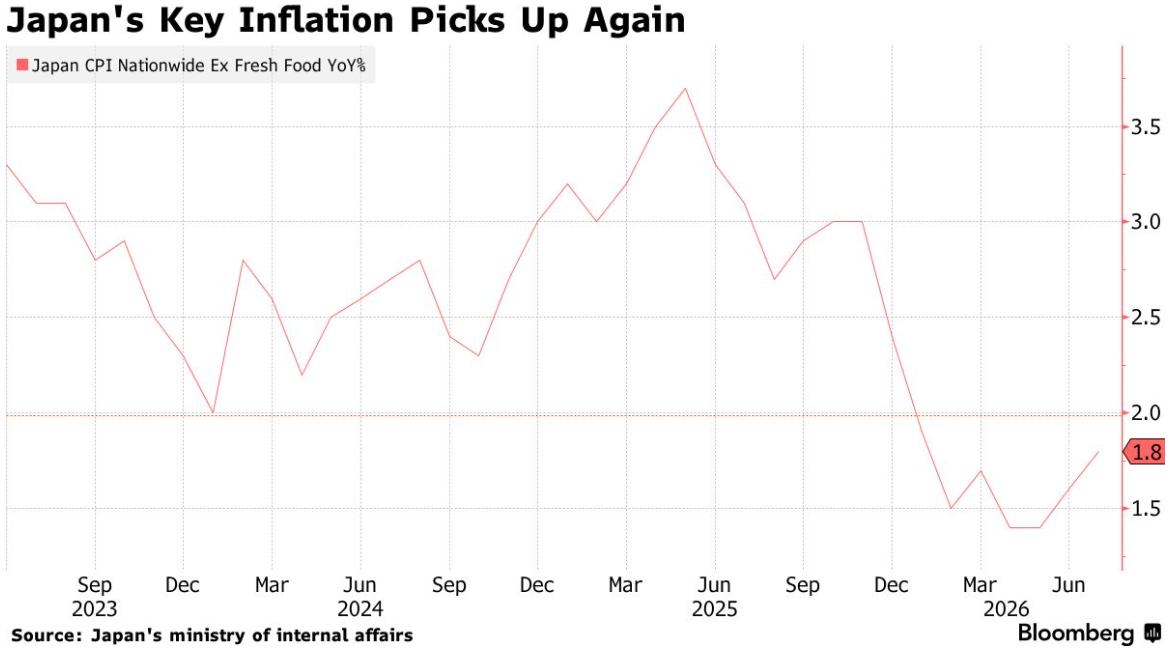
The acceleration in inflation is due in part to energy costs, which rose 0.6% year over year, reversing the slight decline in June. As has been the case for some time, the overall data has been disrupted to a certain extent by government measures to mitigate the impact of rising energy costs. The Ministry of Internal Affairs and Communications said that the reduction in gasoline taxes has slowed the overall price increase by 0.22 percentage points.
This result provided a strong basis for the Bank of Japan to raise interest rates. Just a few weeks ago, Bank of Japan Governor Ueda Kazuo said that the authorities may begin to normalize policies at a faster pace. Investors are increasingly convinced that the central bank will act next month, because even if US and Japanese officials take the rare step of joint intervention in the foreign exchange market in late July, the weakening yen still poses a risk of rising prices.
Economist Taro Kimura said, “Japan's July CPI report reinforces the Bank of Japan's reasons to be wary of excessive inflation. Inflation picked up as oil prices soared from March to June and the weakening yen drove up investment costs. The lower base from last year's energy subsidies also contributed to this acceleration.”
The Bank of Japan has stated that it is expected that starting from the second half of this fiscal year, the year-on-year increase in CPI excluding fresh food will be “significantly higher” than 2%. Economists at Sumitomo Mitsui Nikko Securities predict that this indicator will reach 2.8% at some point in the last three months of this year. The overnight swap index (OIS) market pricing shows that when the Bank of Japan announces its next decision on September 18, the probability of raising interest rates is about 80%.
Processed food prices have risen 3%, which is a pretty fast pace by recent decades; however, since the increase was slower than 3.1% in January, this result dragged down the overall index. The price of rice fell nearly 12% after experiencing a 91% surge a year ago (rice was one of the main drivers of overall inflation at the time).
The price of services, which is a key measure of the sustainability of inflation, rose by 1.2%, slightly accelerating compared to June.
In addition to rising labor costs due to labor shortages, high oil prices and increases in raw material costs brought about by the Middle East conflict have prompted changes in the pricing behavior of Japanese companies. Businesses are increasingly passing on higher costs to consumers rather than absorbing them on their own. According to Imperial Data Bank data, the number of food and beverage products that raised prices this month was 83% higher than a year ago.