
Goldman Sachs spills cold water: Treasury's buyback effect is “relatively short”, and cooling inflation is the “best remedy” to reduce US bond yields
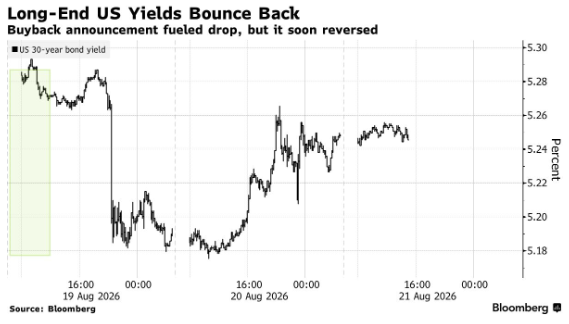
The Zhitong Finance App learned that recently, the US long-term treasury bond market experienced a sharp sell-off. The yield on 30-year treasury bonds once soared to the highest level since 2007. On Friday, the yield was basically flat at 5.25%. Faced with the pressure of a sharp rise in borrowing costs, the US Treasury took urgent action and announced that it would at least double the scale of long-term treasury bond repurchases. However, Goldman Sachs Group is not optimistic about the results of this move, saying bluntly that in the absence of fundamental changes in macroeconomic fundamentals, the Ministry of Finance's efforts may be difficult to sustain. Goldman Sachs Group pointed out that although the US Treasury is doing its best to contain rising borrowing costs, cooling inflation is still the most persuasive way to reduce bond yields.
Goldman Sachs strategist Friedrich Schaper (Friedrich Schaper) wrote in a research report that in the absence of a fundamental shift in the drivers of America's macroeconomic fundamentals, the effects of the Treasury Department's plans to step up debt repurchases may be “relatively short-lived.”
This round of long-term US debt sell-off is fueled by a combination of factors. First, the US fiscal deficit is high, the federal government debt is approaching a record 40 trillion US dollars, net treasury bond issuance continues to increase, and demand-side acceptance capacity has changed marginally, leading to a tightening relationship between supply and demand for US bonds.
According to the latest data, net purchases of US Treasury bonds by private foreign investors fell for the first time in three years, and the year-on-year decline was more than 40%. Second, energy disruptions brought about by the situation in the Middle East have pushed Brent crude oil back to $90 per barrel, and rising inflation concerns are driving up the market's demand for compensation for long-term assets. Furthermore, large-scale corporate debt issuance brought about by the boom in the AI industry is also competing with treasury bonds for capital.
US Treasury Secretary Scott Bessent (Scott Bessent) said on Thursday that he is ready to expand the buyback of high-cost debt and said the government will launch a new fiscal initiative to deal with the highest borrowing costs in years. The day before, the US Treasury Department had just announced that it would “at least double” the scale of repurchases of long-term treasury bonds.
Sharper pointed out that despite some encouraging recent economic data — retail sales falling short of expectations, disappointing employment data, and moderate core inflation in July — the market is still “relatively more focused on upside risks” on US bond yield trends.
Sharper wrote, “We believe that in the current environment, continued accumulation of healthy inflation data — which will increase market confidence in the Federal Reserve stay on hold and drive a return to risk appetite — is still the clearest path to drive yields downward.”