
Is the US bond repurchase comparable to Japan's YCC? The US dollar may not experience a “depreciation spiral,” but the trend under pressure cannot be ignored
The Zhitong Finance App learned that the US bond repurchase promise, which severely shook the market this week, led the market to compare it with the Japanese authorities' policies. In Japan, policies adopted to control borrowing costs (i.e. yield curve control, YCC) eventually led to a long-term weakening of the yen. Wall Street also recently issued a warning saying that the US dollar may become the biggest loser in the repurchases of US treasury bonds. The data shows that the US dollar is currently hovering near a three-month low and is expected to hit the worst weekly performance this month.
Robin Brooks, a senior researcher at the Brookings Institution, said that the US government's move is “the clearest sign so far,” indicating that the US is following Japan's path and dealing with related issues by devaluing its currency. He said bluntly that the US government is “playing with fire.”
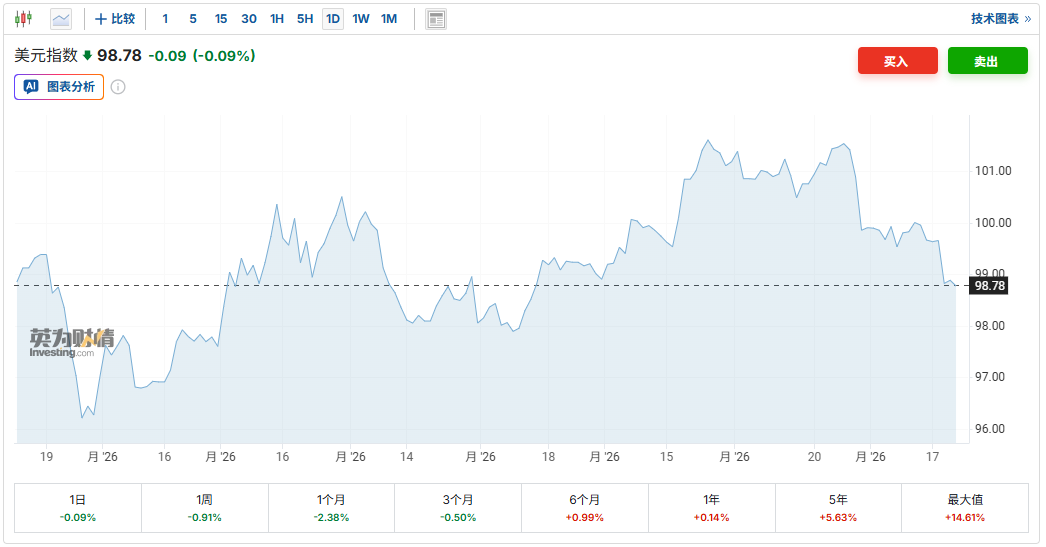
As global long-term bonds continue to be under pressure recently, US Treasury Secretary Scott Bessent threw a bombshell on Wednesday — doubling the scale of weekly liquidity support repurchase operations for a period of 10 to 30 years from at least $2 billion to at least $4 billion each time. This operation quickly dampened long-term yields — the 30-year US Treasury yield plummeted by nearly 10 basis points to 5.18% within a few hours after the news was announced. However, at present, US debt has taken back some of the gains caused by this news. As of press release, the 30-year US Treasury yield was 5.26%, and the 10-year US Treasury yield was back above 4.7%.

The US Treasury's move to increase the repurchase of long-term bonds is pushing the dollar into an awkward situation. “Any kind of yield control weakens the dollar,” said Mohit Kumar, Europe's chief economist at Jefferies International. Gerald Gan, chief investment officer at the Singaporean family office Reed Capital, said bluntly: “The dollar is undoubtedly the biggest victim.” He believes that Bezent is deliberately reducing long-term real interest rates and sending a signal that the weakening of the US dollar will be tolerated to keep the economy running. Steven Barrow, head of strategy at Standard Bank G10, also warned that reducing bond yields through repurchase operations will only further increase the pressure on the US dollar, while not solving the fundamental budget deficit that drives higher US bond yields.
However, some analysts believe that there are certain limitations in comparing the US and Japan's initiatives. The so-called “Abenomics” — the economic policies implemented by former Japanese Prime Minister Shinzo Abe — relies on large-scale monetary easing to stimulate economic growth. These include large-scale quantitative easing programs, which are strongly driving the depreciation of the yen by actually issuing additional yen to buy treasury bonds and reducing yields. The US Treasury's treasury bond repurchases cannot be compared to this kind of monetary stimulus policy, and the US has not chosen to accept depreciation of the local currency as the price it must pay to keep bond yields low.
Steven Barrow said that the US government's intervention in support of the Japanese yen last month proved this. At the time, the US interfered using the euro instead of the dollar, thereby protecting the dollar. Meanwhile, since Japan does not need to sell US Treasury bonds to obtain the dollars needed to support the yen, US Treasury yields are also protected. But he added, “The problem is that America can't get the best of both worlds.”
Foreign exchange traders are currently awaiting Federal Reserve Chairman Walsh's speech at the Jackson Hole Global Central Bank Annual Meeting at the end of this month. If Walsh makes hawkish remarks refuting the market's expectations of lower interest rates, then the dollar may have a chance to take a break.
Daniela Hathorn, senior market analyst at Capital.com, wrote, “How does Walsh view continuing inflation, the recent rise in long-term bond yields, and the size and role of the future Federal Reserve's balance sheet? Any related statement could trigger large-scale repricing of US Treasury bonds, dollars, gold, and stock markets.”
However, if the Federal Reserve resists pressure to raise interest rates, then narratives about the depreciation of the dollar may receive further market support. The options market's sentiment towards the US dollar has reached its most pessimistic level since February. Even though the spot price of the US dollar is falling, this situation indicates that traders are betting that the dollar will weaken further in the future. Robin Brooks said, “Once a currency enters a depreciation spiral, it can be extremely difficult to stabilize it.”