
Malaysia’s growth story has a missing piece
BEHIND Malaysia’s expectation-beating economic performance lies a more sobering reality, with the headline numbers telling only part of the story.
Billions in record-high investment and trade figures can mean little to ordinary Malaysians if good jobs remain hard to find, wages struggle to keep pace and living costs continue to bite.
Half of the formal sector employees in Malaysia earned below RM3,027 as of March.
More than one-third of tertiary-educated employees in Malaysia struggle with skills-related under-employment as they work in semi or low-skilled jobs.
Job losses are reportedly rising, while young jobseekers are finding it increasingly difficult to secure junior roles as artificial intelligence (AI) reduces demand for some entry-level positions.
As for the capital markets, despite the strong flow of initial public offerings taking the limelight, foreign ownership of local equities continues to lurk at multi-year low levels.
Persistent foreign fund withdrawals dragged foreign shareholding further down to 18.3% in June. Until Aug 14, the stock market saw net foreign outflows of RM3.9bil.
This raises a key question: Why does Malaysia’s glittering growth not excite foreign investors?
These developments, among others, continue to fuel a growing question: is economic growth contributing to a fair “shared prosperity”?
Malaysia’s gross domestic product (GDP) defied market forecasts for the third consecutive quarter, growing by 6% in the second quarter of 2026 (2Q26).
A commendable growth indeed, although Malaysia is not alone in beating expectations.
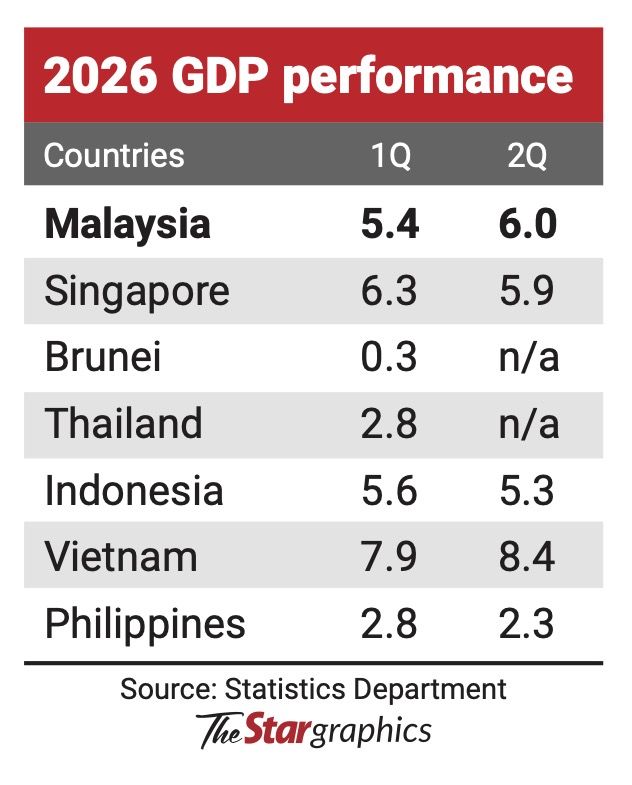
Singapore and Vietnam have also continued to surpass market forecasts in the second quarter.
Interestingly, Singapore – the only high-income nation in Asean – is growing at an almost similar rate or sometimes faster than Malaysia, an upper-middle income country.
In 2Q26, Singapore’s GDP grew by 5.9% after a 6.3% first-quarter growth. In comparison, Malaysia grew by 5.4% in 1Q26.
Theoretically, higher-income economies should expand at a slower pace than developing ones, given their larger economic base and more mature stage of growth.
Center for Market Education chief executive officer Carmelo Ferlito says: “Malaysia should be able to grow faster because it still has more room for capital deepening, productivity convergence and technological upgrading. However, catch-up growth is not automatic.”
Malaysia’s greater abundance of land and natural resources should give it a structural advantage over Singapore’s highly urbanised landscape.
Yet, Singapore has turned its constraints into an advantage, leveraging a highly skilled workforce, strong institutions and its ability to attract and retain global talent.
More importantly, it has deliberately positioned itself around the next wave of technology-driven growth, from advanced manufacturing and semiconductors to AI, digital infrastructure and data centres, while capturing higher-value segments such as research, capital, infrastructure, specialised services and talent.
If a high-income, land-constrained economy such as Singapore can continually reinvent itself around emerging growth engines, the question for Malaysia is less about what resources it possesses and more about what it is doing with them.
Ferlito adds that if fiscal discipline is not in check, and resources continue to be channelled through subsidies, protected sectors and government-selected priorities, Malaysia may grow, but below its potential.
“Malaysia still has substantial catch-up potential, but part of that potential is held back by distortions: a large state and government-linked companies (GLC) footprint, preferential arrangements, regulatory uncertainty, subsidies and industrial policies that can redirect capital according to political priorities rather than market signals.
“The issue is, therefore, not a lack of growth potential, but how much of that potential is allowed to emerge,” he says.
The gaps, Ferlito notes, extend to institutional quality, regulatory simplicity and predictability, public administration, access to high-skilled talent and the depth of a genuinely competitive business environment, including a fairer fiscal system.
The Singapore government recently upgraded its 2026 GDP growth forecast to 4.5% to 5.5%, slightly higher than Malaysia’s 4% to 5% forecast.
However, it is worth noting that Bank Negara Malaysia (BNM) governor Datuk Seri Abdul Rasheed Ghaffour recently hinted that this year’s economic growth could breach 5%.
Growth aside, it remains crucial for Malaysia to ensure the benefits of economic expansion truly reaches the man on the street.
BNM assistant governor Datuk Fraziali Ismail says while minimum wage policies have raised the wage floor, their impact on broader wage growth and ultimately talent productivity remains limited.
“We’ve raised the floor, but what we need to do is build the staircase,” he said during a panel discussion at Sasana Symposium 2026.
“We need to take care of all the things that make our macro (economy) great,” Fraziali added.
Drawing on the broader push by world leaders to make their countries “great again”, Fraziali argued that Malaysia should focus on moving more aggressively up the value chain and expanding Malaysian workers’ access to high-value jobs domestically.
Getting to the root of the problem, tertiary-educated individuals are increasingly caught between a rock and a hard place.
While professionally qualified, many find themselves taking on semi-skilled or low-skilled jobs, whether to compensate for stagnant wages or navigate hiring freezes that have persisted in the post-Covid era.
This under-employment creates a productivity problem that ultimately feeds into disposable income.
Economist Yeah Kim Leng points out that under-employment results in depressed wages, particularly for those in semi-skilled and low-skilled jobs.
“It is a significant structural problem,” Ferlito says.
The underlying issue is that even when lower-skilled workers become more productive, their wages may remain close to the minimum wage due to limited bargaining power and an abundant supply of workers competing for similar jobs.
The central bank’s data show that aggregate wage growth has continued to accelerate in the past several quarters, expanding by 5.5% in 2Q26 compared to 4.4% in 2Q25.
BNM deputy governor Datuk Marzunisham Omar previously said the country’s wage growth has lagged productivity growth and believes there is a need to review its wage-setting system, particularly how adjustments to the minimum wage translate into wages at higher levels.
Ferlito, however, says: “High-paying jobs come from higher productivity and economies of scale, not regulation.”
As AI reshapes the workplace, adapting to technological disruption will be essential for workers to remain relevant and move up the value chain.
The government has called for high-performing sectors to create more high-value jobs, requiring workers to develop specialised skills to manage advanced AI technologies.
This raises a broader question of whether the productivity gains from billions being invested in AI will translate into better employment opportunities, or primarily serve to improve corporate efficiency and returns.
The AI boom is generating strong growth across the sectors it is transforming, while Malaysia’s position in the supercycle is strengthening its trade surplus.
That external strength provides an important buffer against shocks that could otherwise weigh on domestic demand.
The electrical and electronics (E&E) sector played a key role in pushing exports up by 17% in 2Q26, this included information and communications technology (ICT) and machinery equipment, electrical equipment and semiconductors.
IPPFA Sdn Bhd director of investment strategy and country economist Mohd Sedek Jantan believes Malaysia’s export growth could prove more durable supported by heavy investment in the physical infrastructure needed to power the AI economy.
However, economists doubt the 17% growth rate is sustainable as a run rate.
“The 17% real export growth in 2Q26 is clearly not sustainable as a run-rate. The base effect will become less favourable, while global trade growth and semiconductor demand will eventually normalise,” Mohd Sedek explains.
The silver lining is that technology-related demand remains elevated even as its growth rate moderates, making the eventual slowdown more gradual than in a conventional semiconductor downcycle.
“Malaysia’s export cycle is increasingly being supported by the global AI and semiconductor investment cycle, rather than simply by inventory restocking,” he says.
Malaysia’s stronger export performance also appears to be backed by expanding productive capacity, with imports rising alongside as firms bring in more intermediate inputs, equipment and capital goods.
“Real imports increased 13.9% in 2Q26, alongside the 17% increase in exports, while the trade surplus widened to around RM84bil from RM63.2bil in 1Q26,” he notes.
The figures suggest Malaysia’s external strength is being supported not only by export demand, but by increased production capacity tied to the broader AI and semiconductor investment cycle.
Additionally, Malaysia’s resource reliability could prove more valuable than simply offering cost advantages.
According to Mohd Sedek, Malaysia is becoming a key data-centre hub in Asia, but its competitive edge will depend on how quickly it can provide reliable power, grid capacity, water, connectivity and supporting infrastructure.
Power and grid capacity are increasingly the key constraints, underscoring the need for close government-utility coordination.
“Malaysia could reach a point where capital is available but physical capacity is not. That is the risk policymakers need to manage,” he highlights.
Subsequently, the government needs to keep in mind that Malaysia’s export outlook remains heavily exposed to a boom that is doing disproportionate work on the external and industrial side.
The economy has buffers, with services, ICT, financial services and domestic consumption providing a broader growth base.
However, a combination of weaker AI investment, softer global trade, higher energy prices and tighter financial conditions persists as genuine risks.
“If AI-related demand remains strong, it can compensate for the normalisation in other parts of investment and exports.
“If AI capital expenditure slows sharply, the economy would have less private-investment momentum to offset that external shock,” he warns.
Despite the commendable investment flows and export figure, it is crucial to note that the Malaysian economy is highly dependent on private consumption.
In 2025, private consumption alone accounted for 60.3% of GDP growth, according to BNM.
At a glance, the country’s strong consumption could suggest an improved living standard, although it masks the actual reality – a debt-driven consumption amid slower-than-ideal wage growth.
Household debt stood at RM1.73 trillion as of March this year, or about 84.4% of GDP.
Adding concerns to the rising debt amount is the fact that Malaysians now owe over RM5bil in buy-now-pay-later (BNPL) loans, as revealed by the Finance Ministry.
In fact, in just the first three months of this year, BNPL loans have reportedly grown by some RM400mil.
“If spending grows faster than the productive capacity that ultimately supports household earnings, the economy becomes more dependent on leverage and on favourable financial conditions,” Ferlito says.
Inherently, this risks creating a “spoilt-rotten” phenomenon, leaving the economy increasingly vulnerable.
Household spending could, therefore, become increasingly reliant on continued credit expansion, refinancing or favourable financing conditions, with Malaysia already among the countries with the highest household debt-to-GDP ratios.
“Warning signs would include debt servicing rising faster than income, deteriorating repayment quality and consumption remaining strong despite weak real-income growth,” Ferlito says.
The latest consumer price index or CPI release indicated that targeted diesel subsidies helped counter-balance headline inflation, despite firmer food and household costs.
While current consumer inflation remains manageable, a think tank has warned that pressures may be building beneath the surface, with money supply growth returning to Covid-era levels and producer prices rising sharply.
The concern is that higher input costs could eventually filter through to consumers.
“Policymakers should avoid treating consumption as a policy target: the objective should be an environment in which incomes and productivity can grow,” Ferlito says.
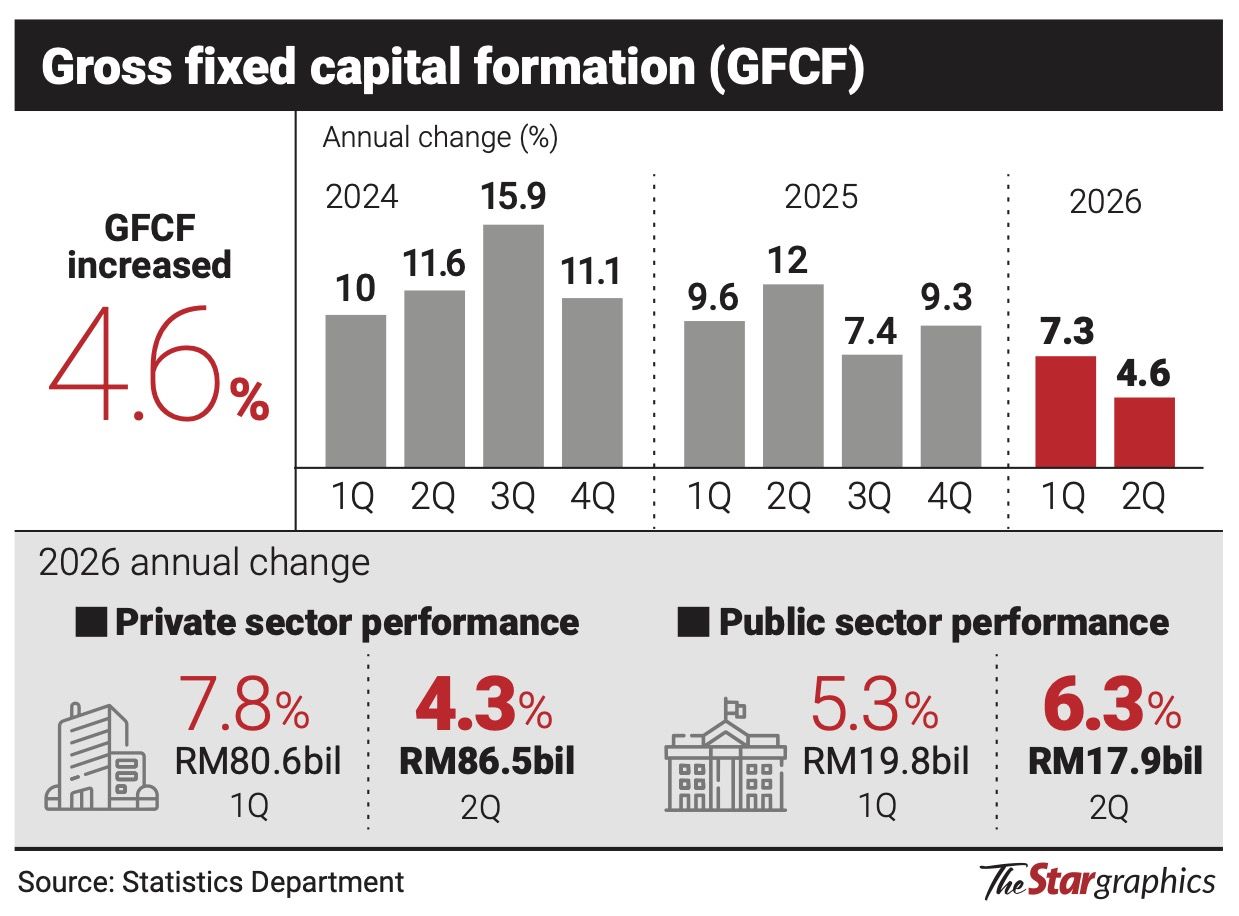
GFCF matters because it tells you how much an economy is investing in assets that can generate future growth, rather than simply measuring what is being consumed today.
Malaysia’s GFCF growth has consistently been on a downtrend, from a high of 15.9% in 3Q24 to 4.3% in 2Q26.
Economists say this is not concerning, unless the slowdown persists.
While Malaysia has a strong approved investment pipeline, Ferlito stresses that the quality and composition of investment matter, noting that GFCF and the Malaysian Investment Development Authority (Mida) investment figures measure different things and should not be directly compared.
That said, what comes next will depend on how the government calibrates its growth strategy to translate investment into productivity gains.
“Shifting investment toward high-value activities and dramatically increasing research and development spending from its current 1% of GDP to over 3% to climb the value chain,” Yeah says.
Ultimately, Malaysia does not have a growth problem so much as a productivity-conversion problem.
The challenge now is ensuring that investment, AI-driven exports and economic expansion translate into higher-value jobs, stronger productivity and rising incomes for Malaysians.