
Twilio (TWLO) Stock May Trade At A Premium As Outlook Rises
After a strong three year run where Twilio stock has delivered a 279.5% return, the shares now sit in an awkward spot. The intrinsic value estimate from a Discounted Cash Flow (DCF) model points to a price that is roughly in line with the market, while the market multiple checks lean toward Twilio looking expensive.
- Over the past three years Twilio has returned 279.5%, which sets a high bar for any further gains to be justified by fundamentals.
- Stronger expectations for revenue growth and the completion of a large share repurchase program can support the long term story, but any disappointment in execution on AI and customer data products may quickly weigh on what investors are willing to pay.
- Twilio scores only 1 out of 6 on our valuation checks, which suggests the stock is not a clear bargain when looking across several different yardsticks.
The issue now is whether Twilio's current US$225.30 share price already reflects most of its intrinsic value, or if there is still room for upside without stretching valuation too far.
Is Twilio Fairly Priced on Cash Flow?
The Discounted Cash Flow (DCF) model values Twilio by projecting its future free cash flows and discounting them back to today. For Twilio, the model uses a 2 Stage Free Cash Flow to Equity approach, anchored on latest twelve month free cash flow of about $992 million and assuming growing cash flows rather than sharp swings.
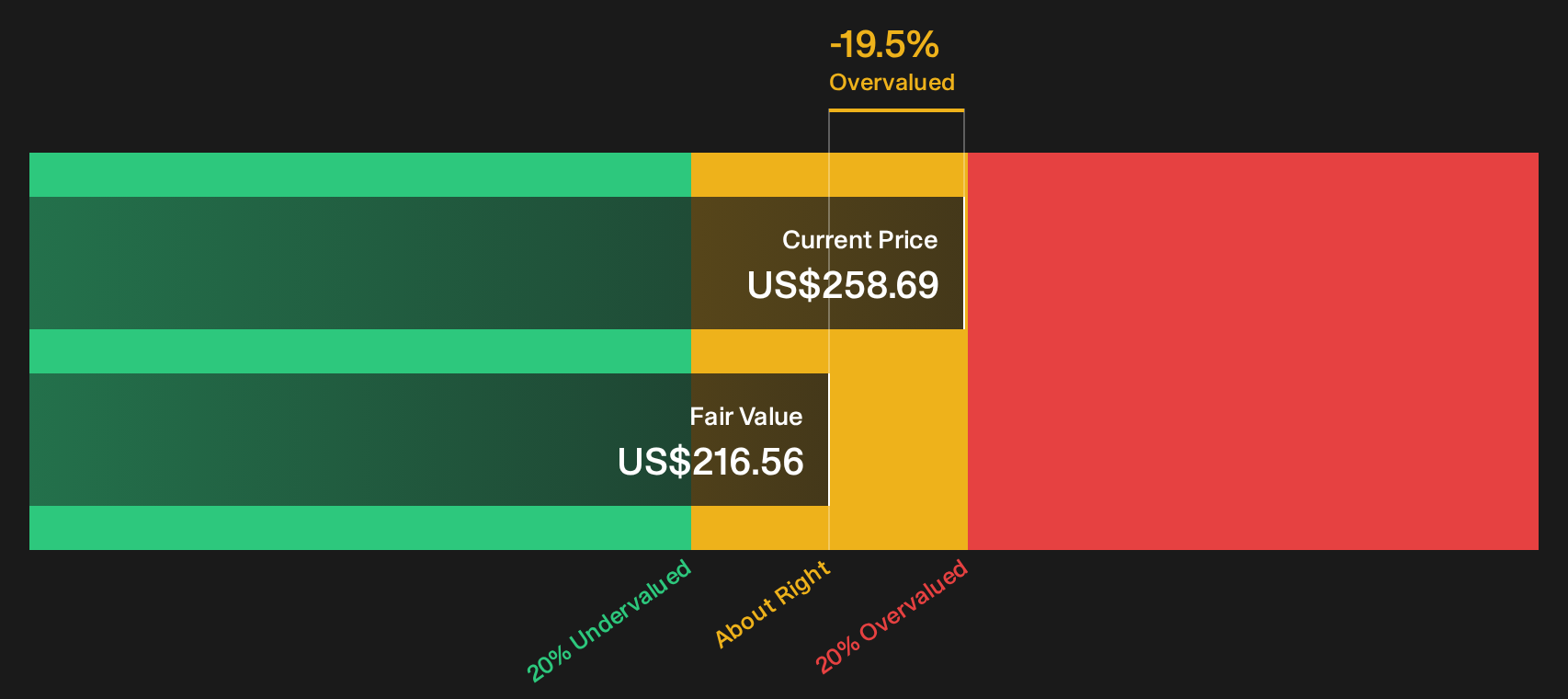
On these assumptions, the DCF points to an estimated intrinsic value of about $221 per share, which is very close to the current $225.30 share price. That implies the stock screens roughly 2.0% overvalued, so the current market price is broadly in line with what the cash flow projections support. Twilio's recent update to its 2026 revenue growth outlook and completion of a large buyback help explain why investors appear comfortable paying a small premium to the intrinsic value estimate.
Overall, the DCF suggests Twilio is about fairly valued at current levels.
Twilio is fairly valued according to our Discounted Cash Flow (DCF), but this can change at a moment's notice. Track the value in your watchlist or portfolio and be alerted on when to act.
Has Twilio Run Too Far on Earnings?
P/E is a useful cross check for Twilio because investors are watching how efficiently current earnings support its market value. Twilio trades on a P/E of about 30.1x, which is above the broader IT industry average of roughly 17.3x and also below a peer group average of around 55.4x. That leaves the stock priced at a premium to the sector, yet not at the very top end of peer valuations.
A blended model that looks at Twilio's growth profile, margins, size and risk suggests a fair P/E closer to 20.0x. Against that yardstick, the current 30.1x implies investors are paying a sizeable premium relative to what those fundamentals might usually support. The recent raise to the 2026 revenue outlook and the completed US$1.2b buyback help explain the willingness to pay up for the Twilio story, but they do not remove the valuation stretch.
On the P/E multiple, Twilio stock currently screens as overvalued compared with a more tailored fair ratio benchmark.

See what the numbers say about this price — find out in our valuation breakdown.
The Twilio Narrative: What Would Justify Today's Price?
Simply Wall St Narratives pick up where the Twilio valuation puzzle leaves off and explain which combinations of future growth, margins and earnings would need to occur for the stock to be worth materially more or less than today's price. Each narrative ties Twilio's potential catalysts and risks to a specific fair value estimate, so you can track over time which version of the story is actually unfolding on the Community page.
The Twilio community is split between a bullish AI driven platform story and a more cautious view that questions how much is already priced in.
Bull case: 32% undervalued
"Twilio's expanding AI-driven infrastructure, omnichannel innovations, and key partnerships position it as a dominant force in next-generation enterprise communications and revenue growth..."
Read the full Bull Case to see why Twilio could be undervalued
Bear case: 12% overvalued
"Reliance on low-margin messaging, slow software growth, regulatory pressures, AI disruption, and rising competition all threaten Twilio's margin, differentiation, and long-term growth prospects..."
Read the full Bear Case to see why Twilio could be overvalued
Do you think there's more to the story for Twilio? Head over to our Community to see what others are saying!
The Bottom Line
Twilio now looks roughly in line with its intrinsic value on a Discounted Cash Flow (DCF) view, while the P/E multiple still screens as overvalued relative to a tailored fair ratio. That split reflects solid cash generation on one side and punchy growth expectations and sentiment on the other. Broader valuation checks are weak, so the stock does not screen as a clear bargain despite the intrinsic value support. The key question from here is whether Twilio can deliver on its AI and customer data ambitions strongly enough to sustain that premium multiple without leaving investors overexposed to disappointment.
This article by Simply Wall St is general in nature. We provide commentary based on historical data and analyst forecasts only using an unbiased methodology and our articles are not intended to be financial advice. It does not constitute a recommendation to buy or sell any stock, and does not take account of your objectives, or your financial situation. We aim to bring you long-term focused analysis driven by fundamental data. Note that our analysis may not factor in the latest price-sensitive company announcements or qualitative material. Simply Wall St has no position in any stocks mentioned.
Have feedback on this article? Concerned about the content? Get in touch with us directly. Alternatively, email editorial-team@simplywallst.com