
Is Bitcoin moving from emptying the air to a sideways stress test? Kalshi bets on the end of the year with a $75,000 bet
The Zhitong Finance App learned that Bitcoin, the world's largest cryptocurrency by market capitalization, has accumulated a cumulative increase of more than 20% since Monday, driving it to a phased high range not seen since May this year, but real money speculators and professional institutional traders of the forecasting market platform — Kalshi, a world-renowned paid forecasting platform — generally expect that Bitcoin will end the whole of 2026 at a level close to the current price level, that is, the rest of the year may tend to fluctuate sideways or change hands at a high level at some stage of the bull market.
According to the average results of contracts related to the platform, speculators and professional institutional traders expect the price of Bitcoin to be around $75,000 by the end of 2026.
These contracts on the Kalshi platform require all traders to place “yes” or “no” binary bets on whether Bitcoin is within a different price range of $5,000 as of midnight on January 1, 2027. The contract will be settled based on Bitcoin price data provided by CF Benchmarks.
Prediction markets (prediction markets) such as Kalshi and Polymarket can be described as popular all over the world since the US presidential election at the end of 2024. At that time, almost everyone was keen to use real money to bet on who Trump or Harris would win the US presidential election on the paid prediction market platform Polymarket. This also meant that the “everything can be gamble” trend began to sweep the financial market. Bets related to the Iran war have also pushed Polymarket geopolitical contracts to record highs, highlighting that the prediction market is showing a “everything can be gamble” trend, but at the same time quickly hit the red line of regulation and ethics.
In large part, prediction markets have become increasingly popular with retail investors over the past year because they provide a new way to bet on major events (such as whether the US government shuts down again), sporting events, and cryptocurrency prices. These are still the largest business categories on Polymarket and Kalshi, but the two companies have also long promoted them as financial places to legally trade politics and global events. The forecasting market has now expanded to include a large number of themed events such as politics, sports, economic data, weather, and geographical events.
After soaring more than 20% in a single week, it is predicted that the market will “put the brakes” on the Bitcoin bull market
Bitcoin's surge this week was mainly driven by two key catalysts: First, the US Treasury intervened in the long-term US bond market to ease the sell-off pressure on the bond market and thereby reduce the selling pressure on risky assets; second, the White House held an event where US President Donald Trump, cryptocurrency industry executives, and regulators jointly pushed the US Congress to approve the “CLARITY Act”, which is critical to market structure and regulatory guidelines.
This US cryptocurrency regulation bill, known as the “CLARITY Act,” if signed into law, will clarify the jurisdiction of US financial regulators over this booming industry and is likely to drive mass adoption of digital assets.
The cryptocurrency industry has been pushing for this critical legislation, calling it critical to the future of US digital assets and necessary to address the core issues that have long plagued cryptocurrency companies. Among other things, the legislation will provide legal clarity to the industry by defining when crypto tokens fall into a security, commodity, or other category. At the same time, compromise clauses surrounding rewards for idle holding stablecoins are becoming the fiercest point of disagreement between the banking industry and the crypto industry.
As this flagship cryptocurrency has risen sharply, market expectations for Bitcoin's year-end price have also improved. Prior to Wednesday, Kalshi's cryptocurrency traders had agreed that Bitcoin would most likely end the year around $66,000.
However, the latest predictions from speculative forces and professional institutional traders mean that the price of Bitcoin will drop slightly from current trading levels around the end of the year. Bitcoin was recently reported above $78,000.
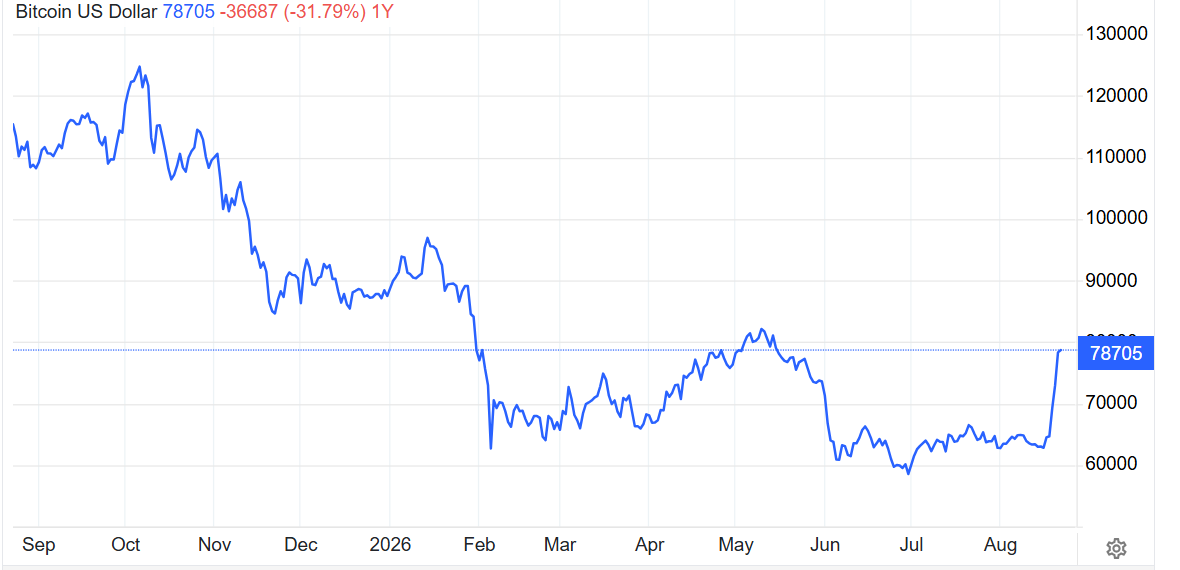
Bitcoin's short-term rapid rise phase may approach the peak of momentum, and then the probability of moving into a highly volatile sideways market or moderate retracement will rise markedly. However, according to some analysts in the coin industry, the $75,000 year-end forecast shown by the Kalshi platform cannot be directly interpreted as “the highest point of the whole year has already appeared.” The contract only predicts the final value of January 1, 2027, and does not restrict Bitcoin from breaking through a higher price level and then falling back to the end during the year.
Is Bitcoin moving from emptying the air to a sideways stress test?
Kalshi's agreed year-end forecast of 75,000 US dollars largely highlights that speculators and professional traders have raised the year-end pricing center from about 66,000 US dollars to 75,000 US dollars, yet they have not continued to extrapolate this week's increase of more than 20%, indicating that the market is shifting from trend upward to valuation and position digestion.
US Treasury Secretary Bezent's expansion of long-term US bond repurchases has improved transaction liquidity, but it has not reduced US net debt, nor is it part of the Federal Reserve's type of money creation; long-term yields are under pressure again after a brief decline. As a result, the market interpreted it as a problem between US fiscal sustainability and US dollar credit, rather than actually resolving the contradiction between supply and demand in the bond market. The weakening US dollar has driven the two major physical and digital safe-haven assets, gold and bitcoin, to become common exports of “currency depreciation transactions.” Bitcoin once approached 79,500 US dollars this week, with a weekly increase of about 23%. This structural narrative still supports medium-term prices, but the Ministry of Finance's operation itself is more like a catalyst for one-time valuation and repricing, and is insufficient to continue providing additional liquidity.
This round of the market includes both actual purchases and technical shortfalls: the net weekly inflow of Bitcoin spot ETFs is about US$1.61 billion, while the scale of short liquidations exceeds US$4.3 billion; the White House's push for the “Clarity Act” has also strengthened the regulatory certainty premium. The problem is that bears' recovery is a one-time fuel. After the price quickly moves away from the medium-term moving average, new capital must continue to flow in to maintain the same slope. Once ETF inflows slow, the dollar's technical rebound, or real interest rates rebound due to the hawkish stance of the Federal Reserve, short-term profit trading may push the market into a “time for space” sideways arrangement.
Bitcoin is likely to be entering a high-frequency turnover phase of volatile prices around $70,000 to $80,000. Fiscal deficits, dollar credit dilution, and regulatory improvements form medium term bottom support; if Federal Reserve Chairman Walsh maintains hawkish, long-term yields close to 5% or risk asset deleveraging, it will limit valuation expansion. Only the continued large-scale inflow of ETFs, substantial progress in the “CLARITY Act”, and the simultaneous decline of the US dollar and real interest rates will be enough to push Bitcoin to break through the current platform and start the next trend.