
The plight of the “meddler” of US debt: the deficit, the wave of AI debt issuance, and the impact of Walsh's position. The Baycent repurchase plan is difficult to shock 4.7% yield
The Zhitong Finance App learned that when he first took office, US Treasury Secretary Scott Bessent lashed out at his predecessor's attempt to “transform” the world's largest bond market, but now he himself has made a similar attempt. Last Thursday, Bezent announced that he would implement what he called a “Treasury version of distorted operation” by buying back a batch of long-term treasury bonds (and issuing additional short-term securities) — a statement reminiscent of the Federal Reserve's famous “distorted operation” plan in the 1960s. Bessent believes that the current long-term yield has deviated from the “equilibrium” level.
The distorted operation did “twitch” US debt for a day — after the announcement of the plan, long-term bond yields fell sharply on Wednesday, but then quickly rebounded. The 10-year benchmark yield, which Basent is most concerned about, closed at 4.73% last week, close to its highest level since taking office.
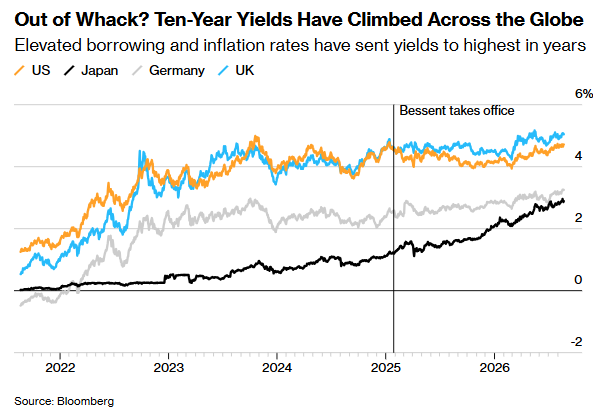
All of this shows that the finance minister's efforts to reduce borrowing costs (especially as the November midterm elections approach) are facing upward pressure far beyond his control. These pressures include: record debt levels in the US (an indicator this week showed that total treasury bonds surpassed $40 trillion) and developed economies as a whole; a surge in corporate bond issuance led by the AI boom; a rebound in inflation triggered by the turmoil in the energy market after Trump's war on Iran; and additional concerns brought about by uncertain policy path of Federal Reserve Chairman Kevin Wash.
“Any path that can reduce long-term returns for a long time cannot bypass areas that the current administration is unwilling to touch,” said Matt King, founder of Satori Insights. He said that reducing the US budget deficit, stock market pullback, or AI investment cooling down can reduce long-term returns.
The “return to normal” dispute
Some market participants do not believe there is a so-called “deviation” in yield. “I think we're back to normal interest rates; 4% to 5% is in the normal range,” — Edward Yardeni, the creator of the term “bond vigilante,” said one hour before Basent took action. And although the Ministry of Finance said its intervention was aimed at supporting liquidity, the J.P. Morgan Interest Rate Strategy Team reported on Thursday that “market function has improved significantly this year.”
Bezent's vision of controlling the yield curve (that is, affecting interest rates with different maturities) has been extended beyond treasury bonds to include so-called “hyperscale enterprises” — companies that are heavily borrowing and investing in the AI field. Earlier this month, Alphabet Inc. issued bonds with maturities of up to 40 years. The finance minister said this week that these investments will eventually pay off in the form of faster, non-inflationary economic growth, but “they are currently causing short-term capital competition.” He suggested that if you sit in the CFO position, “you will consider issuing more bonds with a 'belly' term”, that is, a 5-year term.
This obvious intention to intervene has even prompted market discussions about whether there is a “Bezent put option” — a copy similar to the Greenspan put option in the past. Chris Turner, head of global marketing at ING Groep NV, also used this statement this week, but many people doubt whether Bezent actually has the power to influence returns. The Treasury Department did not respond to a request for comment on Bezent's intervention in the bond market.
“Misinformation” and the deficit dilemma
Faced with rising yields, Bessent said investors were being guided by “misinformation,” while he himself had an “asymmetric” information advantage. “There is a lot of misleading information about the deficit situation,” he said, and promised to redirect the market's attention to what he called Trump's fiscal consolidation plan.
Strategist Alyce Andres commented, “Bezent was unable to control inflation expectations, nor was it possible to force down nominal long-term interest rates, so he chose to reduce the circulation of some long-term securities with poor liquidity through repurchases. But the latest plan must convince investors that buybacks are a bridge to a better debt trajectory, rather than forcibly suppressing yields without resolving deficits.”
Bessent said that in the next few days he will “examine possible measures from both the revenue and expenditure side” with White House budget director Russ Vought, and hinted that it would crack down on fraud and cut transfers to state governments. The “Ministry of Government Efficiency” led by Musk tried similar measures last year, but failed to meet its expected goal of cutting spending.
“We are skeptical that the government can now take substantial action on the deficit issue,” Sarah Bianchi, chief strategist at Evercore ISI, wrote in the research report. In addition to the Ministry of Finance's interest expenses (which now far exceed 1 trillion US dollars per year), spending on social security, health insurance, and Medicaid is the main driver of this year's fiscal deficit (which is estimated to account for about 6% of GDP). Bianchi pointed out that reform of these welfare programs is “absolutely impossible in the short term,” and if the Democratic Party wins at least one house of Congress after the midterm elections, it is even less likely to advance.
Basent vs Walsh?
What is really within Bezent's remit is to adjust debt issuance and repurchase strategies. Prior to this week's operation, the Ministry of Finance had adjusted the broader forward issuance guidelines two weeks ago. Analysts said this opened the door for a possible reduction in the issuance scale of securities for the longest period (that is, the highest yield). Such measures are quite similar to the debt issuance strategy of the Yellen period that Bezent once criticized, and also suggest that there are hidden differences between him and Walsh.
Instead of adhering to claims that yields are out of balance, Walsh almost endorsed the upward trend. On July 29, he said that although the Federal Reserve has not tightened its policy in the face of high inflation, “the market has done a lot of work” and “market prices will continue to respond in the direction and magnitude they see fit.” Walsh himself is about to enter a critical moment of communication — he will be speaking at the Jackson Hole Annual Meeting hosted by the Kansas City Federal Reserve on Friday.
Investors will be watching to see if he will use this to repair his credibility after the poor response to last month's press conference. At the time, Walsh failed to give a reasonable reason to keep interest rates unchanged, avoided any hint that interest rates might be raised in the coming months, and said that the Federal Reserve's inflation target might be adjusted in January.
“We think Basent's actions put Walsh in a somewhat embarrassing situation,” said Mark Dowding, RBC BlueBay Asset Management's chief investment officer for fixed income.
“Reversal script” to be performed
“If Walsh can really explain how they can provide quantitative indicators, how to use information, and give an action plan for the next three to six months, that would be a real reversal of the script,” said George Goncalves, head of US macro strategy at Mitsubishi UFJ. “At least let the market know what to focus on.” Walsh wants to reshape the Federal Reserve's balance sheet (currently holding about $4.54 trillion in treasury bonds), and mentioned the new “Fed-Treasury Agreement,” but did not elaborate on its details.
The original agreement of 1951 greatly limited the influence of the Federal Reserve in the bond market and ended the yield curve control strategy. If current US policymakers really want to reduce borrowing costs, they may need to do the opposite. “Buybacks are more of a signal than a real impact,” and it is difficult to change the market pattern even if the scale is expanded. Rebecca Patterson, a senior member of J.P. Morgan Chase and Qiaoshui and a current senior researcher at the Foreign Relations Committee, said, “A more effective and sustainable policy path is through quantitative easing by the Federal Reserve.”
Before taking office, Bezent referred to continued quantitative easing (that is, the Federal Reserve's debt purchase) as a “permanent drug delivery plan”; while Walsh opposed quantitative easing when he was a member of the Federal Reserve in the early 2010s, he has been one of the sharpest critics ever since. If the two don't make such a major policy shift, then the yield curve will still be dominated by investors. “The economy is resilient, and competition for global capital is intensifying,” said Priya Misra, portfolio manager at J.P. Morgan's asset management division. “It is logical that interest rates will rise.”