
Bank of Japan officials intensively appeared in the market and waited for a “confirmation signal” of the September interest rate hike
The Zhitong Finance App learned that Bank of Japan officials will soon have several opportunities to confirm or suppress the market's increasingly aggressive September interest rate hike bets. Before the next interest rate decision is announced on September 18, several senior Bank of Japan officials will make public appearances one after another. Bank of Japan Deputy Governor Ryozo Himi will be the first to make a public speech this Thursday. Bank of Japan Governor Kazuo Ueda may not attend this week's official meeting in Jackson Hole, but he is expected to hold a press conference and deliver a speech after the Group of Twenty (G20) meeting to be held in the US next week.
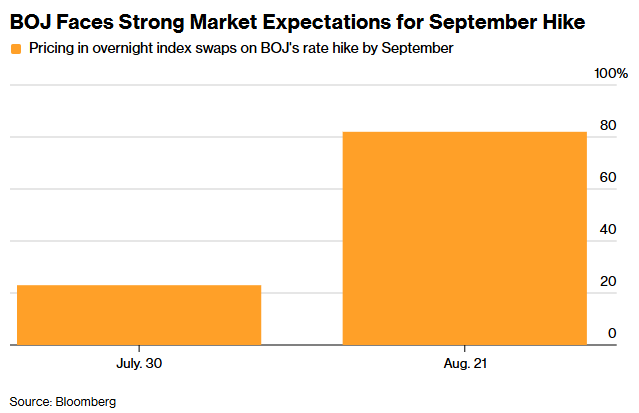
The Bank of Japan faces strong market expectations for a rate hike in September
As of the evening of last Friday, the overnight index swap market showed that the probability that the Bank of Japan would raise interest rates in September was about 82%, more than tripling from about 23% before the Bank of Japan's policy meeting in July. Since Kazuo Ueda seemed to catch some traders by surprise and was fiercely criticized for his decision to raise interest rates in July 2024, he has emphasized the need to fully communicate with the market. After learning the lessons of the July 2024 rate hike — the decision to raise interest rates at the time was one of the factors that triggered the sharp decline in global stock markets — the Bank of Japan apparently prepared for the market ahead of the past three rate hikes.
The yen was also another key factor that forced the Bank of Japan to release policy intentions to the market. At the end of last month, the US and Japan made a rare joint foreign exchange intervention, pulling the yen back from its weakest level in nearly 40 years. Since then, the market's bets on the September rate hike have heated up sharply. Since the yen is still hovering around 160 yen per dollar, which has important psychological significance, there is very limited room for the Bank of Japan to release dovish signals. If the market is already betting on interest rate hikes, but the Bank of Japan decides to keep the policy unchanged, then traders scrambling to close their positions may cause the yen to fall sharply.
This also means that Bank of Japan observers have a stronger incentive to carefully analyze the words of the officials and look for subtle clues to determine whether they agree with current market pricing or whether they want the market to lower expectations of interest rate hikes.
Kento Minami, a senior economist at Daiwa Securities, said, “Chances are, the Bank of Japan will not clearly state that the next rate hike will take place in September. Instead, officials may suggest the need to raise interest rates as soon as possible by emphasizing the risk of rising inflation. The market will interpret this as an endorsement of the September rate hike.”
This makes those subtle policy signals particularly important. If the Bank of Japan repeatedly emphasizes uncertainty, requires further data research, or needs to evaluate the impact of previous interest rate hikes, then these statements may be interpreted by the market as implying that interest rates will remain unchanged in September.
Conversely, if the Bank of Japan puts more emphasis on the risk of rising inflation, the price pressure driven by the yen, or emphasizes the need to avoid policies falling behind the economic situation, then the market's expectations for the Bank of Japan to raise interest rates as soon as possible are likely to increase further.
Investors will also have more opportunities to test whether the expectation of a September rate hike is true through Bank of Japan review committee member Takada Hajime on September 2 and Masuda Kazuyuki's September 10 speeches. Takada Hajime is one of the most hawkish members of the Bank of Japan. He is likely to once again emphasize the need to quickly tighten monetary policy. He was the only member to vote against the Bank of Japan's decision to keep interest rates unchanged last month, when he supported interest rate hikes.
Kazuyuki Masuda, a former Mitsubishi Corporation executive, will also receive close attention from the market. Earlier, his remarks before the June meeting had strengthened market speculation about subsequent interest rate hikes. His speech will be the last public appearance of the reviewers according to the current arrangement before the Bank of Japan makes a policy decision on September 18.
Bank of Japan observers are also watching for a possible meeting between Kazuo Ueda and Japanese Prime Minister Sanae Takaichi. Takaichi Sanae is inclined to ease monetary policy, which makes outsiders think that she may become a potential limiting factor in the Bank of Japan's monetary policy normalization process.
The two have already met three times, approximately every three months, most recently on May 22. Kento Minami said, “It is very likely that they will meet again before the next Bank of Japan meeting. This time, Prime Minister Takaichi Sanae may have to accept an early rate hike. She is a key reason why the market still doubts whether the Bank of Japan can speed up the pace of rate hikes.”
According to previous reports, people familiar with the matter revealed that the government led by Prime Minister Sanae Takaichi supports the Bank of Japan's recent interest rate hike, and the next move is likely to take place in September or October. People familiar with the matter added that the central bank's concern about the weakening yen pushes up prices coincides with the government's desire to enhance the effects of recent US and Japanese exchange rate intervention, and the two sides have reached an agreement on the need to raise interest rates recently.
Furthermore, opposing another rate hike by the Bank of Japan may incur additional costs for the Japanese government. Japan and the US carried out their first joint foreign exchange intervention since 1998 after the Bank of Japan's July meeting. This may further increase the pressure on monetary policy to follow up, rather than making foreign exchange intervention alone responsible for supporting the yen. US Treasury Secretary Scott Bessent said in an interview earlier this month that monetary policy needs to follow up on foreign exchange intervention, and said he is “very confident” that this will happen. Bessent said that he has known Kazuo Ueda for 15 years and believes the Bank of Japan governor will take the necessary actions.