
The Ministry of Industry and Information Technology publicly solicits opinions on the guidelines for the construction of a standard system for industrial robots covering nine basic general sectors
The Zhitong Finance App learned that on August 24, the Ministry of Industry and Information Technology issued a notice to publicly solicit comments on the “National Humanoid Robot Industry Standard System Construction Guide (2026 Edition)” (Draft for Comments). The guide aims to strengthen the planning of standardized work systems for humanoid robots, give full play to the supporting role of standards in leading cutting-edge technological innovation and standardize market order, and promote the high-quality development of the humanoid robot industry.
The guide mainly regulates humanoid robot technology and industrial infrastructure, covering nine major sections in basic general fields, including: AA terms and definitions, AB classification, AC digital identity, AD pilot testing and concept verification, AE testing and evaluation, AF reliability and maintainability, AG open source, AH sustainability, and other parts of AI.
Among them, the AA terms and definitions section aims to standardize basic general terms, core concepts, technical elements and application scenarios in the field of humanoid robots, covering standard definitions, classification categories, comparison between Chinese and English, explanation of terms, and typical application examples of humanoid robots. The AB classification classification section aims to standardize the ability classification method system for humanoid robots, covering topics such as physical form classification, degree of intelligence classification, software and hardware platform classification, and application task complexity of humanoid robots. The AC digital identity standard section aims to standardize the unique logo definition, coding rules and identification mechanism for humanoid robots, covering the components, hierarchical structure, analysis methods of coding and application specifications throughout the product life cycle. The AD pilot testing and proof of concept standards section aims to standardize engineering verification platforms, processes and evaluation systems for humanoid robots in the process of transferring from technology research and development prototypes to industrial-scale production, covering infrastructure, functional implementation, process safety, quality traceability, and results transformation evaluation for pilot testing.
In addition, the guide also proposes five major safeguard measures: one is to give full play to the joint effectiveness of relevant humanoid robot standardization technology organizations to form a collaborative mechanism for standard development and industry promotion; second, to coordinate the strengths of all parties in industry, academia and research, and all links in the industry chain to strengthen the link between humanoid robot standards and policies, scientific research, testing, achievement transformation, etc.; third, to carry out promotion and training of humanoid robot standard systems and key standards to guide enterprises to meet standards in R&D, design, production, management, and testing; four is to guide standardized research institutes to introduce and train standardized talents to establish standardization Talent echelon; the fifth is to establish a tracking and research mechanism for key international standards, encourage and guide domestic enterprises and institutions to actively participate in international standardization exchanges and cooperation, and promote mutual recognition and interface between Chinese and foreign standards.
The original text is as follows:
On the public request for the “National Humanoid Robot Industry Standard System Construction Guidelines (2026 Edition)” (Draft for Comments)
Publication of opinions
In order to strengthen the planning of a standardized working system for humanoid robots, we organized the preparation and formation of the “National Humanoid Robot Industry Standard System Construction Guide (2026 Edition)” (Draft for Comments) (see Annex 1).
Comments are now being publicly solicited. If you have any comments or suggestions, please fill out the “Request for Comments and Feedback Form” (see Attachment 2) 发送至kjbz@miit.gov.cn (email subject: National Humanoid Robot Industry Standard System Construction Guidelines for Comments and Feedback).
Publication period: August 25, 2026 to September 23, 2026
Contact number: 010-68205241
Attachments: 1. “Guidelines for Establishing a National Humanoid Robot Industry Standard System (2026 Edition)” (Draft for Comments)
2. Request for Comments and Feedback Information Form
Department of Science and Technology, Ministry of Industry and Information Technology
August 24, 2026
National humanoid robot industry standard system construction guide (2026 edition)
(Draft for Solicitation of Comments)
In order to thoroughly implement the “National Standardization Development Outline” and “Guiding Opinions on the Innovation and Development of Humanoid Robots”, strengthen standardized work system planning for humanoid robots, give full play to the role of standards in leading cutting-edge technological innovation, standardize market order, and promote the high-quality development of the humanoid robot industry, this construction guide has been specially formulated.
I. Overview of industry development
Humanoid robots are next-generation intelligent terminals that are driven by artificial intelligence, have humanoid morphology and capabilities, and can perform complex tasks autonomously. It covers industry segments such as large and small brains, joints and dexterous hands, sensors, intelligent computing systems, training and data. Four departments including the Ministry of Industry and Information Technology issued the “Implementation Plan for the New Industry Standardization Pilot Project (2023-2035)”, which proposed forward-looking layout for future industrial standards such as humanoid robots. The Ministry of Industry and Information Technology issued the “Guiding Opinions on the Innovation and Development of Humanoid Robots”, which proposed the deployment and improvement of a full-chain standard system. In recent years, China's humanoid robot industry has developed rapidly, and there is an urgent need to establish relevant standards such as terminology, interfaces, testing and evaluation to regulate technological innovation, product development and large-scale application. Currently, there are no officially released humanoid robot standards at home or abroad, and there are more than 100 standards under development and pre-research.
II. General Requirements
Guided by Xi Jinping's ideology of socialism with Chinese characteristics in the new era, thoroughly implement the spirit of the 20th National Congress and 20th Plenary Sessions of the Party, establish and improve a humanoid robot standard system in accordance with the requirements of the “Implementation Plan for Standardized Pilot Projects for New Industries (2023-2035)” and “Guiding Opinions on Humanoid Robot Innovation and Development”, focusing on breaking through the development of standards in the fields of basic commonality, brain-like and intelligent computation, body and components, complete machines and systems, applications, and safety ethics. By 2028, innovate and explore standard development work models, and establish a systematic, scientific, coordinated and supporting standard system. At least 100 key standards have been formulated in terms of humanoid robot capability testing and evaluation methods, key technologies, platforms and systems, scenario applications, safety management, etc., and more than 200 enterprises have carried out standard promotion and implementation promotion, providing solid support for the high-quality development of the humanoid robot industry.
III. Construction ideas
(1) Standard architecture for humanoid robots
Construct a standard system for humanoid robots according to the principle of “comprehensive system, first use, dynamic update”. The standard architecture of humanoid robots includes six parts: basic commonalities, brain-like and intelligent computation, body and components, whole machine and system, application, and safety ethics, as shown in Figure 1. Basic common standards include eight categories of terms and definitions, classification, digital identity, pilot testing and proof of concept, testing and evaluation, reliability and maintainability, open source, and sustainability. They are basic, generic, and guiding standards and specifications required for the development of the humanoid robot industry. Brain-like and intelligent computing standards include nine categories of intelligent computing, data, basic models, world models, intelligent middle layers, development platforms, vertical models, brain-like applications, and group intelligence. They coordinate the “big and small brains” of humanoid robots and key standards in the field of intelligent computing support, and standardize techniques such as training, data, models, and development. Limb and limb component standards include eight categories of humanoid limbs, heterogeneous limbs, sensing modules, execution modules, communication modules, chip modules, energy modules, and connection modules, including key standards for body and body components in humanoid robot development and application. Machine and system standards include seven categories: dedicated machines, interfaces and middleware, operating systems, design and simulation platforms, application software and application stores, interconnection and collaboration, and human-machine-ring interaction. They are standards required for humanoid robot physical hardware and system software and their integration. Application standards include three categories: manufacturing, livelihood services, and special fields. According to the needs of different fields, they regulate the development, operation and maintenance of humanoid robots in different application scenarios. Safety ethics standards include seven categories: general safety principles, physical ontology security, network and data security, model algorithm security, behavioral security, application safety, ethics and social governance throughout the life cycle of the humanoid robot industry, providing safety and compliance guarantees for technological evolution and development.
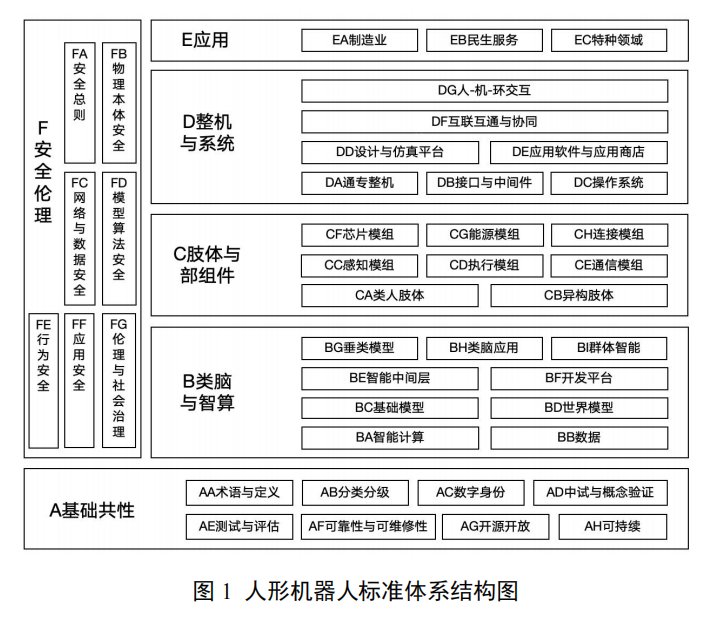
(2) Standard system framework for humanoid robots
The standard system framework for humanoid robots includes six parts: A basic commonality, B-class brain and intelligence, C body and body components, D complete machine and system, E application, and F safety ethics, as shown in Figure 2.
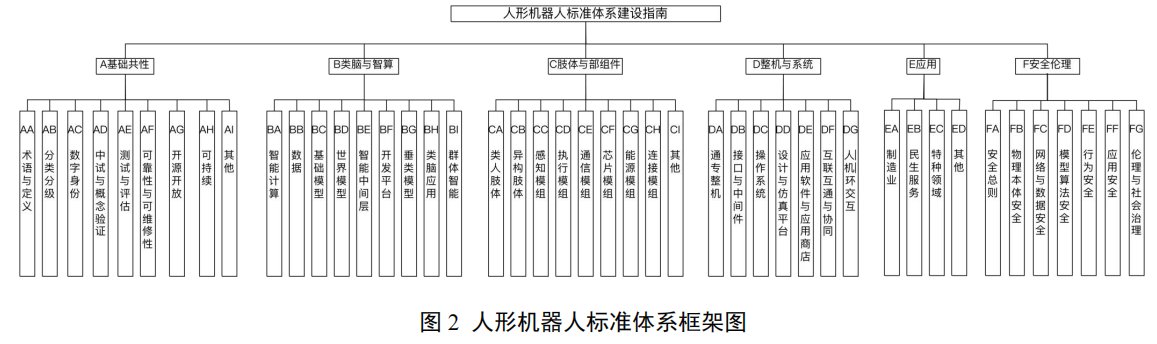
IV. Construction content
(1) Basic common standards
It mainly regulates humanoid robot technology and the foundation of the industry, including AA terms and definitions, AB classification, AC digital identity, AD pilot testing and concept verification, AE testing and evaluation, AF reliability and maintainability, AG open source, AH sustainability, and AI.
AA terms and definition standards
It regulates basic general terms, core concepts, technical elements and application scenarios in the field of humanoid robots, covering standard definitions, categories of core terms related to humanoid robots, comparison of Chinese and English, explanation of terms, and typical application examples.
AB Classification Grading Criteria
Standardize the humanoid robot capability classification method system, covering topics such as physical form classification, degree of intelligence classification, software and hardware platform classification, and application task complexity of humanoid robots.
AC digital identity standards
Standardize the unique logo definition, coding rules, and recognition mechanism for humanoid robots, covering the components, hierarchical structure, analysis methods of coding, and application specifications throughout the product life cycle.
AD pilot testing and proof of concept standards
Standardize engineering verification platforms, processes, and evaluation systems for humanoid robots in the process of transferring from technology research and development prototypes to industrial-scale production, covering infrastructure, functional implementation, process safety, quality traceability, and achievement transformation evaluation for pilot testing.
AE testing and evaluation standards
Standardize evaluation benchmarks and test methods for humanoid robots, covering basic performance tests, advanced intelligence evaluations, environmental construction specifications, collaborative evaluation models, and performance index accounting formulas for humanoid robots.
AF reliability and maintainability standards
Standardize the ability of humanoid robots to complete specified functions under specified conditions and within a specified time, as well as the ability to restore specified functions after failure, covering reliability index systems, life evaluation methods, safety failure mechanisms, modular maintenance design, and condition monitoring and early warning.
AG open source open standards
Standardize the construction of software and hardware open source ecosystems, open interface protocols, and data sharing mechanisms in the field of humanoid robots, covering open hardware descriptions, community governance logic, data sharing agreements, and compatibility certification systems.
AH sustainability standards
Standardize the green, low-carbon and resource recycling requirements for humanoid robots throughout the life cycle from design, production, operation to decommissioning, covering energy consumption limit indicators, carbon emission accounting models, resource recycling rates, and waste disposal processes.
Other AI standards
Standardize other basic common standards, such as those added in technological development that cannot be classified in the existing basic common standard system, covering new cross-cutting common technologies, forward-looking research, and pioneering fields.
(2) Brain-like and intelligent computing standards
The main specifications support autonomous perception, logical reasoning, decision execution, and group collaboration of humanoid robots, core modules for brain-like intelligence, data resources, model systems, and development applications, including nine parts: BA intelligent calculation, BB data, BC basic model, BD world model, BE intelligent middle layer, BF development platform, BG vertical model, BH brain application, and BI group intelligence.
BA intelligent computing standards
Standardize the core concepts, technical systems and application scenarios of software ecosystems such as chip training, reasoning and deployment in the field of brain-like and intelligent computing, covering definitions of embodied intelligent computing terms, specifications for operators and communication interfaces, model deployment and operation environments, and typical application examples.
BB data standards
Standardize the full life cycle technical requirements of humanoid robot data collection, labeling, storage, management, sharing, quality assessment, safety compliance, etc., to ensure the consistency and standardization of large models of humanoid robots in training, simulation and actual deployment.
BC Foundation Model Standards
Standardize the general basic model system for humanoid robots, covering large language models, multi-modal large models, vision-language-action models, etc. for humanoid robot perception, decision-making, execution, and memory enhancement.
BD World Model Standard
Standardize the technical framework and core capabilities of humanoid robots for realistic world models, covering understanding of real physical environments, scene simulation, state prediction, and dynamic generation capabilities.
BE smart middle layer standard
Standardize the middle layer system construction of humanoid robot intelligent systems, link models and application ecology, and provide support for the formulation of other standards.
BF development platform standards
Standardize the architecture design, core functional modules, integrated development environment, and software/hardware collaboration capabilities of humanoid robot intelligent system development platforms.
BG vertical model standard
Standardize the construction of a special model system for the field of humanoid robots, and open up collaboration between models and robot hardware and scene applications, covering topics such as vertical model architectures, multi-modal interaction, intelligent computing requirements, and scene adaptation.
BH brain application standards
Standardize the construction of a scene-oriented application system for brain-like intelligence, connect the brain-like system with the terminal scene ecology, and provide support for the engineering implementation of brain-like systems.
BI Group Intelligence Standard
Standardize collaborative sensing, cross-machine communication protocols, task allocation, dynamic networking, and distributed decision-making mechanisms between multi-robot robots, covering multi-agent collaboration, cloud-side collaborative architectures, and group intelligence protocols.
(3) Limb and limb component standards
The main specifications are physical modules, key components, and essential driving software and hardware that mimic a humanoid robot and support its various functions, including CA human body, CB heterogeneous limb, CC sensing module, CD execution module, CE communication module, CF chip module, CG energy module, CH connection module, and CI nine other parts.
CA physical standards for humans
The technical requirements for human-like limbs that simulate human bones and joints are specified, covering design requirements, performance index requirements, safety requirements, reliability requirements, electromagnetic compatibility requirements, quality control requirements, and maintainability requirements for human-like limbs.
CB isomorphic body standard
The specification defines the technical requirements for some imitation humanoid heteromorphic bodies used to expand the application scenarios and capabilities of humanoid robots, covering design requirements, performance index requirements, safety requirements, reliability requirements, electromagnetic compatibility requirements, quality control requirements, and maintainability requirements for heteromorphic bodies.
CC Perception Module Standard
Technical requirements for standardized acquisition and preprocessing systems for humanoid robots to obtain internal and external environmental information cover sensor integration, sensing accuracy, anti-interference, reliability, and test methods for various sensing modules (vision, force, touch, acoustics, smell, body state).
CD implementation module standards
The technical requirements for standardized humanoid robots to transform control instructions into actual mechanical motion and motion output cover output power, mechanical efficiency, software and hardware integration, operation accuracy, and test methods for various execution modules (rotation, linear, dexterous hands, etc.).
CE communication module standard
The technical requirements for intelligent processing units responsible for data analysis, instruction reconstruction and protocol processing for standardized humanoid robots cover communication bandwidth, upstream and downstream data, communication protocols, and test methods for wired and wireless products such as radio transmission equipment and their key components.
CF chip module standard
An integrated circuit unit that regulates the computing power and control of humanoid robots, covering chip module interface protocols, data formats, computing power indicators, energy consumption indicators, integration requirements, and test methods.
CG energy module standard
The energy subsystem that regulates power support for humanoid robots covers the power density, conversion efficiency, thermal management performance, reliability and safety, and test methods of energy modules.
CH connection module standard
Standard humanoid robots are mechatronic components that interconnect energy and signals through connectors, cables, printed circuit boards, etc., covering the scope of application, interface protocols, service life, and test methods of various connection modules such as interfaces and cables.
Other CI standards
Technical requirements such as basic technology, key structural parts, and functional materials commonly used in humanoid robot limbs and parts, as well as other technical requirements added in development that cannot be classified as existing systems.
(4) Machine and system standards
It mainly regulates the complete humanoid robot and support system, including seven parts: DA communication machine, DB interface and middleware, DC operating system, DD design and simulation platform, DE application software and application store, DF interconnection and collaboration, and DG human-machine-ring interaction.
DA-Connect dedicated machine standards
Technical requirements for general and special mechanical structure, drive control and performance of humanoid robots are standardized, covering movement ability, operating ability, reliability and environmental adaptability.
DB interface and middleware standards
The interface classification, communication protocol, and middleware framework for standardized humanoid robots covers technical requirements for functional interfaces such as control interfaces, feedback interfaces, management interfaces, and application development interfaces, as well as core middleware elements such as inter-module communication mechanisms, data exchange formats, message structures, and semantic specifications.
DC operating system standards
Standardize the architecture design and functional configuration requirements of general and specialized operating systems for humanoid robots, covering system architecture, resource management, device driving, interface calls, etc.
DD design and simulation platform standards
Standardize simulation platform technology in the field of humanoid robots, covering environment construction, physical engine interfaces, model import and export specifications, data recording and playback formats, and performance evaluation indicators.
DE Application Software and App Store Standards
Technical requirements for standardized application software and management rules for software application stores cover software architecture requirements, API design guidelines, call interface specifications, security and privacy protection requirements, application distribution formats, app store review mechanisms, and cross-platform compatibility guidelines.
DF Interoperability and Collaboration Standards
Standardize software and hardware technical requirements and evaluation methods such as stand-alone internal interconnection, device networking, data interaction, task collaboration, and multi-component security authentication mechanisms.
DG Human-Machine-Loop Interaction Standard
Standardize the interaction interface, interaction protocol, and interaction performance requirements of humanoid robots in the ternary space of man, machine, and environment, covering technical requirements and evaluation methods for natural human-robot interaction (multi-modal interaction such as voice, gestures, facial expressions, etc.), human-robot collaboration safety, adaptive environmental interaction, and group collaborative interaction.
(5) Application standards
It mainly regulates the promotion and application requirements of humanoid robots in key industries and typical scenarios such as pension, transportation, cultural tourism, health care, emergency, etc., and stipulates technical requirements, performance indicators, test methods and evaluation rules for typical tasks, operating procedures, functional modules and system capabilities in various application fields, including EA manufacturing, EB livelihood services, EC special fields, and ED.
EA Manufacturing Standards
Facing the operation requirements of humanoid robots in structured and semi-structured industrial environments, specification requirements are put forward on operation capability, environmental adaptability, safety protection, system reliability, operation quality and collaborative efficiency in the manufacturing process, covering the definition, technical requirements, performance indicators, test methods and application evaluation of typical tasks such as handling and sorting, loading and unloading, assembly operations, inspection and maintenance, inspection and quality control, and hazardous environment replacement operations.
EB People's Livelihood Service Standards
The application environment for high-frequency contact, continuous interaction, and collaborative services between humans and robots puts forward standardized requirements for service functions, interactive experience, safety and reliability, privacy protection, operation and maintenance management, and service quality evaluation, covering service processes, interaction methods, system response, safety requirements, quality evaluation, and user experience evaluation for typical application requirements such as consulting and guidance, health assistance, teaching and training, commercial reception and public security.
EC Special Field Standards
Facing task execution requirements in complex hazardous environments, specification requirements are put forward on functional performance, environmental adaptation, safety protection, remote control, collaborative operation, emergency response and mission reliability, covering definitions, technical requirements, test methods and application evaluation of typical tasks such as hazardous environment detection, emergency reconnaissance, rescue, limited space operations, high-risk inspection, complex environmental operation, and extreme environmental protection.
Other ED application standards
It targets uncovered emerging cross-border and niche customized humanoid robot application scenarios, covering the definition, technical requirements, performance indicators, test methods and application evaluation of non-standard tasks, filling gaps in segmented scenario standards, and improving the closed loop of the standard system for all scenarios.
(6) Safety ethics standards
It mainly regulates the safety and ethical standardization of the entire life cycle of humanoid robots, including seven parts: FA safety general principles, FB physical ontology security, FC network and data security, FD model algorithm security, FE behavioral safety, FF application safety, and FG ethics and social governance.
FA General Rules
Standardize the top-level design principles, overall management framework and full-process control requirements for humanoid robot safety systems, covering basic safety framework principles, risk classification methods, management mechanisms, and general safety requirements for different application scenarios.
FB Physical Ontology Safety Standard
Standardize the physical safety of humanoid robot hardware entities and core components, covering topics such as structural reliability, electrical system safety requirements, and supply chain safety and controllability.
FC network and data security standards
Standardize cybersecurity and data lifecycle protection mechanisms for humanoid robots, covering radio security, network connections, communication protocols, cloud service platforms, etc., as well as security protection requirements and support capacity building requirements for all aspects of data collection, processing, storage and circulation.
FD model algorithm security standards
Standardize the security requirements for the entire process of design, development, training optimization, deployment and operation, and iterative upgrade of humanoid robot model algorithms, covering topics such as compliance with algorithm logic, controllable autonomous decision-making, defense against attacks, identification of abnormal behavior, and iterative algorithm auditing.
FE behavioral safety standards
Standardize the behavioral safety requirements of humanoid robots during interaction and operation, and ensure that robot behavior is predictable, controllable, and intervenable, covering topics such as perception planning safety, motion control safety, operation safety, human-computer interaction safety, inspection and diagnosis mechanisms, emergency response mechanisms, and behavioral safety verification methods.
FF application safety standards
Standardize safety requirements, entry conditions and operation control mechanisms for humanoid robots in different application scenarios, covering risk identification, task boundary setting, personnel and environmental protection, deployment acceptance, operation monitoring, accident handling, and scene adaptability safety evaluation in typical application environments such as service scenarios, industrial scenarios, and special scenarios.
FG Standards of Ethics and Social Governance
Ethical and moral restrictions and social impact assessments that regulate the development and application of humanoid robot technology, covering technical ethical frameworks, applied ethical guidelines, social governance mechanisms, and compliance requirements with relevant laws and regulations.
5. Safeguard measures
The first is to give full play to the joint effectiveness of relevant humanoid robot standardization technology organizations to form a collaborative mechanism for standard development and industrial promotion. The second is to coordinate the strengths of all parties in industry, education, research, and the industrial chain to strengthen the link between humanoid robot standards and policies, scientific research, testing, and transformation of results. The third is to carry out promotion and training on humanoid robot standard systems and key standards to guide enterprises to meet standards in R&D, design, production, management, and testing. The fourth is to guide standardization research institutes to introduce and cultivate high-end standardized talents and build a standardized talent echelon. Fifth, establish a tracking and research mechanism for key international standards, encourage and guide domestic enterprises and institutions to actively participate in international standardization exchanges and cooperation, and promote mutual recognition and interface between Chinese and foreign standards.
This article was selected from the “Ministry of Industry and Information Technology” official website; Zhitong Finance Editor: Chen Siyu.