
Natural Gas Futures Consolidate Near Range Lows as Supply Glut Meets Geopolitical Risk
A Market Caught Between Ample Supply and Global Supply Shocks
The market remains caught between a well-supplied domestic backdrop and a tightening global picture. US dry gas production climbed to an average of 111.5 billion cubic feet per day so far in August, up from a monthly record of 110.7 bcfd in July, according to LSEG data. At the same time, weekly storage injections have been running below normal, with the most recent EIA report showing an addition of just 16 billion cubic feet, compared with 19 bcf a year earlier and a five year average closer to 29 bcf, as a persistent heat dome across the South slows the pace of builds without sparking a decisive price breakout. The Electric Reliability Council of Texas has forecast that peak power demand from August 21 through 25 will exceed the all-time record set in July, keeping gas fired generation demand elevated.
Internationally, the picture is far more supportive. LNG vessel traffic through the Strait of Hormuz has collapsed by roughly 95% since US and Israeli military operations against Iran resumed in late February 2026, removing close to one fifth of global LNG supply and intensifying competition for US cargoes among European and Asian buyers. European gas prices have climbed above 65 euros per MWh, their highest level since January 2023, while the region's storage sits at just 62%, the lowest seasonal level in records dating back to 2009. Despite that global tightness, the EIA's August Short Term Energy Outlook lowered its 2026 Henry Hub price forecast to $3.44 per MMBtu, down from $3.67 in July and more than 20% below the February 2026 estimate of $4.31, citing looser domestic fundamentals. Adding to the bearish undertone, forecaster Vaisala Xweather projects the 2026 to 2027 winter could rank as the sixth hottest on record in the Lower 48 as a strengthening El Nino pattern develops.
What the Market Has Done
- Last August, the market rallied hard from the 2.83 area (in the vicinity of Daily Level 3) up to the 5.5 area, where it capitulated. The advance was underpinned by an early and colder than normal start to the heating season, with prompt month futures topping out near $5.49 in early December 2025 on frigid weather, near record LNG feedgas demand, and an EIA revision that had raised its winter price outlook to $4.30.
- That capitulation triggered a sharp subsequent selloff and a large gap down from December 2025 into the start of January 2026, driving the price back to the 2.6 area (Daily Level 3). The reversal was fundamentally driven by weather models flipping milder within days of the December peak, which deflated the cold driven premium, prompted a rapid unwind of speculative long positioning, and left the market pricing in a comfortably supplied winter.
- Buyers responded quickly, bidding prices back up to the 4.5 area (Daily Level 1) and filling the gap that had formed during the decline. That rebound coincided with a brutal cold snap and Winter Storm Fern in late January 2026, which drove a sharp round of storage withdrawals and briefly renewed heating demand before record production growth reasserted itself and capped the advance.
- Since then, the market has rotated back down toward the 2.6 area and settled into a narrow sideways range between 3.33 (Daily Level 2) and the 2.6 area.
- This range bound behavior has developed during the transition between the summer injection season and the approach of the withdrawal season, a period in which the market often pauses to digest the storage trajectory before committing to a firm directional bias ahead of winter.
- The yearly VWAP is currently flat as the market chops through it, which further illustrates a balanced market with no clear directional conviction from either buyers or sellers.
- More recently, over the past two weeks, the market has been compressing into an increasingly tight range near the bottom of the current consolidation.
What to Expect in the Coming Weeks
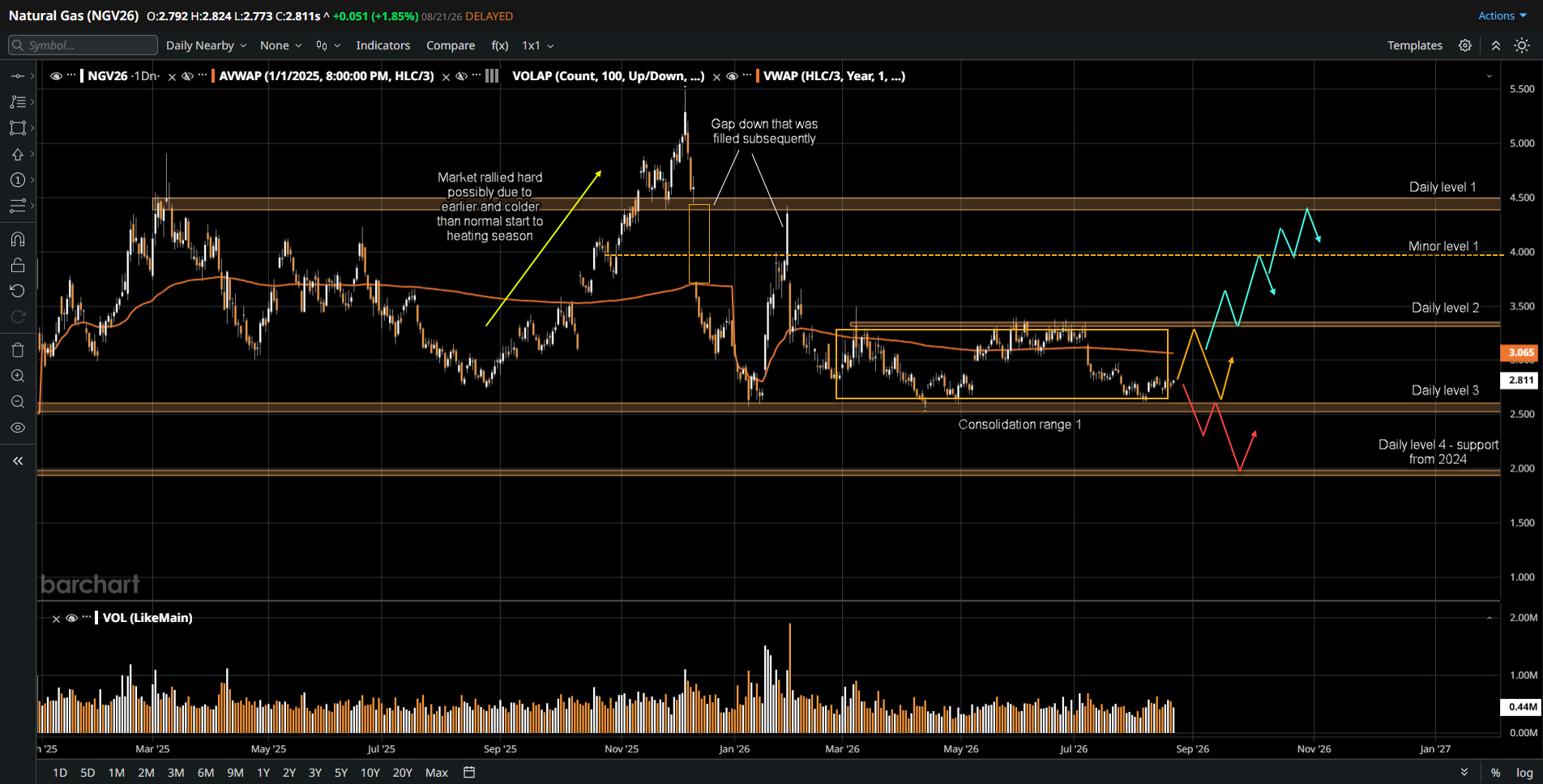
The key levels to watch remain 2.6 (Daily Level 3) and 3.33 (Daily Level 2), as the boundaries of the current consolidation.
Neutral Scenario
- Expect buyers and sellers to continue responding at the edges of the current consolidation range between 2.6 and 3.33, given that the market remains in balance.
- A possible supporting condition for this scenario is a continuation of the present pattern, where periods of hotter than expected weather offset record production levels just enough to prevent a decisive breakout in either direction.
Bullish Scenario
- The first clue for this scenario would be buyers stepping up bids and compressing price against the 3.33 level.
- If the market is able to break and gain acceptance above 3.33, expect a move up toward 4.0 (Minor Level 1), where some responsive selling could emerge.
- If sellers do not respond at 4.0, expect a further move up toward the 4.5 area (Daily Level 1).
- A possible trigger for this scenario is a further escalation of the Strait of Hormuz conflict that disrupts additional LNG vessel traffic, or a shift in weather models toward a more extreme and prolonged late summer heat wave that accelerates power burn and slows storage injections even further.
Bearish Scenario
- The first clue that this scenario might be playing out is if sellers step down offers and begin capping rotations at the yearly VWAP.
- If buyers subsequently fail to defend the 2.6 area, expect the market to break down and move toward 2.0 (Daily Level 4), which represents support carried over from 2024.
- A possible trigger for this scenario is a de-escalation or resolution of the Iran conflict that restores LNG flows through the Strait of Hormuz, combined with continued record domestic production and a mild start to the withdrawal season that keeps storage comfortably above the five-year average.
Conclusion
Technically, natural gas remains pinned within a well-defined range between the 2.6 and 3.33 levels, with price chopping through a flat yearly VWAP in a clear sign that neither buyers nor sellers currently hold the upper hand. A decisive close and acceptance beyond either boundary appears necessary to unlock the next directional leg, whether that is a move toward the 4.0 to 4.5 area on the upside or a retest of the 2.0 area on the downside. Fundamentally, the market remains split between a comfortably supplied domestic backdrop, with production near record highs and storage still tracking below normal but supply still ample, and a tightening global backdrop driven by the Strait of Hormuz disruptions that have pushed European benchmarks to their highest levels since January 2023. How these competing domestic and geopolitical forces resolve over the coming weeks, alongside the pace of storage injections heading into the withdrawal season, will likely determine which side of the range eventually gives way. Which side of this range do you think breaks first, and what would it take to convince you?
We provide the infrastructure you need to quantify your discipline and ensure every decision is backed by the confidence of seeing exactly what drives your performance. Start trading with the clarity you deserve. Open an Account today.
Disclaimer:
This article is provided for informational and educational purposes only and does not constitute financial, investment, or trading advice. The analysis presented reflects the author’s market observations and opinions at the time of writing and is not a recommendation to buy or sell any futures contract, security, or financial instrument. Futures trading involves significant risk and is not suitable for all market participants. Losses may exceed initial margin deposits, and market conditions can change rapidly.
Any scenarios, levels, or market expectations discussed are hypothetical in nature and are intended solely to illustrate potential market behavior. They do not represent actual trading results and should not be interpreted as guarantees of future performance. Past performance, market behavior, or historical price action are not indicative of future outcomes.
Readers are solely responsible for their own trading decisions and risk management. Always conduct independent research, consider your financial situation and risk tolerance, and consult with a qualified financial professional, if necessary, before engaging in futures or derivatives trading.