
Singapore Consumer Stocks Worth Watching As Inflation Cools
Singapore inflation is cooling in the headlines yet still uncomfortably warm in everyday bills, and that mix is putting a fresh spotlight on domestic consumer and services stocks exposed to this news. Lower than expected July inflation eases policy worries, while rising power and food costs keep pressure on margins. This article highlights three Singapore listed stocks from the screener that could be positioned to benefit if this balance holds.
The three stocks below are just a sample from this theme. The full screen surfaced 8 more Singapore listed consumer and services companies with equally compelling narratives that are not covered here. To identify your own highest conviction ideas, head straight into the Singapore Domestic-Oriented Consumer and Services Stocks screener.
ValueMax Group (SGX:T6I)
Overview: ValueMax Group is a Singapore based pawnbroking, moneylending, and jewellery retail company that serves everyday consumers and small businesses, which closely ties its fortunes to domestic spending and financing needs. It runs pawn and retail outlets, sells new and pre owned jewellery and watches, and trades gold and other precious metals.
Operations: ValueMax Group generates most of its revenue from retail and trading of jewellery and gold at about S$510 million, with pawnbroking contributing around S$112 million and moneylending about S$73 million.
Market Cap: S$928 million
ValueMax Group provides direct exposure to Singapore’s consumer finance and jewellery spending in an environment where inflation expectations appear more predictable and policy signals are steady. The company reports higher H1 2026 revenue of S$370.73 million and net income of S$62.62 million, supported by domestic pawnbroking, moneylending and jewellery retail activity. A roughly 4% dividend yield and an 18.2% ROE add income and profitability appeal, although the dividend is not well covered by free cash flow and profit margins have come under some pressure. In addition, all liabilities are funded by external borrowing, which raises funding risk. For investors assessing how that trade off could affect the business, the detailed risk and cash flow analysis may be useful.
ValueMax Group’s 18.2% ROE and roughly 4% yield can look appealing, yet heavy reliance on external borrowing and thinner margins leave questions. Get the full risk and dividend story in the 3 warning signs (2 are major!)

Far East Hospitality Trust (SGX:Q5T)
Overview: Far East Hospitality Trust is a Singapore focused hotel and serviced residence trust with 13 properties and over 3,300 rooms and units that are closely linked to local tourism, staycations and services spending in a relatively stable inflation and interest rate setting. Through its stapled REIT and business trust structure, plus a stake in three Sentosa hotels, Far East Hospitality Trust aims to provide investors with regular distributions backed by income from a S$2.56 billion portfolio of hospitality and mixed use assets.
Operations: Far East Hospitality Trust generates most of its revenue from hotels and serviced residences at about S$92 million, with around S$18 million from retail units, offices and other spaces and a small segment adjustment.
Market Cap: S$1.1 billion
Far East Hospitality Trust gives you direct exposure to Singapore’s hospitality cycle at a time when inflation readings are easing policy concerns, and services spending and domestic travel remain important drivers. Recent H1 2026 results show higher sales of S$53.79 million and net income of S$30.98 million. The appeal is tempered by an unstable dividend history and debt that is not well covered by operating cash flow, which makes interest costs and occupancy trends important to watch. If you are looking for a domestically focused income play with growth potential but meaningful balance sheet and payout risks, Far East Hospitality Trust may warrant closer consideration.
Far East Hospitality Trust’s income story is tied to Singapore’s hotel cycle, yet its debt coverage and unstable payouts leave plenty of questions. Cut through the noise with the 4 key rewards and 3 important warning signs (1 is major!)

SIA Engineering (SGX:S59)
Overview: SIA Engineering provides maintenance, repair and overhaul services for airlines, with a focus on airframe and line maintenance, engine and component work, and technical ground handling, anchored in Singapore but serving carriers across Asia, Europe and the Americas. Its business is closely linked to regional aviation activity and a largely local cost base, which fits the screener’s focus on Singapore oriented services companies that may benefit if inflation and financing conditions stay relatively stable.
Operations: SIA Engineering generates most of its revenue from Airframe and Line Maintenance at about S$1.0b, with around S$454 million from Engine and Component services and a S$33 million eliminations and adjustments item. Singapore accounts for roughly S$812 million of revenue and France about S$253 million.
Market Cap: S$3.5b
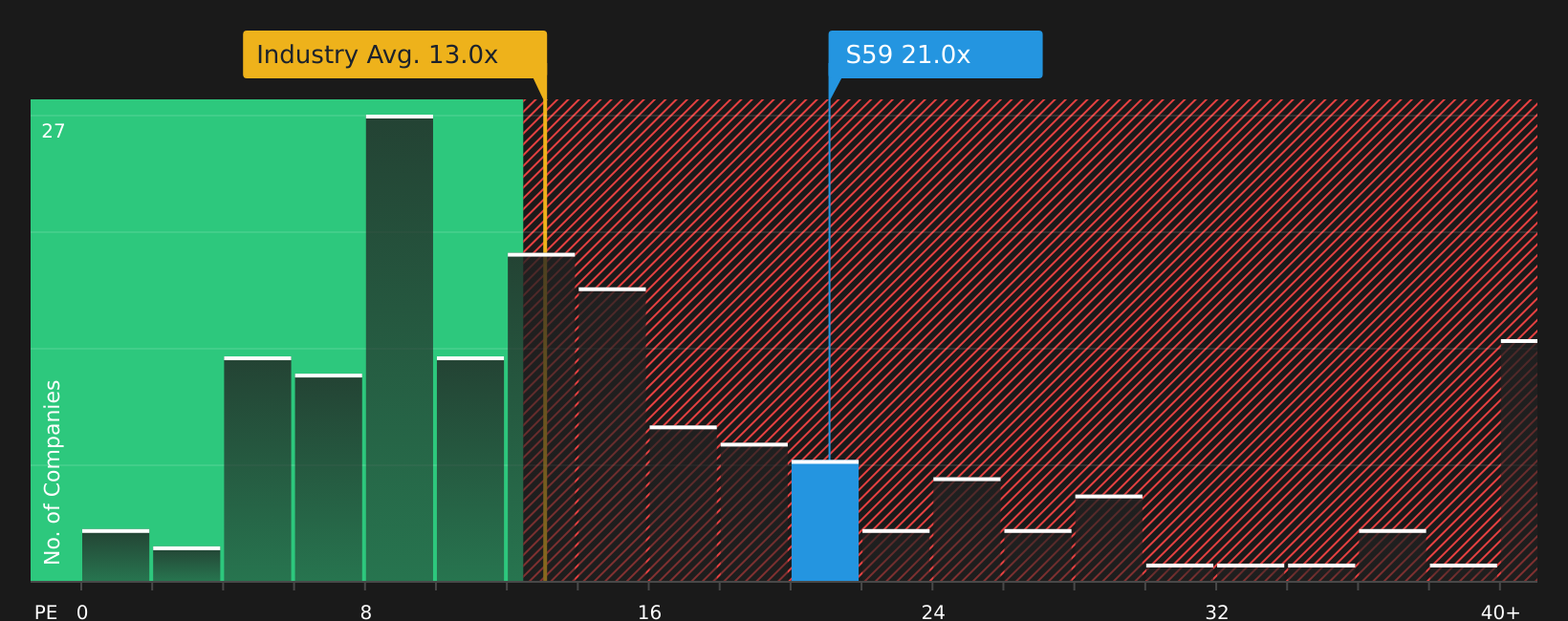
SIA Engineering provides exposure to Singapore’s aviation services ecosystem through an MRO business with strong local roots, mid teens net margins and a roughly 3.5% dividend yield. Recent earnings growth around 21% and a forecast earnings growth rate near 9% per year may appeal to investors who prefer steadier progress over rapid swings, and recent deals with Air India and Safran add potential future workload. The trade off is a relatively rich P/E near 20.7x and dividends that are not well covered by free cash flow, which raises questions about payout resilience if cash generation softens or costs rise. For investors weighing that balance, the current setup presents both income and growth angles to consider.
SIA Engineering’s earnings story and mid teens margins are one side of the picture. The less discussed piece is how that P/E near 20.7x lines up with its growth profile in the analyst forecasts for SIA Engineering
Seeking Alternatives Before The Crowd
Fresh ideas can move fast. Some stocks build quiet momentum, others approach breakout levels while still under the radar for now. Act based on your own research and timing.
- Look for resilient income opportunities before yields change by using the curated 424 dividend fortresses that focuses on consistency and financial strength.
- Track where AI-related profits are currently reported by using the hand picked 76 profitable AI stocks that aren't just burning cash to focus on businesses with established earnings instead of only narratives.
- Research potential infrastructure-related opportunities by scanning the curated 39 power grid technology and infrastructure stocks that highlights companies associated with grid upgrades and reliability projects.
This article by Simply Wall St is general in nature. We provide commentary based on historical data and analyst forecasts only using an unbiased methodology and our articles are not intended to be financial advice. It does not constitute a recommendation to buy or sell any stock, and does not take account of your objectives, or your financial situation. We aim to bring you long-term focused analysis driven by fundamental data. Note that our analysis may not factor in the latest price-sensitive company announcements or qualitative material. Simply Wall St has no position in any stocks mentioned.
Have feedback on this article? Concerned about the content? Get in touch with us directly. Alternatively, email editorial-team@simplywallst.com