
Higher US debt kicks off a critical week: the market keeps an eye on Beisent's “fiscal initiatives” and Walsh Jackson Hole's debut
The Zhitong Finance App learned that at the beginning of this week, the US Treasury bond market rose slightly, and the market's eyes are on US Treasury Secretary Scott Bessent and Federal Reserve Chairman Kevin Walsh, who are about to deliver speeches. Their remarks may be a key weather vane that will determine the next direction of bond yields.
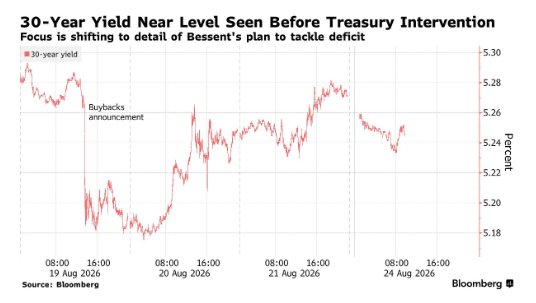
On Monday, yields on US bonds of all maturities generally declined. The market fluctuated sharply in the previous week. At one point, the cost of borrowing US 30-year treasury bonds was close to a 20-year high. Afterwards, the US Treasury stepped up repurchase efforts, and market sentiment eased somewhat. As of press release, the 10-year treasury yield declined by 3 basis points to 4.71%; the 30-year yield also fell by a similar margin, to 5.24%.
What investors are most concerned about right now is US Treasury Secretary Bezent's next move. Last week, he unexpectedly announced that he would expand the scale of repurchases of long-term treasury bonds, which caught the market by surprise. Today, bondholders are eagerly awaiting specific details of the “fiscal move” he previously mentioned — a plan that Bezent sees as one of the key tools to deal with America's huge fiscal deficit.
At the same time, Walsh also became the focus of market attention. He will deliver the keynote address at the Jackson Hole Annual Symposium hosted by the Kansas City Federal Reserve on Friday. Outsiders generally expect that he will have to confront a difficult question: how will the Federal Reserve coordinate its own policies with Bezent's intervention to reduce long-term borrowing costs as inflation continues to far exceed target levels.
“This week the market will revolve around Kevin Walsh's first speech as Chairman of the Federal Reserve in Jackson Hall,” said Geoff Yu, senior market strategist at Bank of New York Mellon. “At a time when long-term treasury bonds are still highly sensitive, investors urgently need to clarify how the Federal Reserve will respond to the Treasury's policy actions.”
Yu also pointed out that the July personal consumption expenditure (PCE) data released on Wednesday is expected to “further exacerbate this week's tense atmosphere.” According to estimates by economists surveyed, the year-on-year PCE growth rate in July will slow slightly to 3.6%, down from 3.7% the previous month; core PCE is expected to remain unchanged at 3.3%.
Since taking office in May, Walsh hasn't given much forward-looking guidance. However, his public appearance after the last policy meeting triggered a sharp sell-off in the market, which shows that the market is highly sensitive to this Friday speech.
Despite a slight decline in yields on Monday, the current level is still close to the point where the Treasury intervened last week — this is interpreted by the market as the US Treasury is already uneasy about the current level of borrowing costs. One of Bessent's core tasks during Trump's appointment was to try to keep yields down as much as possible in a context where America's annual interest expenses have far exceeded 1 trillion US dollars.
However, according to reports released by Marc Seidner, Chief Investment Officer of Unconventional Strategies at Pacific Investment Management Company (PIMCO), and Pramol Dhawan, Head of Emerging Markets Investment, the company is considering increasing its bond holdings when yields rise further.
“From our perspective, the current yield level is becoming more and more attractive by historical standards, providing a valuable opportunity for long-term investors to enter the market,” they said in the report. “We are still optimistic about the allocation value of the bond market.”