
Wall Street investment trends have changed abruptly! As long-term bond yields surged, technology bulls “retreated”, and banks competed with gold and copper mines for the main line
The Zhitong Finance App learned that under the combined influence of the surge in the scale of AI-related technology companies' debt issuance, the “bursting of the AI credit bubble” debate, and the rise in yield on US bonds with a 10-year term or more, global technology stocks surrounding the theme of AI computing power trading are experiencing a typical round of “upward discount rate shock+contraction in financial market risk appetite.”
According to statistics from Wall Street financial giant Goldman Sachs, the IT sector (that is, the IT sector where most technology stocks are located) became the industry with the largest net sales of US stocks last week, and experienced the biggest reduction in total exposure in more than two years; more importantly, the sell-off came almost entirely from the rapid reduction in institutional positions, rather than the accelerated expansion of short positions, indicating that Wall Street institutions are actively cashing out profits, reducing the AI concentration of their holdings and shifting to the classic safe-haven sector to avoid the risk of surging returns.
This position change is closer to the phased deleveraging and clearing of crowded positions in AI trading, rather than a complete denial of the logic of AI computing power and long-term demand for AI application software. However, if long-term US bond yields and credit spreads on technology companies continue to accelerate upward, AI-related concept stocks that rely on external financing, rely on huge forward cash flow, have a long return period, and are highly sensitive to changes in risk-free return on the denominator side will still be under pressure; however, AI computing power industry chain leaders and key cloud AI inference computing power suppliers with strong free cash flow, clear visibility of computing power orders, and difficult to replace technical barriers may also be the first to obtain capital reallocation after institutions are cleared of congested positions and leverage. The increase further shifted to fundamental screening.
It wasn't a bear attack but the bulls withdrew! AI beliefs were tortured by bond market yields, and technology stocks became the biggest net sales sector
Goldman Sachs statistics show that the IT sector was an investment theme far ahead of other segments in terms of net sales in the US stock market last week, and this large-scale sell-off was almost entirely driven by bullish selling forces.
Robbie Stancard, a senior analyst at Goldman Sachs, said that the sector's total allocation exposure also recorded the biggest percentage decline in more than two years, highlighting that investors have drastically reduced their risk allocation exposure to this sector.
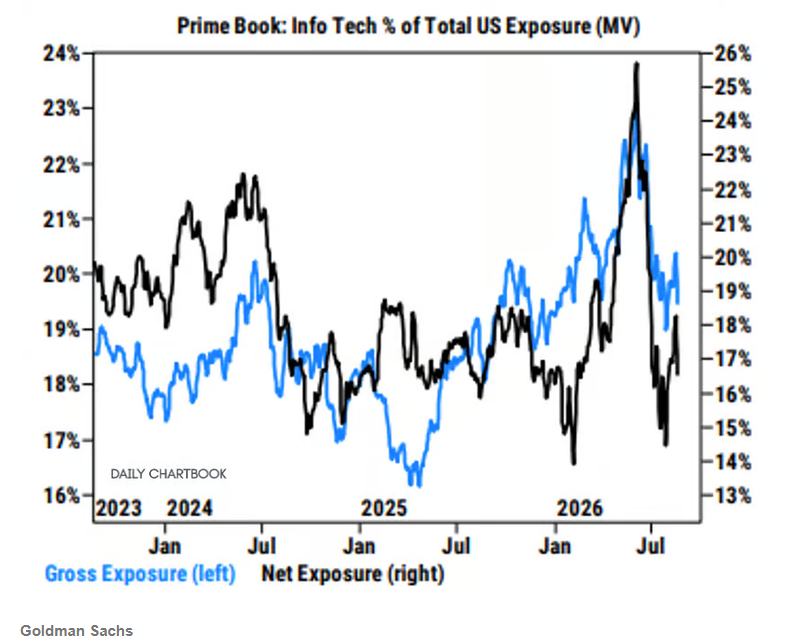
The chart compiled by the agency shows that total exposure to the IT sector accounts for about 20% of total exposure to the US market, which is significantly lower than the peak of nearly 24% earlier this year. The net exposure statistic is around 19%; during the recent sell-off period, the indicator dropped from a peak of around 26% in 2026 to around 16%.
Previously, both indicators continued to rise sharply in the first half of this year. Total exposure rose from about 18% in early 2026 to close to 24%, while net exposure surged from about 17% to 26%. This was followed by a major reversal after the Korean stock market pullback in June and a major sell-off in global semiconductors in July.
A team of analysts led by Goldman Sachs's Stancard said that the latest round of sell-offs was almost entirely driven by long sales rather than an increase in short positions, which indicates that investors are reducing their current bullish allocation exposure to popular technology sectors related to AI computing power topics.
The Goldman Sachs analyst team said in the research report that the market investment trend has changed, but to be more accurate, it is not a “complete abandonment of the AI computing power theme”, but rather a shift from “a single high-beta transaction for AI computing power hardware” to “deleveraging/de-congested positions+positions to high cash flow and long-term low centralized stock balance+spread across assets.”
According to data compiled by Goldman Sachs, global hedge funds suddenly backhanded net sales of US stocks after falling back and forth in late July, and the net leverage ratio (Net Leverage) index fell to a one-year low of 48.3%; in addition, information technology became the sector with the largest net sales volume, and almost all of the sell-offs came from the reduction of positions by long positions. Total exposure to the technology sector has declined from a peak of close to 24% during the year to about 20%, and net exposure fell from about 26% to 16%. This means that institutions are compressing crowded positions and portfolio volatility rather than betting on the collapse of AI fundamentals through large-scale addition of bears.
The surge in yield on long-term bonds of 10 years or more and the pressure to issue bonds are rewriting Wall Street strategies and investment trends
The Goldman Sachs analyst team said that the core of triggering the change in style is the double and continuous rise of the “long-term discount rate+AI financing cost”: the yield on 30-year US bonds once hit about 5.33%, and the 10-year term approach 4.7%, causing future cash flow discounts for technology stocks, data center project financing costs, and the alternative appeal of US bonds to stocks.
Since 2026, the amount of AI-related bonds issued has been about US$220 billion, far higher than the previous year's US$12.5 billion; the credit spread on technology bonds has risen to about 89 basis points, which is about 9 basis points less than overall investment-grade bonds, indicating that investors have begun to demand a higher “AI financing risk premium.” However, AI debt issuance is mainly an amplifier of the long-term term premium (Term Premium), and is not the sole cause of rising yields — the US fiscal deficit, inflationary resilience, and the Federal Reserve's credibility are still deeper driving forces.
The so-called “AI momentum decline” mentioned by Goldman Sachs in the research report mainly refers to a complete change in price momentum factors, and is not equivalent to AI orders, token demand, or computing power capital expenditure peaking: software has become the biggest weight for three-month momentum bulls, while the semiconductor and AI composite sector has slipped into the bear side, reflecting that the main investment line is shifting from “which AI industry chain participants can undertake the largest AI capital expenditure” to “who can continue to turn computing power and tokens into strong income, earnings per share (EPS), and free cash flow”. Goldman Sachs still anticipates that the deployment of enterprise AI computing power infrastructure resources is accelerating, and that the increasingly complex and huge reasoning process will continue to tighten the AI computing power constraints of cloud computing giants.
As a result, the AI computing power-themed deal is not completely over, but rather a farewell to indiscriminate valuation expansion: cash-rich platform-based cloud computing leaders, AI application software, and memory chip giants and data center infrastructure suppliers that clearly deviate from the EPS trajectory still have opportunities; new cloud vendors that are highly dependent on debt, project financing, and continuous refinancing face tougher balance sheet trials.
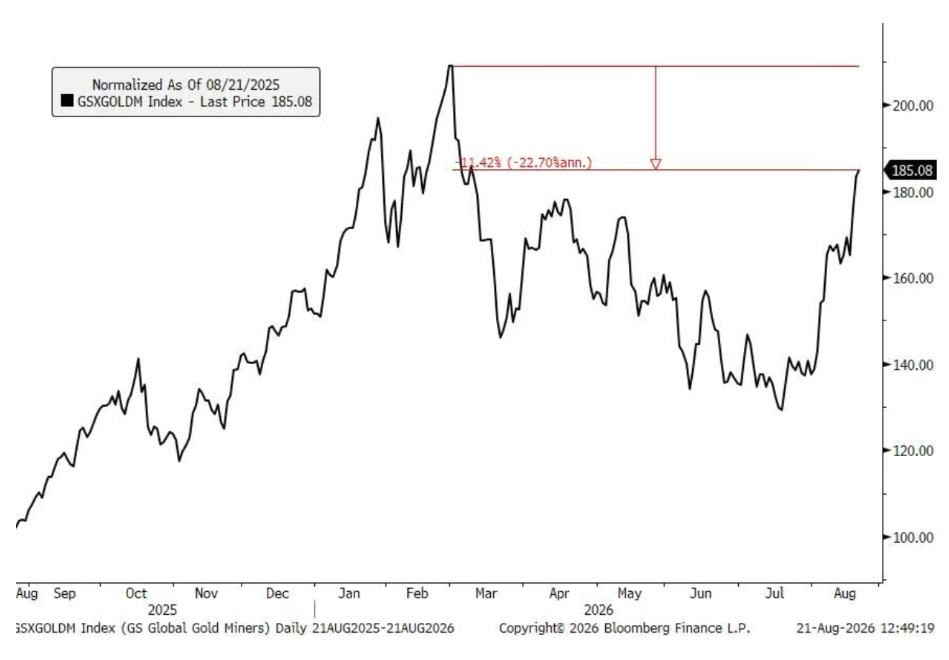
At the cross-asset level, the Goldman Sachs analyst team said that capital appears to accelerate the construction of a classic barbell portfolio of “high-quality AI cash flow+banks+hard assets” (that is, Barbell): European and Japanese banks benefit from rising yield curves and “higher and longer” interest rate expectations and net interest income (NII) improvements; gold spot commodities and gold-type mining companies undertake financial credit dilution and weakening dollar transactions; copper stocks benefit from power grids, data centers and geopolitics, and the actual supply of energy infrastructure at the core level in the context of the East-West superpower game Give restraints.
Goldman Sachs added, however, that investors cannot view all physical assets as winners — utilities and real estate are still being sold off due to the alternative nature of bonds. If long-term debt maturity premiums, credit spreads, and AI-related financing supply continue to rise sharply, European and Japanese bank stocks, gold, copper, and AI application platforms with current cash flow and stock stocks with high quality fundamentals and long-term low concentration of positions will be more likely to take over the market leadership.