
“Cruel Summer” predicts a sharp turn! Castle Securities overturns US bonds and bets on a decline in long-term yields
The Zhitong Finance App learned that just last month, it also warned US bond investors that they would usher in a “cruel summer” with Frank Flett, head of macroeconomic strategy at Citadel Securities (Citadel Securities), and now they believe that the risk balance has turned favorable to the rebound in US debt. He wrote in a report on Tuesday: “We now believe that the asymmetry of risk is biased towards a decline in long-term returns.”
Recently, US long-term treasury bonds have continued to be under pressure due to market concerns about inflation, fiscal deficits, and technology companies issuing large amounts of debt to finance AI infrastructure expenses. The 30-year US Treasury yield soared to the highest level in nearly 20 years last week, prompting US Treasury Secretary Bessent to announce plans to expand repurchases of treasury bonds maturing between 10 and 30 years to contain the sharp decline in the bond market.
Flite pointed out that the bond market is overcrowded with bearish positions, while inflation data is improving. He added that Castle Securities's simulation of trend tracking strategies such as CTA shows that compared with recent historical levels, the current bearish positions of these strategies are “quite extreme.” This means that if the price of US bonds falls further, it may only trigger a limited additional sell-off; and if the bond market continues to rebound, it may force shorters to make up their positions.
This bullish sentiment marks a shift in Flite's position. At the beginning of July, he warned that bond investors had underestimated the new Federal Reserve Chairman Kevin Walsh's determination to curb inflation and called on the Federal Reserve to raise interest rates at the July 29th meeting. At the time, most economists expected the Federal Reserve to keep interest rates unchanged, so this view was against the trend. However, in the end, the Federal Reserve kept interest rates unchanged at that meeting. However, Walsh's remarks at the press conference raised questions about the market's commitment to fight inflation, and long-term US bonds were sold off to further boost growth.
Today, Fright believes that market concerns about the credibility of the Walsh policy have been exaggerated because recent economic data, including weak employment and inflation data, “seem to have proven that a more dovish policy response function is reasonable.” The strategist also sees Castle Securities's cross-asset model as another reason to be bullish on US debt. He wrote that since 2003, in 64 historical periods where economic growth and monetary policy signals are similar to the current situation, the yield for the next 120 days has declined 71% of the time, with an average decline of 0.25 percentage points.
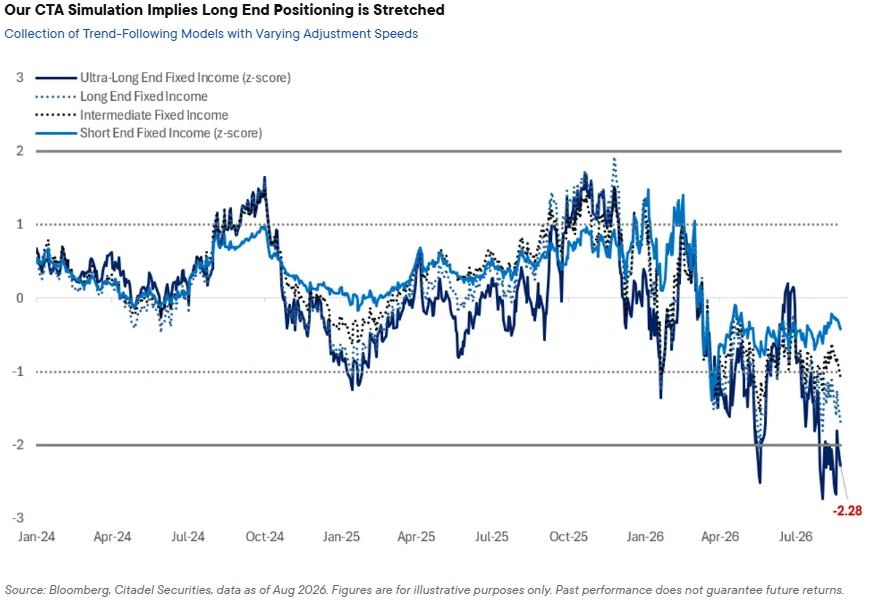
It is worth mentioning that some signs in the bond market seem to confirm Flett's views. Although long-term US bond yields are still close to multi-year high levels, the latest market indicators show that the US Treasury intervention has begun to have an impact, and traders are increasingly unwilling to confront this policy force called the “Bezent Put Option” by the market.
Since Bezent announced the expansion of repurchases, US Treasury bonds have performed significantly better than interest rate swaps for the same period, and the interest rate spread between 30-year US bond yields and swap interest rates has narrowed to the lowest level since February this year. Meanwhile, the benchmark US bond yield experienced a brief fluctuation after the policy was announced, and has now begun to gradually decline.
The impact of the Ministry of Finance's policies is also very obvious in the options market. Over the past week, bond futures options linked to long-term US Treasury bonds have clearly turned bullish, and demand for call options has increased rapidly compared to put options. In contrast, the degree of option bias in short-term US bond futures is still close to the neutral level of the past few months, indicating that the current market's attention to policy intervention is mainly focused on the long end of the yield curve.
Some derivatives brokers said that currently the real “trading opportunities” in the market are concentrated in the long term. He said that if there is a kind of “fear” in the current market, it is instead a fear that further government intervention will cause a sudden sharp drop in long-term returns. In other words, in the past, investors were mainly concerned that US bonds would continue to be sold off and that yields would soar further; and as the Treasury clearly entered the market to buy back long-term bonds, some traders began to worry that continuing to short long-term bonds might experience a sudden increase in policy.
Although some market participants think that Bezent's intervention was a mistake, traders still have to face the reality that there is now a well-funded buyer in the market who is likely to continue to expand the scale of purchases.
However, in contrast to Flet's views is the legendary investor Rui Dalio, founder of Bridgewater Fund. Dalio issued an article last week warning that the US debt crisis may arrive within “about three years, with an error of no more than two years.” He further stated that investors should reduce their bond holdings and allocate up to 15% of their capital to gold to hedge against the risk of a US debt crisis.
Currently, the market is still concerned about America's huge debt issuance, geopolitical risks, and the Federal Reserve's future policy path. It is particularly noteworthy that, according to the latest data released by the US Treasury Department on August 19, 2026, the total US federal government debt has broken through the $40 trillion mark for the first time.
According to Dalio, the crux of the problem is not only the absolute size of debt, but an increasingly obvious imbalance between government debt supply and market demand. He compared the government debt system to the human body's blood circulation system: if debt can be effectively converted into productivity and income growth, debt itself does not necessarily pose a problem; but if debt growth fails to generate sufficient revenue to repay principal and interest, debt payments will gradually squeeze other fiscal expenses.
When the supply of debt exceeds market demand, Dalio believes that two outcomes usually occur: one is that interest rates rise, which further boosts the economy and government financing costs; second, the central bank provides liquidity by cutting interest rates and purchasing government bonds, but this may be at the cost of currency depreciation and higher inflation. It may eventually form a self-reinforcing cycle of “debt-monetary expansion—inflation.”
Furthermore, Hoisington Investment Management, which has been watching multiple US bonds for more than 30 years, also pressed the “steering button” in early July. This legendary fixed-income institution has completely adjusted its investment position, which has continued for more than 30 years. Regulatory documents show that the agency is drastically reducing the sensitivity of the bond portfolio to changes in long-term interest rates.
In its quarterly report, Hoisington Investment Management points out that the widening fiscal deficit and increased demand for capital forms a “broader structural background”, which “indicates that both inflation and long-term treasury bond yields will be on the rise.” The report was co-signed by company founder Van R. Hoisington and chief economist Lacy Hunt. The latest judgment proposed by the two broke the agency's long-standing bullish stance on US Treasury bonds over the past few decades.
Fixed-income investors are now generally worried that not only will inflation remain at a higher level in the future, but volatility will also rise further. Inflation can weaken real bond returns, while keeping interest rates high for a longer period of time. Van R. Hoisington wrote in the report that the “long-term equilibrium range” of inflation is shifting upward, and that it may be between 3.5% and 4.5% in the future, “and there is a high risk that the inflation rate will break through 5% in stages.”
Continued expansion in the size of debt is another risk that Hoisington is concerned about. According to the report, this is prompting investors to “increasingly demand higher risk premiums on US Treasury bonds.” Higher risk compensation requirements mean that the future interest rate environment may “not be as stable as between 1990 and 2020.”