
Natural gas has replaced oil as the “new powder keg” for European inflation: gas storage is the lowest in the same period of five years, TTF is approaching a five-month high, and the risk of the central bank's interest rate hike has reignited
The Zhitong Finance App learned that as European gas prices approach a five-month high and gas storage levels fall to the lowest level in the same period in many years, bond investors and policy makers are shifting their biggest concerns from oil to natural gas. Analysts warned that natural gas's transmission to Eurozone and UK inflation is far greater than oil, and is hardly buffered by fiscal policy, which may force the ECB and the Bank of England to raise interest rate paths again. The latest forecast shows that the overall inflation rate in the Eurozone will peak at around 4.2% in January 2027, far higher than the current level.
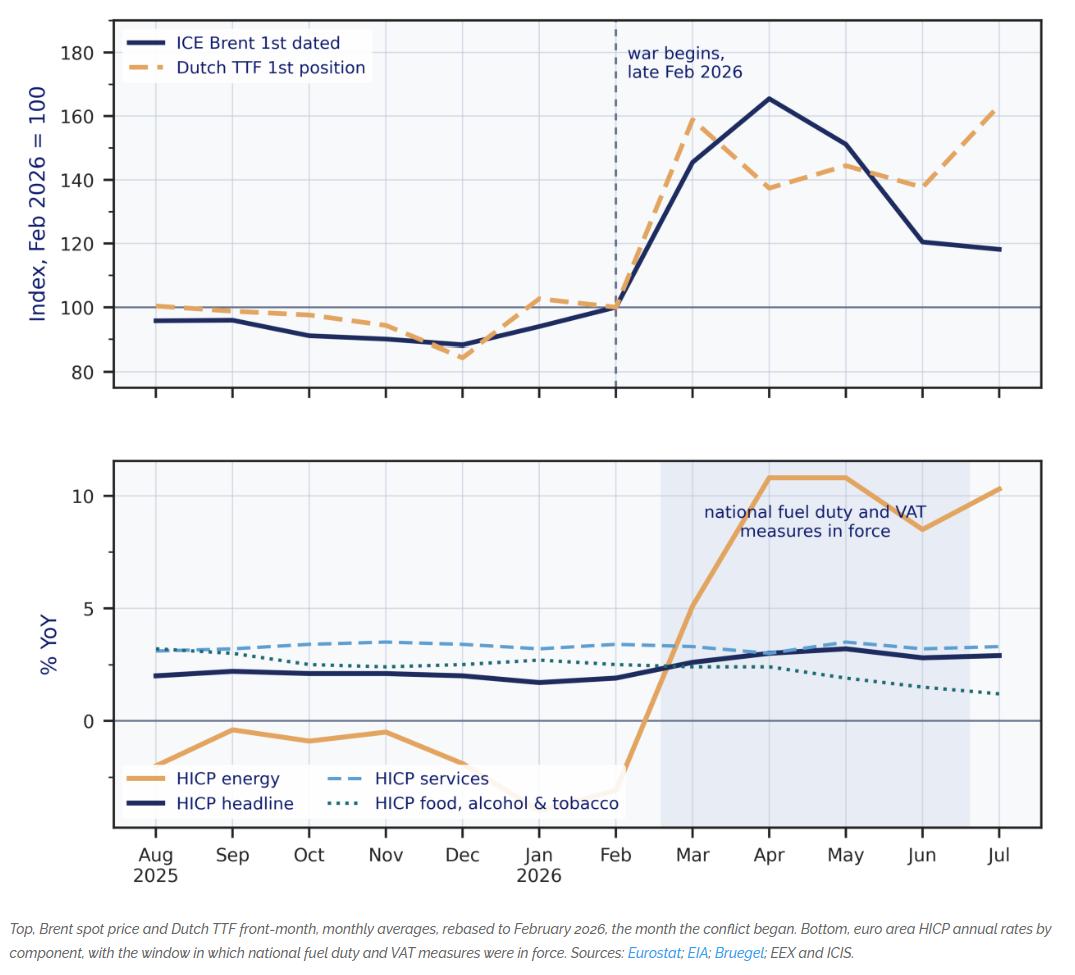
Since the US-Iran conflict escalated at the end of February 2026, there has been a clear divergence between gas prices and oil price trends in Europe. As of press release, the Dutch TTF gas price in recent months has risen from about 32 euros per megawatt-hour at the end of February to 64 euros, about double the level a year ago; European gas prices are close to a five-month high, and winter contract prices are more than double that of the same period last year. In contrast, Brent crude oil has risen from 71 US dollars per barrel before the conflict to about 86 US dollars now. Although it is still more than 10 US dollars higher per barrel, it has fallen sharply from the peak in the second quarter, and is about 30% lower than the peak driven by the US-Iran war.
This fragmentation is reshaping risk pricing in the European bond market. German and British 10-year treasury yields have hit decades' highs, and market participants pointed out that natural gas has replaced oil as the most critical variable among the energy factors driving upward yields.
Jamie Searle, Citibank's European interest rate strategist, said: “The price of natural gas has taken over as a key driver of yield. Since the beginning of July, natural gas prices have continued to be followed for a long time, and attention to crude oil prices has declined relatively.” He pointed to the increasing correlation between 10-year benchmark bonds and natural gas prices.
Emma Moriarty, portfolio manager at CG Asset Management, also emphasized: “Gas prices are more relevant to the UK and Europe, and have not actually declined in any cease-fire agreement; instead, they continue to rise.” The agency has raised its inflation-linked government bond position in the flagship multi-asset fund to close to a record 49%, citing the rising risk of continued price pressure.
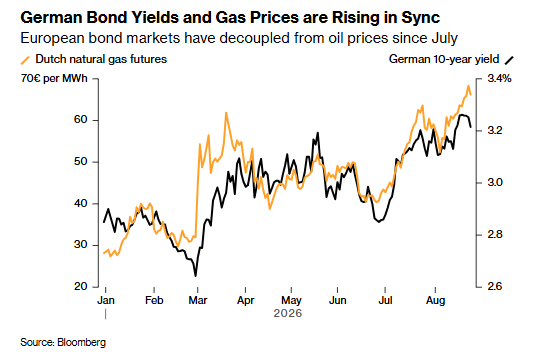
“A potential energy crisis is forming in the gas market, and the transmission of inflation is far greater than that of oil,” Megum Muhic, a market strategist at RBC Capital, and others wrote in an August 13 report.
The “oil bias” of fiscal buffers
According to the latest data, the inflation rate in the Eurozone rose to 2.9% in July from 2.8% in June, and the year-on-year increase in the energy segment accelerated from 8.5% to 10.3%. However, one of the key factors driving the rebound in energy inflation is that the fiscal buffers previously introduced by various countries in response to rising oil prices have expired one after another.
According to the Brueghel Institute's tracking, the total fiscal expenditure promised by European countries to deal with the energy shock was 11.8 billion euros. The biggest single items were fuel consumption tax cuts and value-added tax relief for electricity, and more than half of the measures did not target specific groups. Spain promised 4.7 billion euros, including 2.6 billion euro tax cuts on fossil fuels and electricity, implemented from March 21 to June 30; Germany's 1.6 billion euro energy tax relief covering May and June; Italy's motor fuel consumption tax cuts continued from March to May; and Ireland's measures continued until July. Most of the measures in Germany, Italy, and France expired at the end of the second quarter, while fuel discounts in Spain were gradually reduced during the summer.
The withdrawal of these measures is directly reflected in the July data. Motor vehicle fuel prices in Germany surged 23.0% year on year in July, precisely because fuel discounts ended on June 30; while household energy prices fell 1.4% year on year, still benefiting from remaining relief measures. Eurozone energy inflation jumped from 8.5% in June to 10.3% in July, largely as a result of declining fiscal buffers.
By contrast, natural gas received little fiscal protection on a similar scale. Europe's exposure to gas is mainly transmitted through price rather than quantity. More importantly, the price increase of natural gas was about three times that of oil, yet there was no corresponding policy hedging. Macroeconomics and inflation forecasting technology company Turnleaf Analytics indicated in its August 18 forecast that as most of the oil-related relief measures expire and the remaining measures are gradually withdrawn, the impact on gas prices will become more obvious in the winter.
Hormuz bottlenecks and gas storage crisis
In addition to this, the fragility of the European gas market also stems from supply-side structural bottlenecks and insufficient inventory buffers. The Strait of Hormuz usually accounts for about 20% of the world's liquefied natural gas supply, and unlike oil, natural gas has no alternative transportation routes, and there are few strategic reserves to absorb the supply gap.
Since the end of March, Qatar Energy has suspended some exports due to force majeure, and it has been extended until October. Although Qatar gas accounts for less than 4% of the EU's total gas imports, and direct losses are limited, the problem is that Asian buyers have absorbed more than 80% of Qatar's exports and are now competing with Europe for spot liquefied natural gas from the Atlantic basin.
Within a few weeks after the conflict, the Asian JKM benchmark price surged 51%, the Dutch TTF rose 35%, and the US Henry Hub price fell 9%. Europe is not physically dependent on Qatar, but it is a price taker in this market.
Weak inventory levels have exacerbated the impact. EU gas storage depots were only 28% full on April 1, 2026, the lowest in four years; by the beginning of July, they had only recovered to around 49%. The gas storage volume reached 60% on August 13 and about 61% in mid-August, which is still the lowest level in the same period in five years. EU law requires a gas storage rate of 90% by November 1, and is recommended to reach 80% in difficult cases, with a minimum exemption of 70%. To achieve the 90% target, the amount of liquefied natural gas needed to be imported will be about 13% higher than in 2025, and Asia has marginal bidding power in the current market.
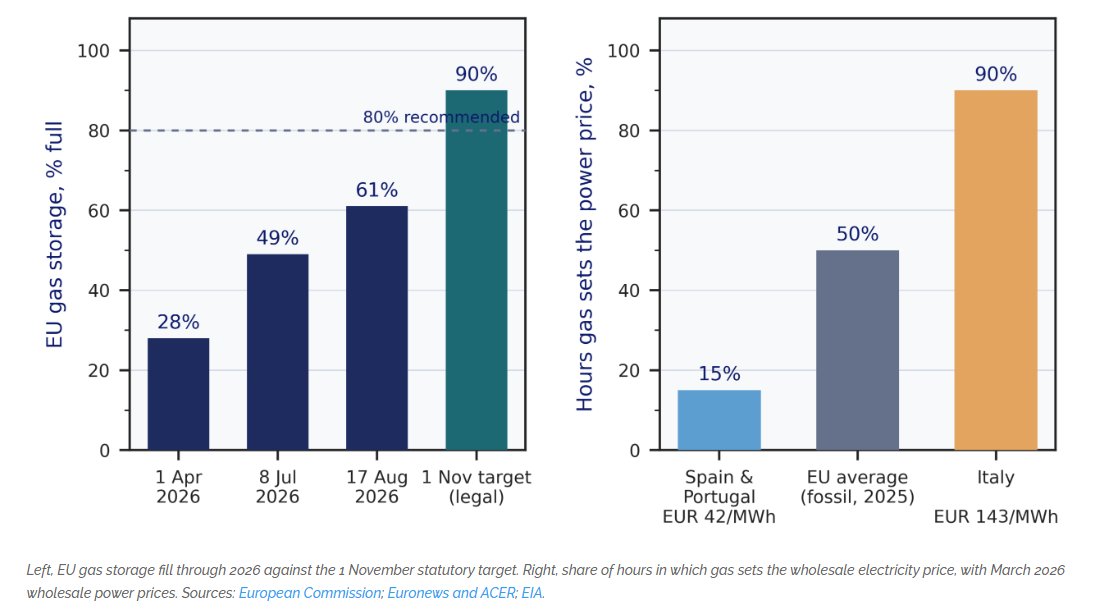
RBC strategists pointed out that even if there is a breakthrough in the Middle East situation and oil prices fall further, as long as concerns about natural gas supply continue, interest rate pressure will be difficult to ease. “This makes the risk distribution of interest rates asymmetrical: there is limited room in the market, and the escalation of the situation means significant downside risks.” They wrote in their report.
Turnleaf Analytics' forecast shows that the overall inflation rate in the Eurozone will rise to about 3.4% in August, peak at about 4.2% in January 2027, then fall back to about 3.2% in April, and stabilize at around 3.4% in July. This path is driven both by gas and energy price levels, and by base effects.
Eurozone energy inflation was negative every month from November 2025 to February 2026, falling 4.0% year on year in January 2026. Therefore, even if energy prices in euros remain stable, the year-on-year increase will be boosted by the base effect in January, and then fall back after the base is positive in March. Turnleaf said its forecast for August 18 was about 0.3 percentage points lower than August 3, which mainly reflected a decline in Brent crude oil prices, but natural gas prices did not fall at the same time.
Looking at the composition of inflation, energy weighed 9.0% in the Eurozone HICP basket in 2026, and 10.3% energy inflation contributed about 0.9 percentage points to overall inflation. The service sector weighed 46.8%, up 3.3% year on year, and remained between 3.0% and 3.5% over the past year; non-energy industrial products weighed 25.2%, up 0.9%; food, alcohol, and tobacco weighed 18.9%, down from 3.2% in August 2025 to 1.2% in July 2026. These data show that the Eurozone is still facing large relative price shocks, but core inflation has yet to fully absorb the rise in energy prices.
Turnleaf's contribution breakdown shows that the biggest contributor to Eurozone trade energy prices is the Dutch TTF gas moving average in recent months, ahead of Brent's initial price. At the same time, the Eurozone core CPI implied by the market also occupies an important position in the model.
The central bank and the market face asymmetric risks
Since this year, the ECB has raised interest rates once, while the Bank of England remains on hold. The money market currently prices that the two central banks will each raise interest rates once before the end of 2026, and raise interest rates once more before September 2027. However, many strategists believe these assumptions may have to be adjusted in view of rising gas prices and lack of progress in the Strait of Hormuz negotiations.
Steven Barrow, head of G10 strategy at Standard Bank, said: “This latest inflation threat comes from energy storage difficulties and the impact of summer heatwaves and droughts, making us more cautious. We are ready to raise our interest rate forecasts at any time.” RBC strategists emphasized that even if the Middle East cease-fire reduces oil prices, if natural gas supply problems continue, interest rate pressure will still exist, and the risk distribution is biased upward.
Although the surge in bond yields was driven by other factors, including unsustainable public finances, massive debt issuance by hyperscale cloud service providers, and unpredictable US policies. However, market participants believe that among energy-related risks, natural gas currently poses the greatest threat to interest rate prospects in Europe and the UK.
The foreign exchange market is also beginning to reflect this risk. Strategist Adam Linton pointed out that EUR/USD's rise may soon face resistance from high gas prices. Currently, the correlation between energy prices and the euro is insufficient to prove that it dominates the exchange rate, but as gas prices rise, this correlation is worth paying close attention.
For Europe, the next winter will be a critical test. Gas storage buffers are weak, fiscal protection is lacking, supply risks in Hormuz are unresolved, and the buffering effect of renewable energy may weaken during periods of peak demand and low output in winter. The path of inflation in the Eurozone soaring to 4.2% in January next year is gradually becoming the benchmark scenario that the bond market and central banks must face.