
From Megawatts to Tokens: Dexiang Cloud Computing (00199)'s AI Infrastructure Revaluation Path
The global AI competition is expanding from model competency disputes to infrastructure and capital organization capabilities. Alibaba announced this week that it will raise HK$80 billion through placement to invest in full-stack AI capabilities; CoreWeave's second-quarter revenue reserves were about US$104 billion, which has not yet been included in the additional commitments of over US$25 billion at the beginning of the third quarter. Customers first lock in computing power, and enterprises then advance capital expenses. Land, electricity, computer rooms, networks, and financing are becoming the backbone of AI competition.
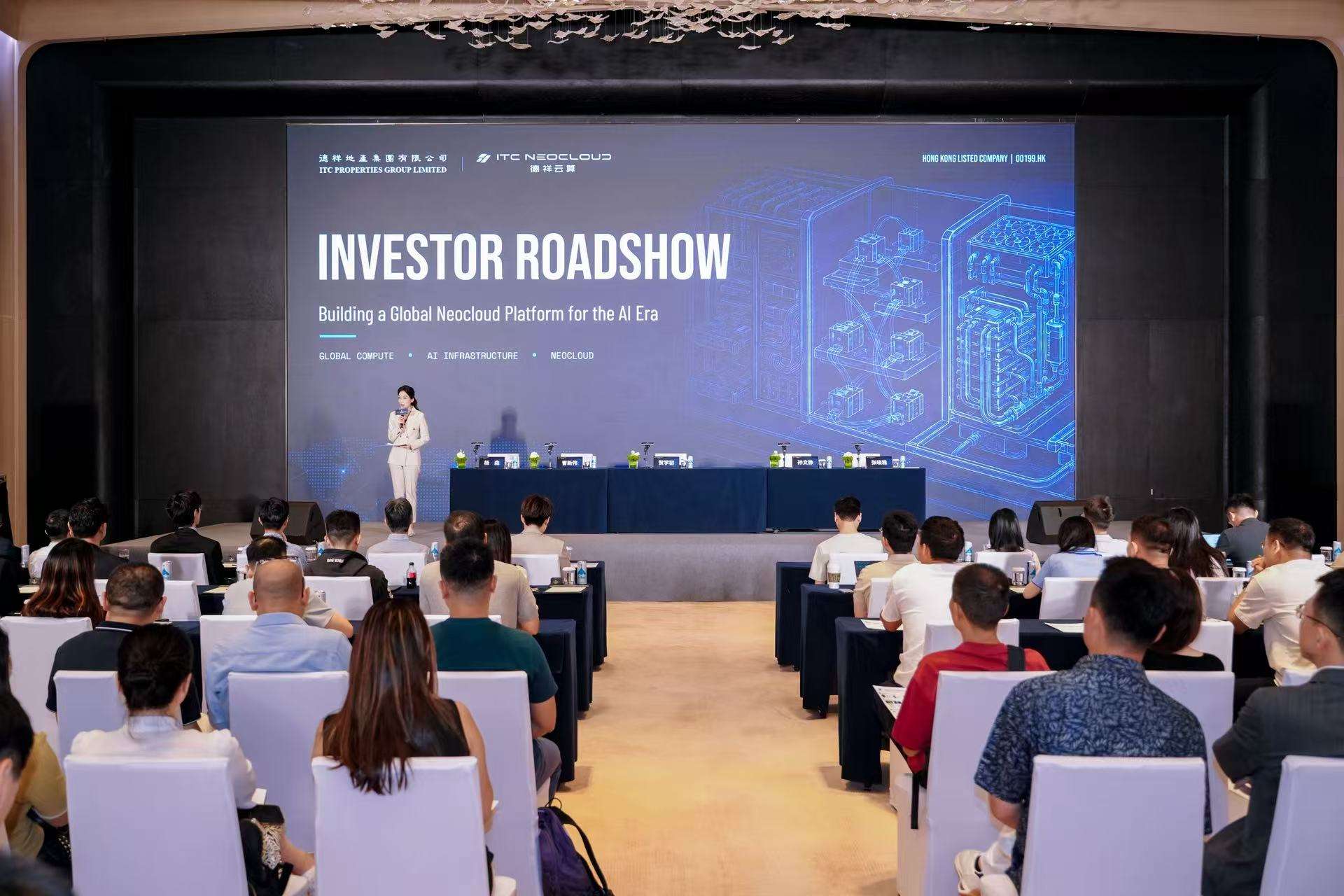
In this context, Dexiang Real Estate (00199) held an open day for investors in Shenzhen on August 26. The company has passed a bill to change its name to “Dexiang Xinyun Computing Power Group Co., Ltd.” and is shifting from a traditional real estate platform to a global AI infrastructure platform connecting energy, AIDC, GPU and token services. The day before the event, the stock price closed at HK$2,875, with a turnover of HK$35.62 million and a market value of approximately HK$3.1 billion.
From “real estate discounts” to “infrastructure pricing”
Dexiang's transformation logic begins with judging the infrastructure cycle. He Xuechu, co-chairman of the board of directors, compared AI to communication networks in the industrial era of highways, ports, and the Internet. AIDC also relies on land, energy, approval, engineering, and long-term operations, and superimposes GPU clusters, computing power scheduling, and modeling capabilities.
“Model companies will continue to iterate, and some will disappear, but the infrastructure that supports productivity will exist for a long time. What we really want to manage in the future is a global AI productivity network.” — He Xuechu, Co-Chairman of the Board of Directors of Dexiang Real Estate
He Xuechu summarized the implementation of the strategy as operable assets, computing power revenue, technical capabilities, long-term customers, and continuous cash flow, and rewrote the conceptual transformation into verifiable indicators. Cao Xinwei, executive director and general manager of Dexiang Intelligent Computing, disclosed that the company's global planned capacity is about 2.4 GW, covering 7 countries and 13 nodes. This is the size of the plan and reserve, not the installed capacity; the valuation depends on how many projects can be approved, commenced, delivered, and leased.
The overall plan for the Nantong Rudong project is 1 GW, with an initial phase of 200 MW. It is intended to rely on wind power, photovoltaics and geothermal power to build a Yangtze River Delta deduction computing power base. The company's communication scenario is that every time the electricity price enters the “head 5”, the PUE falls below 1.2; Cao Xinwei said that the initial capacity was pre-locked by the customer. Beijing plans 50 MW, and has obtained key conditions such as land, electricity, energy consumption and water; Zhang Bei plans more than 100 MW; and Hong Kong undertakes international GPU deployment and computing power overseas. As a result, a division of labor connecting Nantong reasoning, Beijing collaboration, and Hong Kong to the world was formed. The value does not add up to capacity, but whether a node can get close to customers, obtain low-cost energy, and create replicable delivery capabilities.
“We want green electricity, not green for the sake of being green. The core is to actually reduce electricity prices and operating costs through multiple energy access.” — Cao Xinwei, Executive Director of Dexiang Real Estate and General Manager of Dexiang Intelligent Computing
From MW, GPU to Token
If we only turn resources into computer rooms, Dexiang will still set prices according to traditional IDC. The company plans to first convert MW into GPU computing power, then form tokens, contracts and cash flow through unified scheduling, inference optimization, and model services. The four types of revenue include AIDC operations, GPU leasing and computing power services, enterprise model deployment, and usage-based MaaS services: the underlying business provides large-scale cash flow, and the upper level services seek to increase unit computing power revenue and profit margins.
“If a good AI Infra engineer can increase GPU efficiency by 20%, the economic effect is close to increasing the company's GPU production capacity by 20%, and there is no need for additional capital expenses of the same size.” — Yang Sen, Strategy Director of Dexiang Real Estate
This sentence points to the valuation watershed between Neocloud and traditional data centers: the former sells computational power production capacity that can be scheduled, measured, and continuously optimized. The longer the platform runs, the more it can accumulate adaptation data for models, chips, loads and nodes, and technical efficiency is more likely to be converted into gross profit.
Capital constraints and valuation differences
Management estimates that recent projects such as the first phase of Nantong, Beijing, Suzhou and Hong Kong Science Park total about 310 MW, with a total investment of nearly HK$8.5 billion. The company plans to use project financing as the core, with banks and financial leasing institutions providing about 70% to 80% of the capital at the project level; capital is introduced into industrial capital, RMB funds, and strategic partners, and listed companies retain instruments such as placement and convertible bonds. The cost of financing, project equity ratio, and delivery pace will determine the value shareholders will ultimately obtain.
The valuation logic given by Dexiang is not complicated: the underlying AIDC is priced according to deliverable capacity, utilization rate, and stable cash flow; GPU services look at equipment utilization, contract duration, and capital costs; MaaS and token platforms depend on scheduling efficiency, unit token cost, and revenue scale. As the project moves forward, the valuation anchor will also shift from resource reserves to assets under construction, operating cash flow, and platform revenue.
Under this framework, management believes that if recent projects are delivered according to plan and a stable lease is formed, there is room for the company's value to increase several times compared to the current market value. This is not a consistent target price in the market, nor does it mean that the relevant value has been achieved; more accurately, the current stock price still mainly reflects capital expenditure and execution risks in the early stages of transformation, and the profit structure after the AI infrastructure is platformized is limited. The discount provides potential flexibility, and also leaves the burden of verification to the company.
Revaluation begins with the first cash flow
The path given by management is to first generate continuous computing power revenue, then promote long-term GPU rental, platform climbing, and more project delivery, and eventually enter large-scale operation of flagship projects. The valuation triggers are therefore clear: project delivery, GPU lease initiation and renewal, token revenue growth, and financing implementation. Once these nodes continue to appear, the market's valuation method may also change accordingly.
The capital market will not wait for all projects to mature before revaluing them, nor will they revalue them based on global plans alone. It often starts with the first megawatt of electricity delivery, the first batch of GPUs to rent, the first token bill, and the first positive cash flow. Whether the stock price is cheap depends on how much planned capacity Dexiang can turn into contracts, revenue, and cash flow; judging from the progress of on-site disclosure, customer pre-targeting, and business path, this fulfillment curve no longer starts from scratch.
For investors, what Dexiang is most concerned about is not how big the story is, but whether it can deliver faster than market expectations.