
Bitcoin returns to $80,000, but MSCI hangs once again! Strategy (MSTR.US)'s proud financing flywheel ushered in an “exponential identity trial”
The Zhitong Finance App learned that Bitcoin, the world's largest cryptocurrency by market capitalization, recently rose above $80,000, bringing a phased resurgence to Strategy (MSTR.US), where Michael Saylor is at the helm — the company's stock price has rebounded by more than 35% in the past week, yet it has accumulated a cumulative decline of about 60% over the past year. This also shows that the recovery in Bitcoin transaction prices can fix Strategy's net asset value and capital market bullish sentiment, yet it has not eliminated the structural risk of relying on issuing securities such as common shares and preferred shares to raise funds and continue to increase its Bitcoin holdings; so far, the company has invested more than 60 billion US dollars to buy Bitcoin, and is still seeking new sources of capital.
The focus of the latest discussions at MSCI, a global index compiling company, is not about Bitcoin itself, but rather about redefining the boundaries between “operating companies” and “investment instruments”: if MSCI determines that a strategy with the title of “major Bitcoin” and “Bitcoin shadow stock” is mainly engaged in asset accumulation rather than carrying out a business with sufficient operational substance, its index eligibility may be cancelled, thereby triggering passive capital sales, declining investor coverage, and equity dilution pressure. Thus, this is not only a potential index adjustment, but also a systematic stress test of Saylor's “rising currency prices — issuing securities and financing — buying more bitcoins”, a complete set of capital flywheels.
Under Michael Saylor's leadership, Strategy (formerly MicroStrategy) began investing almost all of the company's cash in Bitcoin in 2020.” As a result, Strategy's rise was based on a groundbreaking and innovative flywheel strategy: selling stocks, buying Bitcoin, riding Bitcoin's unprecedented bullish rise, and then repeating the process back and forth. At its peak, the company's market capitalization was far higher than the value of its cryptocurrency holdings. Now, this premium is facing market questions, and stock market investors' belief in the “Bitcoin treasury model” is rapidly weakening.
Bitcoin's rebound is difficult to solve the “exponential identity crisis”: MSCI re-examines operating company boundaries
Bitcoin's rebound has given Michael Saylor's Strategy company some breathing room. But just as market pressure begins to ease, an old threat from indexer MSCI is resurfacing.
MSCI is considering rules that could remove the company from its global stock index, which could put new pressure on the funding model that supports Strategy's huge Bitcoin holdings. MSCI's consultation comes at a time when Saylor is seeking more capital to continue to buy Bitcoin. This further heightens market concerns about the dilution of shareholders' equity and the performance of securities related to financing Bitcoin purchase plans worth more than $60 billion.
The proposal will exclude companies identified by MSCI as mainly engaged in asset accumulation rather than actual business. MSCI said that if this method is applied using data up to May of this year, Strategy, Japan's Bitcoin treasury company Metaplanet Inc., and Yellow Cake Plc, which invests in uranium assets, will all be excluded.
The proposal resurfaces a threat that seemed to have subsided earlier this year. At the time, MSCI dropped a plan for companies that held large amounts of digital assets. Instead, the index producer said it will conduct a broader review of companies whose business activities are more oriented towards investment rather than actual operation.
This distinction is now central to the latest call for comments. The proposal issued by MSCI earlier this month did not specifically set rules for Bitcoin or other digital assets, but rather sought to determine whether a company has sufficient operating activity to qualify for inclusion in the stock benchmark index.
Edward Yoon, strategist at Macquarie Capital Index, said, “MSCI has expanded the discussion to a more fundamental question: what kind of companies are eligible to be recognized as operating companies and included in the stock market's many MSCI benchmark indices.”
As Bitcoin climbed back above $80,000, Strategy shares rose more than 35% over the past week, providing some breathing room after a long period of decline in cryptocurrency and corporate stock prices. However, the stock has accumulated a decline of about 60% over the past year.
Passive capital recession and rising financing costs: Index exclusion may oppress Strategy's capital structure
The prospect of being eliminated from major indices may add another layer of pressure to Strategy's capital structure. As the investor base that must hold the stock will shrink, the exclusion from the index may weaken market demand and put pressure on stock prices.
Melissa Roberts, managing director of Index Rebalancing and Strategic Opportunity Research from Stephens Inc., said that being removed from the main benchmark index may put technical pressure on stocks in the short term, and may even overwhelm the company's fundamentals in terms of market technology. She added, “One of the worst consequences of being excluded from the index is that stocks lose a great deal of investor attention. Overall, stocks being removed from the index usually cause turnover rates to rise and cause stock price performance to lag during the shareholder base restructuring period.”
In the consultation plan released in August, MSCI proposed a quantitative screening process based on five financial indicators: operating asset intensity, cost intensity, cash flow screening, fair value intensity, and capital dependency. If a company fails MSCI's strict screening criteria for core operating assets and fails four of the other five financial tests, the company will be deemed ineligible for inclusion in the index.
Yoon said the method aims to identify companies whose economic activity is closer to investment instruments than operating companies. Investment instruments such as exchange-traded funds, investment funds, and business development companies are currently excluded from the MSCI investable index system.
Yoon added, “As a result, this consultation did not introduce a new concept. Instead, it extends existing principles to businesses that, despite adopting a traditional corporate structure, are likely to have economic characteristics similar to investment instruments.”
A precedent for rules other than short-term money flows? Asset-based listed companies face fundamental identity torture
The core of the dispute is how indexers should differentiate between operating companies and investment instruments as cryptocurrency treasury type companies such as Strategy increasingly revolve around asset accumulation.
Lance Vitanza, a senior analyst at TD Securities, said: “Our conclusion is that this dispute is not so much about impacting the MSTR stock price itself in the short term, but rather that it acts as a precedent and may be more important for Bitcoin treasury/treasury-type companies and other asset-based listed company structures. We believe investors may have underestimated the broader significance of this consultation.”
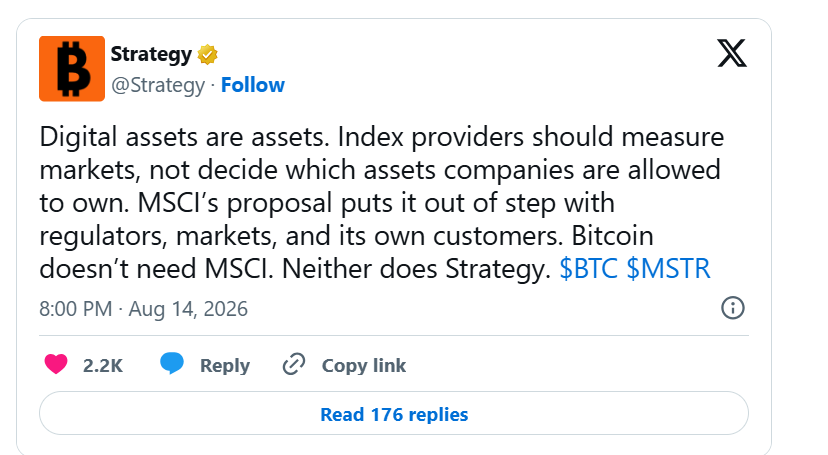
Strategy, led by co-founder Saylor, did not respond to requests for comment. However, the company said in a social media post: “Index producers should measure specific market conditions rather than decide what assets companies are allowed to hold. There is a serious disconnect between MSCI's proposal and the positions of regulators, the market and its own customers.”
The current proposal also appears to be aimed at limiting the impact of rule changes on existing index constituents. Yoon pointed out that MSCI is considering setting up a watch list and buffer threshold, and requires the company to fail the screening for two consecutive review periods before removing it.
He added: “This careful approach gives issuers and investors time to evaluate potential impacts while helping to avoid unnecessary disruptions to benchmark-tracking portfolios.”
MSCI is seeking feedback from market participants. The deadline is the end of September, and plans to publish the results of the consultation in October.