
On the eve of Jackson Hole, key data was released: US PCE stuck at 3.7% in July, GDP remained at 1.5% uncorrected in Q2, consumer spending was revised but stagnated in July
The Zhitong Finance App learned that the inflation index that the Federal Reserve is most concerned about, unexpectedly stabilized in July. The second estimate of US GDP for the second quarter announced on the same day remained unchanged at an annualized 1.5% annualized growth rate, but both consumer spending and commercial investment improved from the initial value. However, actual consumer spending remained flat month-on-month in July, indicating that the economy cooled down after strong growth in early summer.
Analysts believe that these data have further strengthened the reasons for the Federal Reserve to stay on hold for the time being. Although inflation has clearly declined from its high point, it is still sticky, and trade policy uncertainty and the risk of energy price recovery are still there. This has made the Fed cautious in choosing future policy paths. Investors will pay close attention to Federal Reserve Chairman Walsh's speech at the Jackson Hole Global Central Bank Annual Meeting on Friday to find clues on how decision makers can evaluate stubborn inflation and policy trends.
Economists Troy Durie, Andrew Sacher, and Anna Wong said, “The main implication of the July Personal Income and Expense Report is that potential inflation is relatively moderate and actual spending performance is sluggish. We expect the Federal Reserve to stand still for the rest of the year.”
Inflation is still sticky, recovering moderately from month to month
According to data released by the US Department of Commerce's Bureau of Economic Analysis on Wednesday, the personal consumer spending price index rose 3.7% year on year in July, the same level as in June. It is still far above the Federal Reserve's target level of 2%, and slightly higher than the 3.6% expected by economists. On a month-on-month basis, PCE rose 0.2%, in line with market expectations, and fell 0.1% in June. At that time, it was the weakest reading since April 2020. The core PCE index, which excludes food and energy, rose 0.2% month-on-month and 3.3% year-on-year in July.
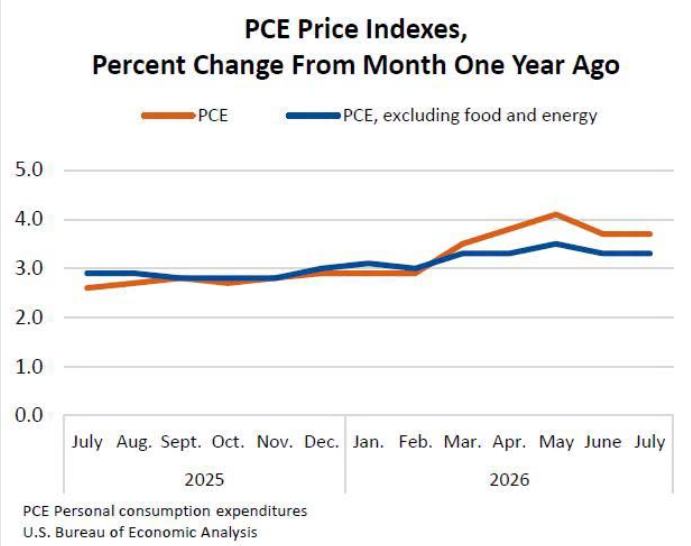
This indicator has been above the Federal Reserve's 2% target for 65 consecutive months since February 2021. PCE peaked at 7.2% in June 2022, then the Federal Reserve initiated the most aggressive rate hike since the 80s, driving inflation back gradually. However, after Trump returned to the White House last year, he introduced a new round of import tariffs, which boosted a wide range of commodity prices. Since then, the US and Israel have launched air strikes on Iran, triggering a sharp rise in energy prices, further complicating the inflation situation.
In May of this year, PCE's year-on-year increase once rose to a three-year high of 4.1%. The reason was that about one-fifth of the world's oil supply was interrupted due to the US-Iran conflict, and energy prices rose sharply. Six months later, although the conflict is still not finally resolved, the exchange of fire has been reduced, and oil prices and the wider inflationary pressure caused by it have fallen from spring highs.
Structurally, behind a moderate month-on-month rise in inflation in July, actual spending on core goods fell 0.8%, while spending on services rose 0.3%. The service inflation index excluding energy and housing rose 0.3% month-on-month. This indicator is regarded by some Federal Reserve officials as an important reference for measuring domestic inflationary pressure.
It is worth noting that the US Bureau of Economic Analysis will adjust price measurement methods for some categories starting next month, covering fields such as legal services, computer software, and investment consulting. Many economists expect that the adjusted core PCE reading may be revised down, which may have some impact on judging the future path of inflation.
GDP remained 1.5% in the second quarter, and consumption and investment were stronger
The second estimate of US GDP for the second quarter released on the same day shows that the annualized GDP growth rate after inflation was 1.5%, in line with the initial value, and lower than the 2.1% growth rate in the first quarter. However, the details in the underlying data are more optimistic.
Consumer spending, which accounts for more than two-thirds of US economic activity, grew by 3.4% on an annualized basis, higher than the initial value of 3.2%. Non-residential fixed investment increased by 8.5%, indicating that enterprises are still willing to invest. An indicator that measures potential demand more narrowly — final sales to domestic private buyers — grew by 4.2% after revision, higher than the initial value of 3.9%, the strongest growth rate in more than three years. Excluding net exports, inventories, and government spending, the indicator often better reflects the economy's endogenous demand momentum.
Government spending declined by 1% annualized in the second quarter, mainly reflecting a significant decline in non-defence-related spending. Meanwhile, the annualized increase in the core PCE price index in the second quarter was revised up from the initial value of 3.4% to 3.6%, indicating that the inflationary pressure for the quarter was slightly higher than initially estimated.
Real consumer spending stagnated in July, and the savings rate rose to a four-month high
Despite strong consumer spending performance in the second quarter, momentum declined markedly after entering the third quarter. According to July data released on Wednesday, actual consumer spending after adjustment for inflation remained flat month-on-month, with strong growth recorded in May and June.
Nominal personal income increased 0.4% month-on-month, and wages and salaries increased 0.3%. After deducting inflation, real disposable income increased by 0.4%. The savings rate rose to 3%, the highest level in four months.
Although the slump in consumer spending in July was partly affected by temporary factors: Amazon (AMZN.US) moved this year's Prime Day promotion from July to June of last year, which may have overdrawn part of the spending ahead of schedule, thus depressing the July spending data. But economists remain wary about the outlook. The average price of gasoline in the US has rebounded to more than $4 per gallon, which may curb consumer spending on other goods and services. Furthermore, the additional buffers previously brought about by higher-than-normal tax refunds may have subsided.
Retailers, including Walmart (WMT.US), said that price-sensitive consumers are still spending, but they are more likely to look for discounts and specialty products, and their consumption behavior tends to be cautious.
Federal Reserve policy differences and rising trade uncertainty
As the inflation data was released, the debate within the Federal Reserve about the outlook for interest rates became more intense. At the FOMC meeting in July, the majority of members voted to keep interest rates unchanged in the 3.50% to 3.75% range. This has been a continuous standstill since December last year. The fall in inflation over the past two months has supported keeping interest rates unchanged, but the slow pace of improvement may be difficult to persuade a few officials advocating further policy tightening. According to these officials, inflation has continued to be above target since February 2021, and without further restrictions on demand, it will be difficult for inflation to return to 2%.
Meanwhile, new trade uncertainties are building up. Trade negotiations between the US and Canada, the second-largest trading partner, broke down on Friday, leading to the entry into force of new tariffs on $20 billion of Canadian goods. Since then, both Washington and Ottawa have announced more retaliatory measures. Unless the two sides reach an agreement, these measures will continue to take effect in the next few months. This may bring price pressure caused by new tariffs and further complicate the Federal Reserve's policy choices.
After the data was released, US Treasury yields and the US dollar rose, while US stock index futures declined. The futures market shows that the probability of interest rate hikes in September remains around 40%.
Currently, the focus of the market is turning to Federal Reserve Chairman Walsh's speech at the annual meeting of global central banks held in Jackson Hole, Wyoming on Friday. Investors hope to find more signs of how the Federal Reserve is dealing with stubborn inflation, especially in the context of slowing economic growth and continued price pressure, whether the central bank will remain patient, and a possible path for future policy adjustments.
Since taking office in May, Walsh has been cautious about policy trends and is more inclined to let the market play a leading role.
Recently, however, US government bond yields have continued to rise. Both 10-year and 30-year Treasury yields rose to their highest levels since 2007 — on the eve of the global financial crisis. This surge in yield was driven by multiple factors, including investors' lack of confidence in the Federal Reserve's adherence to inflation targets, and concerns about debt and deficits in the federal budget.
Although Treasury Secretary Scott Bessent announced a plan a week ago, saying that the Treasury will step up treasury bond repurchases, market participants are still skeptical about whether this move can have a substantial impact on yields.