
Demand for AI is growing at an accelerated pace! Nvidia (NVDA.US) Q2 revenue doubled year-on-year, and the 70% growth rate guide for the next fiscal year far exceeded expectations, and reached an agreement with Amazon for 2 million GPUs
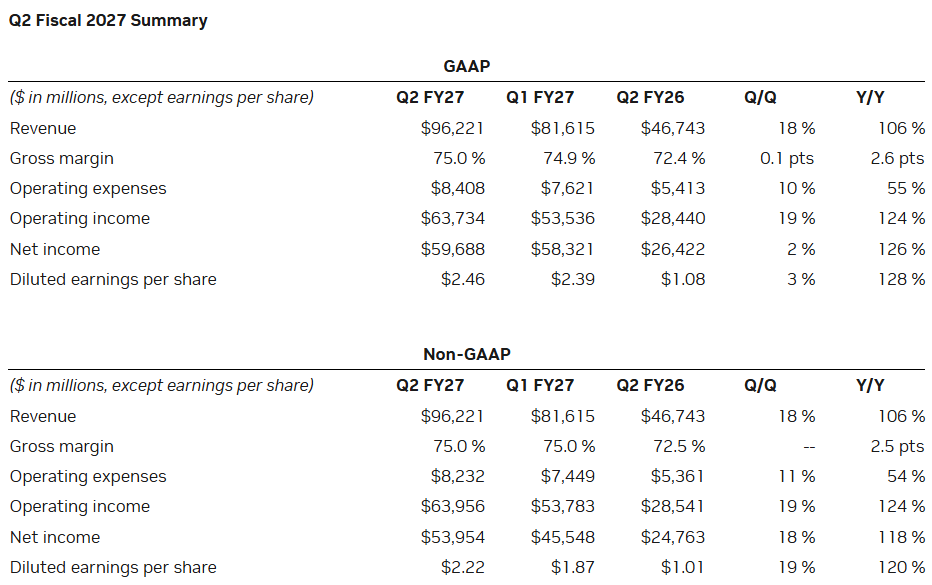
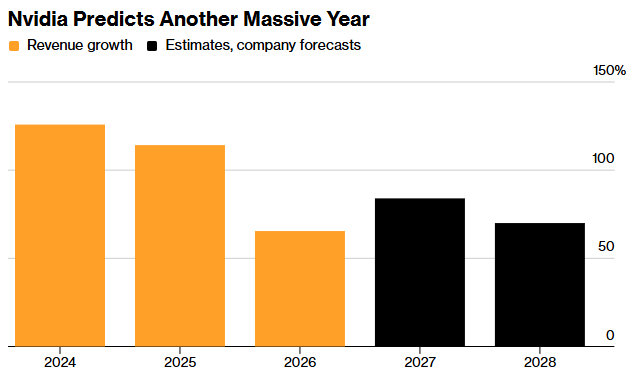
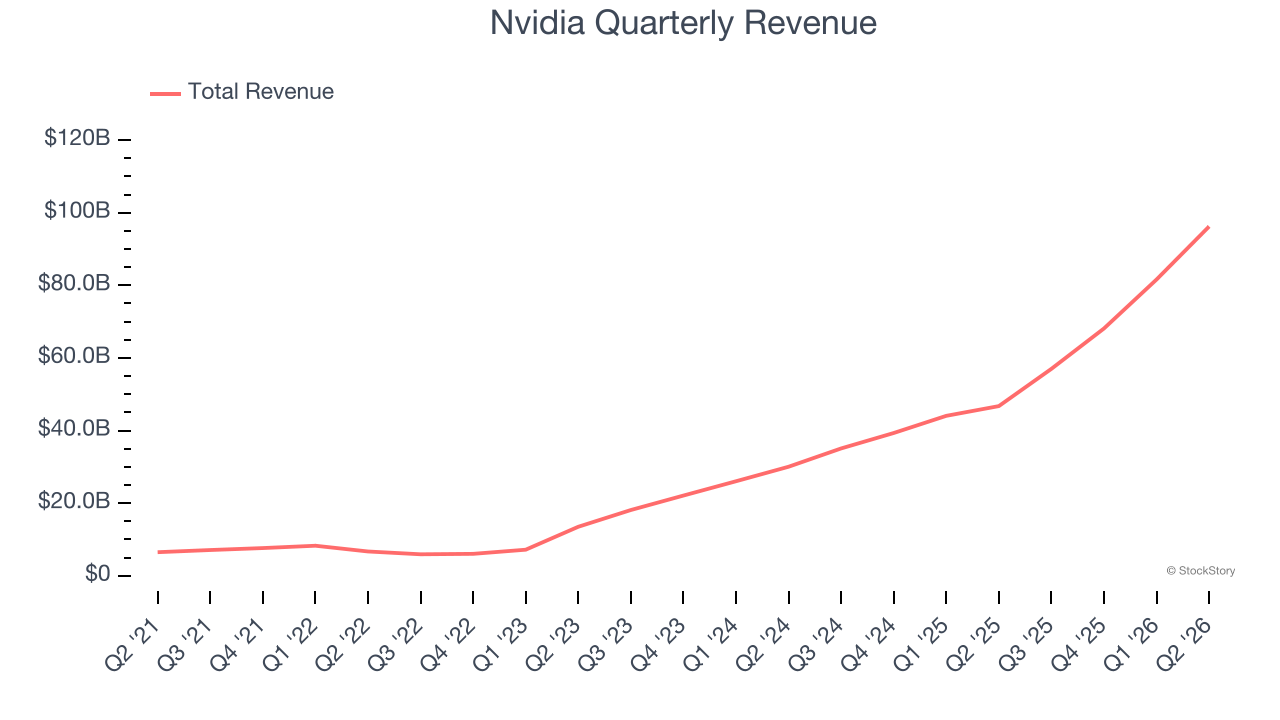
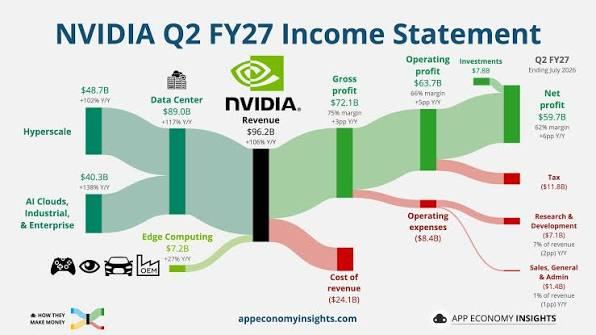
The Zhitong Finance App learned that after the market on Wednesday, Nvidia (NVDA.US), once again handed over a quarterly report card that could go down in history — revenue of US$96.22 billion, up 106% year on year, net profit of US$59.69 billion, and adjusted earnings of US$2.22 per share. The three core indicators completely crushed Wall Street expectations. What is even more exciting for the market is that for the first time, the company gave long-term guidance for revenue growth of about 70% for the 2028 fiscal year, far exceeding analysts' previous expectations of about 45%.
However, this “textbook-level” earnings report experienced a V-shaped reversal where it first fell by nearly 3% after the market and quickly rose by more than 4% after the conference call. Against the backdrop of five next-day declines in the past six financial reports, the market has long regarded “exceeding expectations” as the default script — only guidelines sufficient to push forward the revision of future profit forecasts can restart valuation expansion.
Data panorama: $96.2 billion of “inertia beyond expectations”
For the second fiscal quarter ending July 26, 2026, Nvidia's core indicators have crushed market expectations across the board:
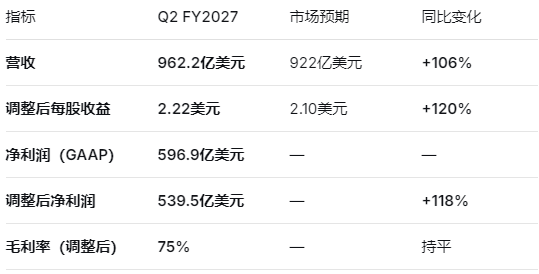
Revenue was about 5.7% higher than the company's previous guideline of US$91 billion, exceeding expectations by the largest margin in nearly two years. Free cash flow reached $21.3 billion, and adjusted net profit soared 118% year over year.
Three Quarterly Report Guidelines: Fulfilling “Whispering Expectations” of $108 billion
For the third quarter, Nvidia expected revenue of $108 billion (± 2%), exceeding market expectations of $104.2 billion. The guidelines also assume that no data center calculation revenue from China is included.
Procurement commitments surged from $119 billion in the previous quarter to $279 billion, mostly related to memory purchases — both a reflection of demand and a source of cost pressure. The CFO specifically mentioned that Hopper data center products shipped to China this quarter were less than 1% of data center revenue.
As analysts expect Nvidia's profit margins to come under pressure as Rubin chip production capacity climbs and memory prices rise in the silicon supply chain, the company's profit margin has attracted much attention.
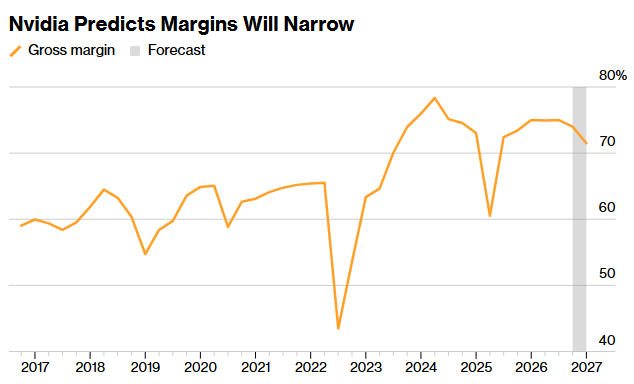
In terms of gross margin, Nvidia expects adjusted gross margin for the third quarter to be 74% (± 50 basis points), down from 75% in the current quarter. The CFO warned that due to soaring memory costs, gross margin is expected to bottom out in the fourth fiscal quarter (ending January next year), falling to 71% to 72%, and stabilizing between 72% and 73% in the 2028 fiscal year.
Data centers: $89 billion “absolute engine”
The data center business remains a core pillar of Nvidia's growth, with quarterly revenue of $89 billion, up 117% year over year, accounting for 92.7% of total revenue.
Looking at the customer structure, Nvidia adjusted its data center business disclosure standards in the last quarter, dividing customers into two categories: hyperscale (Hyperscale) and ACIE (AI cloud, industrial and enterprise customers). This quarter:
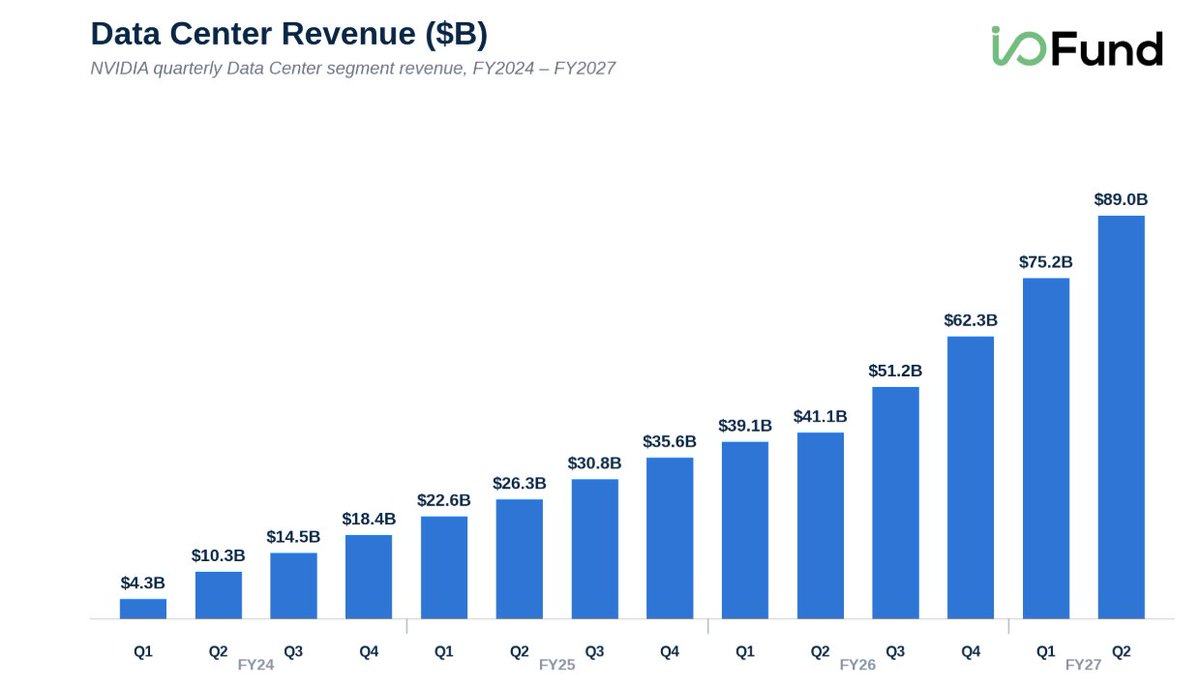
Hyperscale customers: Revenue of US$48.71 billion, up 102% year on year and 13% month on month;
ACIE customers: Revenue of US$40.31 billion, up 138% year on year and 25% month on month.
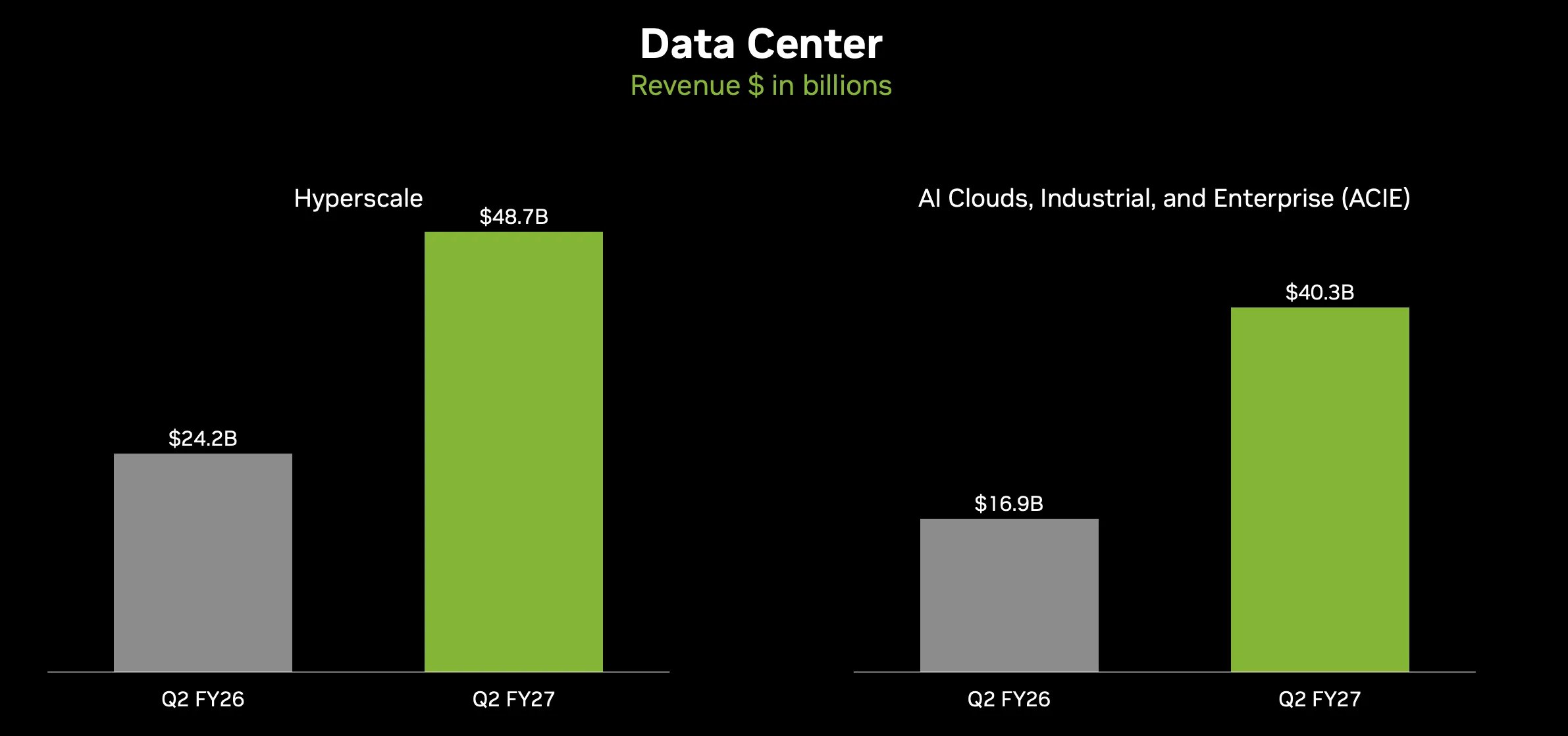
The growth rate of ACIE's business has surpassed that of hyperscale customers, indicating that demand for AI computing power is spreading from leading cloud vendors to sovereign AI, regional cloud service providers, and a wider range of enterprise customers. Nvidia has been working to expand its customer base to show that its sales are no longer as dependent on a few tech giants as before.
CEO Hwang In-hoon said in an earnings statement: “A year ago, a single laboratory drove construction; today, we are ushering in a golden age of new AI laboratories and startups. Multiple cutting-edge laboratories are expanding in parallel, the open model ecosystem is prosperous, and physical AI has also begun to go online.”
FY2028 guidance: 70% growth crushes expectations, supply remains a bottleneck
For the first time, Nvidia gave a revenue growth forecast for the 2028 fiscal year — around 70%. This figure far exceeds the market's previous estimate of about 45%. Hwang In-hoon said in a conference call that he had never given performance guidelines a year in advance before. CFO Kress clearly stated that at least until FY2028, supply will still be a bottleneck limiting growth. Wong In-hoon further stated that without supply restrictions, the company's performance outlook for the 2028 fiscal year would be “much higher.”
Big tech spending spikes in artificial intelligence
Nvidia is one of the companies with the highest market capitalization in the world, and its performance is seen as a weather vane in the AI market because its chips power most of the world's largest data centers and advanced artificial intelligence models.
A few weeks before the report was published, several companies, including Microsoft and Meta — Nvidia's two major customers — reiterated previous expectations that big tech companies would invest more than $730 billion in artificial intelligence infrastructure this year, a significant increase from $400 billion last year.
Nvidia, the core chip maker of the AI boom, is optimistic about sales prospects for the 2028 fiscal year, easing concerns that AI spending may lose momentum. Nvidia is the company with the highest market capitalization in the world and a leading supplier of artificial intelligence accelerators, which are key components for training and running artificial intelligence models. This position has made Nvidia's quarterly earnings a weather vane for the state of the industry as a whole.
The Nvidia CFO also said that if Nvidia gets more supply, it will grow even faster. “It's incredible that demand is growing at an accelerated pace even at our current size,” she said. “Customer predictions suggest we will double our growth next year.”
Major partnership with AWS: 2 million additional GPUs deployed
The financial report also announced that Nvidia has expanded its cooperation with Amazon AWS. Kress revealed that the two sides will deploy an additional 2 million Nvidia GPUs in Amazon's global infrastructure in 2027 and 2028. This partnership further strengthens Nvidia's dominant position among hyperscale cloud service providers.
Hwang In-hoon pointed out that market demand “is growing at an accelerated pace,” and additional orders from AWS are the latest footnote to this trend.
Vera Rubin fully operational: a new engine for 20% of data center revenue
In Nvidia's second-quarter earnings report, Hwang In-hoon said that market demand is growing at an accelerated pace. He also highlighted the launch of the company's newest chip family, Vera Rubin. “Artificial intelligence infrastructure construction is progressing at full speed,” he said. “Vera Rubin is now in full production and was designed to support this moment.”
While Blackwell is still shipping in large quantities, Nvidia's next generation AI system, Vera Rubin, has fully entered mass production.
CFO Colette Kress revealed in a conference call that Vera Rubin began shipping earlier this month. Each GW of Vera Rubin computing power deployed corresponds to a revenue opportunity of approximately $40 billion. Vera Rubin is expected to contribute approximately 20% of data center business revenue in the third quarter.
Vera Rubin is no longer a single chip, but a complete POD-level system — composed of Vera CPU, Rubin GPU, Groq 3 LPX, BlueField-4 storage, and Spectrum-6 network. Nvidia's supply chain has covered more than 350 factories and 30 countries, and system manufacturers such as Dell, HPE, Lenovo, and Supermicro have all entered the mass production system. CoreWeave, Google Cloud, Microsoft Azure, Oracle, and Nebius are already deploying related systems.
Huang Renxun said, “Vera Rubin has been fully mass-produced and was created just for this moment.”
The revolving finance controversy: the “grey area” of hundreds of billions of dollars
In addition to numbers that exceeded expectations, the variable that the market is most concerned about is Nvidia's increasingly complex circular financing (Circular Financing) arrangements.
On the one hand, Nvidia participated in a $500 billion AI infrastructure financing platform — cooperating with Apollo, Blackrock, Blackstone, Brookfield, Goldman Sachs, and KKR, with the goal of mobilizing more than $500 billion in third-party capital over the long term. On the other hand, the company may also provide credit support of up to 105 billion US dollars for data center projects leased by OpenAI. Goldman Sachs is also shouting — market concerns about “revolving finance” continue to heat up, and Nvidia must provide details on a conference call.
The core dispute of these arrangements is: are they releasing real and financing-bound computing power requirements, or are they advancing part of future demand to the present through credit support from Nvidia itself and partner financial institutions? Nvidia's logic is both offensive (funding disruptors to accelerate global AI deployment) and defensive (funding non-hyperscale ecosystems to diversify the customer base).
But the key question remains — if AI inference revenue data growth cannot cover the high cost of computing power, these financing arrangements may turn from boosters to sources of risk.
For this reason, in this financial report, Nvidia listed debt separately as an independent risk factor for the first time, warning that increasing external financing commitments may have an “adverse impact” on financial conditions and cash flow. As of July 26, the company's outstanding senior notes were $33.5 billion, and the size of the commercial paper plan was $25 billion. The company will repay $15 billion in debt over the next one to five years, compared to only $2.75 billion in the previous quarter.
Nvidia warns: “Maintaining our debts, contractual restrictions, and issuing additional debt may cause us to use a significant portion of our operating cash flow to repay our debts and principal.” The company said that although such financing transactions can accelerate the spread of AI and create greater demand for products, critics worry that revolving financing will fuel human demand.
Shareholder return: 26 billion in return, 99 billion on standby
In terms of capital return, Nvidia returned approximately $26 billion to shareholders this quarter through share repurchases and dividends. By the end of the quarter, the company's remaining share repurchase authorization amount was approximately $99 billion. The cash dividend for the next quarter is set at $0.25 per share. The quarter also issued $25 billion in senior unsecured notes for general corporate use.
The threat of growing competition
However, a growing portion of tech companies' planned spending is shifting to autonomous chip development, aimed at reducing reliance on Nvidia's expensive and supply-limited processors. Meanwhile, a large number of potential competitors are coveting Nvidia's lucrative market. Meanwhile, Nvidia's customers are also increasingly developing their own chips, which may reduce their dependence on Nvidia in the long run.
As artificial intelligence is increasingly used to automate tasks and answer queries, Nvidia's graphics processors face increasing competition from central processors and custom chips that are better suited to handle this process known as inference. This shift has prompted major technology companies to invest in developing their own chips.
Just this week, OpenAI, the maker of ChatGPT, said its new Jalapeno processor outperformed Nvidia's current processor product line in tests.
According to reports, Meta plans to begin production of its self-developed “Iris” artificial intelligence chip in September as part of its fourth-generation custom chip project aimed at reducing computational costs.
According to reports in June, Alphabet has ordered more than 3 million chips from Intel, which are expected to be delivered in 2028. The report also notes that Nvidia is also evaluating the US chipmaker's manufacturing technology to produce a processor that integrates four GPUs into a single unit.
Competitors Intel and AMD are also targeting the reasoning market, and a number of Chinese companies, including Baidu, are already producing chips for such tasks.
Nvidia has noticed this trend. In March of this year, Nvidia unveiled a new central processing unit and artificial intelligence system based on technology licensed from inference focused startup Groq. The deal, worth $17 billion, combines Groq's chips with its upcoming Vera Rubin platform.
Earlier this month, SpaceX CEO Elon Musk announced that the company would exclusively use Nvidia's hardware, further solidifying Nvidia's leading position in the artificial intelligence market.
Nvidia said that by 2027, the revenue potential of its artificial intelligence chips could exceed $1 trillion, double the $500 billion predicted by Blackwell and Rubin chips before 2026.