
On the eve of Jackson Hole's annual meeting: the dollar “breathes” awaiting Walsh's speech, traders quietly rebound to hedge
The Zhitong Finance App learned that as the Jackson Hole Global Central Bank Annual Meeting kicks off this Thursday, the foreign exchange market is focusing all its attention on Federal Reserve Chairman Kevin Walsh's keynote speech on Friday. Against the backdrop of US Treasury Secretary Scott Bessent's unexpected intervention in the bond market last week and long-term US bond yields once approaching a 20-year high, the dollar trend is at a delicate and fragile crossroads. The flow of funds in the options market shows that traders are quietly increasing their hedging against the further rebound of the US dollar, although they also admitted that this high-profile speech may eventually be “unsurprising.”
According to data from the Chicago Mercantile Exchange Group (CME Group), 57.2% of trading positions in the US dollar options flow so far this week will benefit from the strengthening of the US dollar against a basket of major currencies, a sharp jump from 43.2% last week. This change clearly shows that before Walsh's speech, market participants are reevaluating the dollar's bearish exposure and reserving room for potential hawkish signals.
At the same time, as a key indicator for measuring the positioning and sentiment of the options market, the risk reversal (risk reversals) indicator also sends a signal: traders' bearish tendencies towards the US dollar have clearly subsided this week, and the negative bias has been reduced by about half compared to before. Francesco Pesole (Francesco Pesole), a foreign exchange strategist at Dutch International Group, commented: “This is a potentially critical turning point for the foreign exchange market, and the market may be unwilling to excessively short positions in the US dollar at this time.”
Behind this cautious sentiment is a precaution against possible hawkish remarks by Walsh. Market sources pointed out that if in his speech, Walsh reiterated the position that the Federal Reserve should focus on monetary policy, keep a distance from fiscal affairs, or even hinted at concerns about current inflationary stickiness, the US dollar may receive further support. Last week, Bezent announced that the Treasury would step up its efforts to repurchase long-term treasury bonds — doubling the maximum repurchase operation to at least $4 billion starting September 9 — a move interpreted by some investors as a move to “reduce yields,” which at one point weakened the dollar. However, the US dollar has since recovered about half of its decline, showing the delicate game between repricing fiscal and monetary policies in the market.
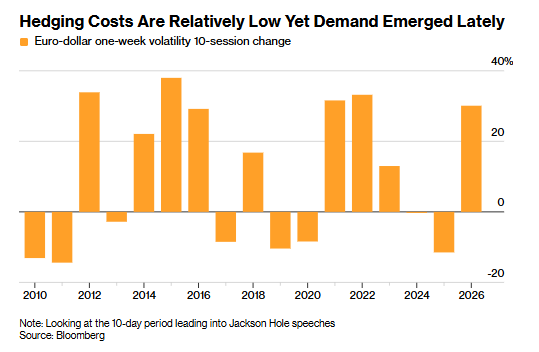
Although the flow of options shows a rise in demand for hedging, the implied weekly volatility of EURUSD is currently only 4.69%, far below the annual average, but also the second-lowest level since 2010 before the Jackson Hole meeting. This seemingly contradictory phenomenon reflects deep differences in the market's judgment on the direction of Walsh's speech: on the one hand, traders are hedging against a rebound in the US dollar to prevent hawkish accidents; on the other hand, volatility pricing suggests that the market as a whole does not expect Walsh to give clear direction.
It is worth noting that although the absolute level of implied volatility is still low, the one-frequency fluctuation rate has cumulatively increased by about 30% in the past ten trading days, which is the fifth largest cumulative amount of volatility since 2010 before the Jackson Hole meeting. In other words, although the market lacks consensus on the “direction,” the risk awareness of “fluctuation” itself is growing. Once Walsh's wording exceeds expectations, whether in a hawkish or dovish direction, it could trigger market fluctuations far greater than what current volatility pricing suggests.
Spectra Markets' Brent Donnelly (Brent Donnelly) admits that the central bank's annual event “may not come as a surprise in the end.” He believes that it is difficult for Walsh to actually take a hawkish stance in the context of current economic data — recent US economic growth and inflation data are showing a slowing trend; but at the same time, the dovish shift is also embarrassing, because the Treasury is already trying to curb long-term yields. If the Fed releases a signal of easing, it would be tantamount to further weakening the dollar, driving up inflation expectations, and hedging or even offsetting the Treasury's efforts.
In this dilemma, Walsh's most “safe” option is probably to avoid short-term policy guidelines and instead discuss structural issues.
Aftermath of Bezent's intervention: the Federal Reserve faces pressure to “cooperate”
The severe turmoil experienced by the US Treasury bond market last week was the core cause of the tense market sentiment before the Jackson Hole meeting. The yield on 30-year US Treasury bonds once soared to a 19-year high, reflecting deep market concerns about stickiness in US inflation, widening fiscal deficits, and rising demand for sovereign financing. Although the Treasury buyback increase, led by Vincent, curbed the sell-off in the bond market in the short term, its political implications and inflationary impact have sparked widespread controversy.
Bank of America's foreign exchange strategy team said in a report on Wednesday that the US dollar was “in a tight state” before the Jackson Hole meeting, and if Walsh “disappoints the market,” the dollar may face further continued sell-off. According to Bank of America's analysis, since the Federal Open Market Committee (FOMC) meeting in July, partial liquidation of long positions in the US dollar has been one of the core topics in the foreign exchange market. The bank characterized the Jackson Hole meeting as a “critical risk event” faced by both bonds and the US dollar.
Bank of America strategists further pointed out that after the Treasury intervenes in the bond market, the Federal Reserve “can also play a role” to help curb long-term yields — either by adopting a more hawkish policy stance or by providing more clear guidance on inflation prospects and policy response functions.
They wrote, “We expect Walsh to adjust his communication methods to help stabilize the bond market. If he fails to do that, we are concerned that the long-term yield could quickly climb above 5.5%.” More importantly, if Walsh limited his speech to broad structural topics such as productivity or population structure, “we are concerned that the market may interpret this message as dovish.”
Bank of America also stressed that the foreign exchange market itself was in a “passive defensive posture” when it entered the Jackson Hole meeting.
“The dollar depreciated sharply and widely after the US Treasury announced a buyback plan last week, acting as a 'pressure relief valve' in this active effort to suppress US bond yields,” the strategists wrote. “This is the latest in a series of recent negative US dollar events, including the unexpected 'dovish' stance of the July FOMC meeting, and the overall slowing trend of US growth and inflation data released in August.”
According to the latest inflation data released on Wednesday, the Federal Reserve's preferred inflation indicator, the personal consumption expenditure (PCE) price index, rose 3.7% in the 12 months ending July, and is still significantly higher than the Fed's target level of 2%. This data reminds the market that although some economic indicators have recently shown signs of slowing down, inflationary pressure has not actually subsided, and the Federal Reserve is far from being able to declare victory in the fight against inflation.
On the eve of Walsh's speech, the predictions of the major agencies showed significant differences.
Economists at Morgan Stanley expressed relatively “pessimistic” expectations in Monday's report: “We believe Federal Reserve Chairman Kevin Walsh's desire to reduce communication is sincere, and we don't expect him to provide anything that clarifies his outlook on the economy and monetary policy in the near future.”
However, in Tuesday's report, Stifel gave a very different judgment: “We expect Jackson Hole to send a dovish message, the yield curve will steep, and the dollar will weaken.”
Benjamin D. Jones (Benjamin D. Jones), head of global research at Invesco, proposed a more detailed analytical framework in Wednesday's report. He pointed out that Walsh's tone will affect the speed at which 10-year US Treasury yields approach the critical 5% mark. Jones said he will focus on three aspects: “How he balances growth and inflation, whether he acknowledges rising term premiums, and whether he believes financial innovation is changing the transmission mechanism of monetary policy.”
Jones further analyzed: “The dovish speech helps the front end of the yield curve, but it may put long-term yield and inflation expectations at upward risk. In my opinion, this will also reinforce the trend of a weaker dollar, stronger gold, and a steeper curve.” The hawkish statement “may help restore some credibility and support long-term US debt, but for some consumer sectors already under pressure from high gasoline prices, this will tighten financial conditions.”
Jones also made an intriguing judgment: regardless of Walsh's remarks, “the path of least resistance is still an upward trend in US yields.” He cited multiple forces driving higher long-term returns: “Resilient nominal growth, ongoing risk of inflation, huge demand for sovereign financing, rising Japanese yields, and capital competition brought about by the AI investment boom.”
Regarding whether the 10-year US Treasury yield will break through 5%, Jones believes that many market observers still underestimate this possibility, but he personally doesn't think that breaking through 5% will cause particularly serious damage to the economy or stock market. In his view, the Treasury Department's recent decision to step up the repurchase of long-term bonds itself is “revealing,” which shows that US officials are uneasy about higher long-term yields.
“If Walsh shares this view in any way, the more likely outcome is a hawkish speech,” Jones concluded.