
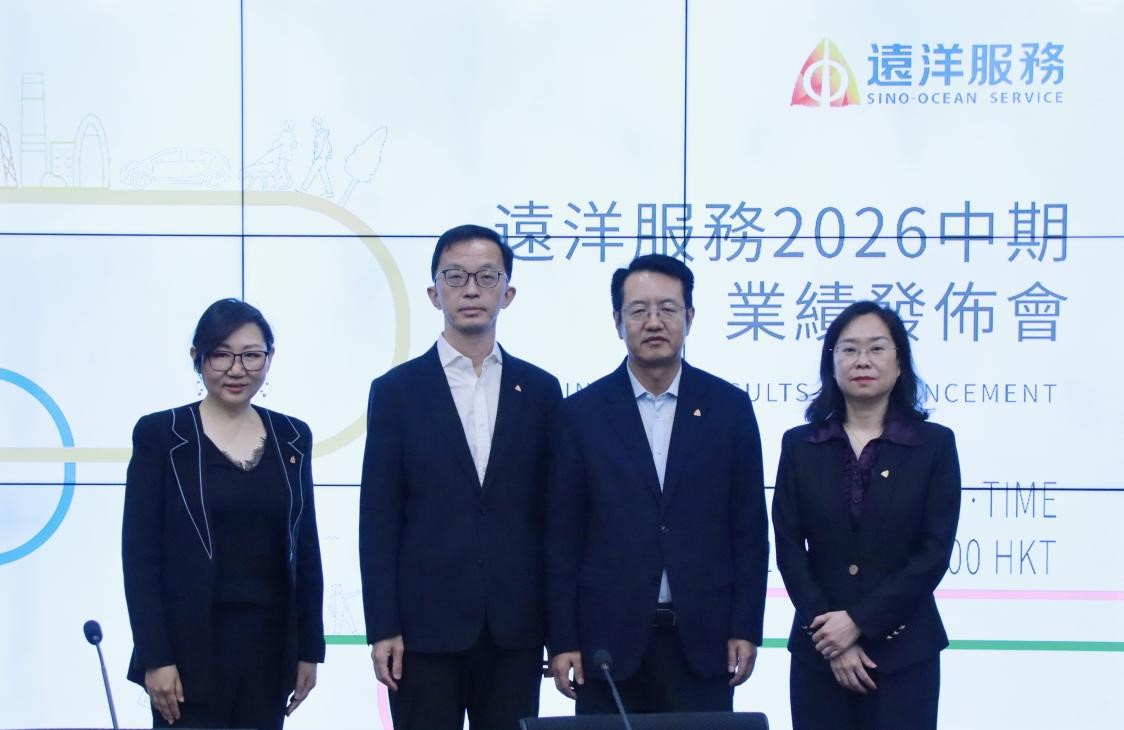
COSCO Services (06677) held the 2026 Interim Results Conference
Zhitong Finance App learned that on August 28, 2026, Ocean Service Holdings Co., Ltd. (06677) announced the 2026 interim results. Mr. Yang Deyong, Co-Chairman of the Board of Directors of Ocean Services, Mr. Hou Min, CEO, Ms. Zhu Geying, Chief Financial Officer, and Ms. Zhou Ying, General Manager of the Capital Markets Department, attended the press conference.
In the first half of 2026, Ocean Service achieved revenue of 1.29 billion yuan, with third party revenue accounting for 93.5%. Business independence continued to be consolidated, non-cyclical revenue accounted for 77.7%, and revenue stability increased significantly. Gross margin increased 3.8 percentage points year-on-year to 15.5%, and the core net profit margin to mother was 6.3%. Cash in hand was 640 million yuan, and net operating cash flow was 240 million yuan. Under strategic adjustments to actively eliminate non-main businesses and inefficient businesses, the company continued to improve its revenue quality and profitability around the four strategic directions of “main city, main project, main product, and main team”.
Focus on major cities: optimize the layout and improve the quality of development at the same time
The company focuses on core cities to strengthen brands, deeply cultivate cities to increase density, implement a “equal emphasis on scale and quality” market expansion strategy, and tilt resources towards major cities. As of June 30, 2026, the operating area of ocean services reached 84.48 million square meters. The share of Tier 1 and 2 cities remained 81.1%, and the average cost of managed properties was 2.9 yuan/month/㎡, which is at a high level in the industry. Major cities account for 77.3% of the total management scale, of which a single city in Beijing has managed an area of 11.585 million square meters, unleashing the brand effect and urban density.
In terms of external development, the company insists on prioritizing the expansion of major cities and high-quality projects. In the first half of the year, a single-year contract amount of 130 million yuan was added, an increase of 76% over the previous year; 50 new projects were added, covering 22 cities, 68% of which were located in major cities, and 25 new customers were added. The central government enterprise and government procurement customer reserve projects account for more than 50%. Customers have strong ability to fulfill contracts, stable cash flow, and prospects for continuous exploration. Major non-residential business formats such as hospitals, commercial offices, and schools were strengthened, and landmark breakthroughs were achieved during the period, and the non-residential service capabilities were widely recognized by the market.
Strengthen main projects: lead by benchmark, focus on high-quality projects
Implement hierarchical project classification management, implement differentiated operation strategies for projects at different energy levels, optimize resource allocation efficiency, and focus on leading the efficiency of major projects. Start by improving the ability to serve customers, put service into customer sensibility and sustainable relationships, and build the core competitiveness of the enterprise. Design 67 service points around the customer's entire life cycle and implement them in a hierarchical manner according to project type.
In terms of community co-creation and co-construction, 1,283 community events were held, covering 223,000 visitors. The first national table tennis competition was held in 16 cities, and more than 1,500 owners participated. Eleven projects established a tripartite collaborative governance mechanism, and the “one party member on one floor” model of Hangzhou Dahe Chenzhang became a model for innovation in grassroots governance.
Optimizing main products: business-division policies, continuous improvement of service capabilities
Strengthen product capabilities based on basic property services. The residential industry stabilizes the basic market, commercial writing and public construction businesses focus on professionalization and market-based expansion, value-added services return to the real and effective needs of customers, and digitally serve customer experience, operational efficiency and transparent management. The overall service system is committed to making services identifiable, replicable, priceable, and sustainable. Residential service standards have been fully upgraded. Focus on high-frequency customer contact points, refine service specifications around the “three major spaces and five major scenarios”, build a “core city/main project classification” matrix, create service benchmarks in a hierarchical manner; simultaneously iterate the basic service rating system to enrich the personalized product library. In terms of quality control, we promote the normalization of quality control through high-frequency quality inspection for all staff and the solidification of work order systems.
Write a complete list of services in the commercial format, and establish a standardized product system with 4 types of basic services and N menu-style optional value-added services. During the period, commercial property service revenue reached 160 million yuan, managed 73 projects, and managed an area of 6.036 million square meters, laying the foundation for large-scale expansion of the non-residential sector.
Community value-added services focused on owners' needs, restructured the service system, and restored gross margin to 39.0%. Upgrade to the home service system and launch the housekeeping reservation and group purchase module to open up the whole process of online browsing, ordering, and door-to-door visits. The standardized business system for community retail, home delivery services, and home pension updates can replicate the initial formation of a profit model.
Main team: improving the quality of talents and strengthening organizational capacity
Reshape the quality of the core team and form a stable sustainable talent pool. Management sinks to the front line and implements listening actions. Every month, middle and senior management go deep into the project to resolve specific issues to ensure that decisions are close to the front line. Expand the capacity of the project backbone, implement the “Cornerstone Plan” and “Elite Plan” to train project leaders, establish a mechanism for learning, growth and experience replication, and allow benchmarking practices to flow rapidly internally. Frontline personnel efficiency has been improved, and personnel reuse has been implemented around work scenarios. Through star ratings and training combined with a drive-through mechanism, employees are helped to grow in a stepwise manner.
Reshape the quality of operations and build long-term competitiveness
In the first half of 2026, Ocean Service replaced “quality improvement” with “increase” and structural adjustment for long-term competitiveness. The operating chassis was more solid, and the path of high-quality development became clearer. The company's overall strategy adheres to three-dimensional collaboration and integrated development, with “customer first” as the core orientation, “people-oriented” as endogenous support, and “shareholder first” as the value goal, consolidating the foundation for long-term development in all aspects. The core development ideas focus on two main lines: one is to continuously improve customer service capabilities, optimize service quality, and build core competitiveness based on high-quality customer service to simultaneously achieve comprehensive optimization of the service system, cash flow, and accounts receivable quality; the other is to use the main team, main city, and main product construction as the core gripper to innovate the resource allocation model, break the previous decentralized and averaged resource investment pattern, and promote accurate convergence of various resources, concentrate and empower core sectors to form a long-term management system with internal and external collaboration and improved quality and efficiency.