
The European stock market, which has been rising for five months, has faced a stress test! Can the semiconductor device and Halo theme led by Asmack break the “September Curse”?
The Zhitong Finance App learned that the strong rise in semiconductor equipment led by lithography giant Asmack and the “HALO effect” catalyzed a five-month continuous monthly rise, which can be described as pushing the European stock market into the latest sensitive phase of “still strong fundamentals and weakening tactics.” The Stoxx Europe 600 Index has risen 10% since this year, and the forward price-earnings ratio has risen 15 times, 14.5 times higher than the 10-year average; at the same time, seasonal weakness in the European stock market in September, the Iran war continued to push up the prices of refined oil products and natural gas, expectations of interest rate hikes by the European Central Bank, political uncertainty in France and the US, and the recovery in trading volume after the summer season may all increase market fluctuations.
Some analysts said that the European stock market's benchmark stock index, the Stoxx Europe 600 Index, supports around 640 points, indicating that the medium-term upward trend has not been disrupted, but after the benefits are gradually priced by market capital, the European market will shift from general gains to a highly volatile stock selection stage dominated by profit realization, asset quality, and position structure.
The rise in the European stock market over the past five months is not a single macro beta. Semiconductor equipment leaders such as Asmack and BE Semiconductor, a hybrid bonding advanced packaging equipment, received a super dividend on global AI capital expenditure in the first half of the year, while the “HALO effect” — heavy assets, low obsolescence (Heavy Assets, Low Obsolescence) — continued to drive capital flows to real assets such as semiconductor equipment, energy infrastructure, industry, defense, transportation, and utilities that are difficult to replace with artificial intelligence. These stocks, which have a “HALO” aura above their heads, including lithography giant Asmack and BE Semiconductor Industries NV, occupy a high weight in the European heavy asset stock market, while the weight of the US stock market is biased towards “lightweight capital” stocks.
Since July, at a time when the semiconductor sector in the global stock market has gradually recovered, the European market has become an important destination for global capital to spread the risk of concentration in US technology stocks with high entry barriers, long-term stable cash flow, and low risk of technological disruption. The European stock market is not an extremely crowded and high-beta technology index like the Philadelphia Semiconductor Index and the Nasdaq 100 Index. Instead, AI computing power growth factors are embedded into a balanced chassis of traditional high-quality industries with extremely scattered, low concentration of positions, and very high cash flow quality over a long period of time.
The five-month rise in the European stock market is facing seasonal risks. Five consecutive gains are about to hit the “September curse”
The five-month rise in the European stock market is about to face a period of difficult performance in history, and macroeconomic risks continue to accumulate at this time.
September is usually the worst performing month for the Stoxx Europe 600 Index for the whole year. Over the past five years, the index has declined by an average of 2.1% in September. This time, this seasonal pattern coincides with central banks releasing more hawkish ECB policy signals, heightened political uncertainty in France and the US, and a protracted geopolitical conflict in the Middle East surrounding Iran.
As stock market trading volume is expected to pick up after the summer trading slump is over, and after the Stoxx Europe 600 Index has risen 10% this year, the sensitivity of the European stock market to any negative news will further increase.
Violeta Todorova, a senior research analyst at Leverage Shares, one of Europe's asset management giants, said: “After experiencing a strong rise, the market may be more vulnerable to volatility. The current margin for fault tolerance in terms of profit prospects and valuation has shrunk, so investors may no longer want to ignore disappointing data or negative news.”
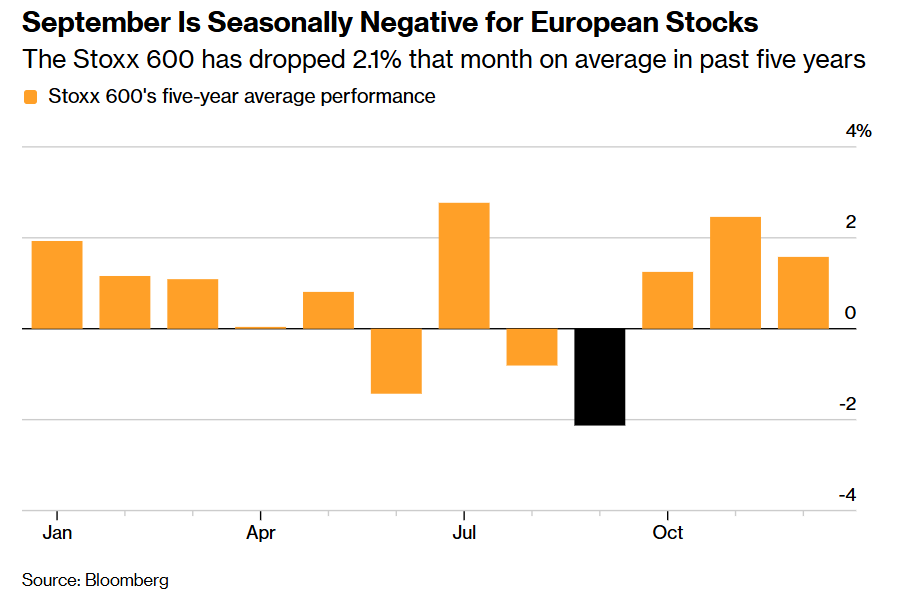
As shown in the chart above — September had a negative seasonal impact on European stock markets. Over the past five years, the Stoxx Europe 600 Index fell by an average of 2.1% in September.
Daily market trends suggest that changes may have begun. As of August 20, the Stoxx Europe 600 Index had been falling for seven consecutive trading days, almost setting the record for the longest continuous decline in ten years. Although the decline was minor, it indicates that market sentiment has begun to cool since the benchmark index hit a record high earlier this month.
Hawkish central bank policy paths and overcrowded positions could amplify fluctuations
However, for now, the overall upward trend is still intact, as the index rebounded after approaching the support level around 640 points. This shows that some investors still believe that strong corporate profits and resilient economic growth will provide a long-term boost.
Partner Alpesh Patel from RootBridge Capital said that weakening weekly momentum coexisting with a monthly upward channel “usually means that the market is absorbing previous strong gains rather than forming a top.” However, he added that investors “have every reason to be nervous, as September usually reveals a market where positive news has been exhausted and bullish positions are becoming more crowded.”
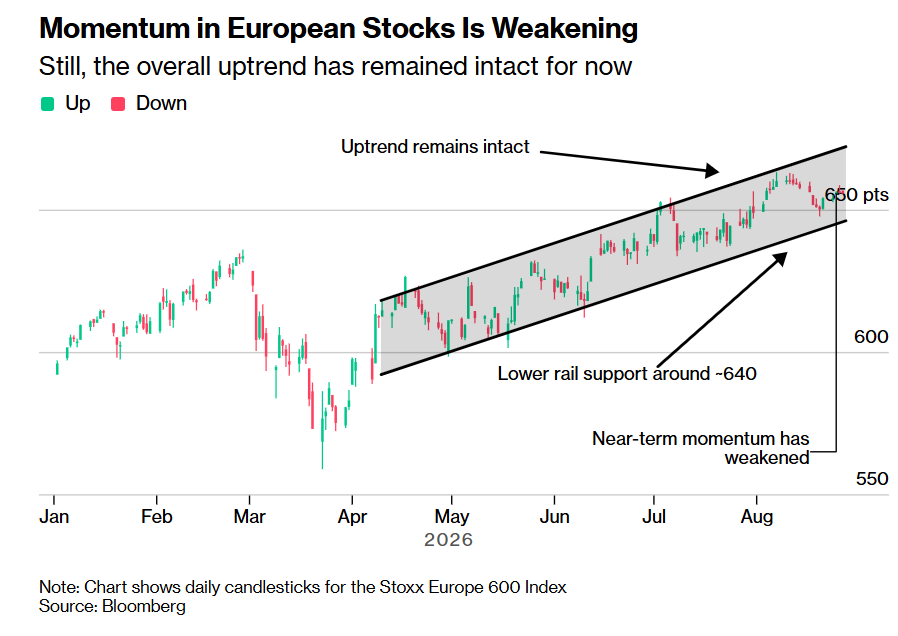
As shown in the chart above, the bullish momentum of the European stock market is weakening; however, the overall upward trend is still intact. Note: The chart shows the daily candlestick chart of the Stoxx Europe 600 Index.
One of the main risks comes from inflation and the ECB's monetary policy outlook, mainly because the war with Iran in the Middle East continues to push up oil prices. Large-scale AI spending is also expected to increase price pressure. Swap market traders have almost fully factored in the possibility that the ECB will raise interest rates next month.
Investors will get more clues at the Jackson Hole Economic Policy Symposium on Friday. Federal Reserve Chairman Kevin Walsh is scheduled to speak later today, followed by ECB Executive Board Representative Isabelle Schnabel. Schnabel said this week that since the Middle East conflict has increased the risk of rising inflation and the Eurozone's unexpectedly strong economic performance, the benchmark interest rate must rise further.
Capital inflows into European stock futures are sending bearish signals. Citigroup strategists said that although overall positions in European stocks were the strongest in developed markets on average, market sentiment “moderately deteriorated” last week. According to their data, recent capital flows were mainly driven by newly created short positions on the blue-chip EuroStoxx 50 Index and the German DAX Index.
Citibank strategist David Chew wrote in a research report: “The key tactical risks focus on the German DAX Index, where profitable long positions coexist with severely loss-making short positions, forming an asymmetrical capital flow structure.” He said, “This pattern continues to expose the market to the risk of increased volatility. The trigger may be a squeeze of bears or an acceleration in profit settlement activity.”
AI beneficiary stocks are heating up but are accompanied by hesitation, and valuation premiums have entered a period of true profit testing
Marina Zavolok, chief European stock strategist from Wall Street financial giant Morgan Stanley, believes that one of the hottest trades in the European stock market may also be showing signs of weakness. A large basket of stocks comprised of stocks benefiting from the expansion of artificial intelligence applications has risen 13% this year. The core reason is that investors are betting that record large-scale spending on this technology will drive potential operating cost savings and labor productivity increases.
However, Zavolok said that this round of rise has always been accompanied by cautious sentiment. She added: “Investors rebuying stocks benefiting from European AI capital expenditure are very hesitant and have many questions.” She cited market concerns about European economic cycles and austerity cycles.
As the Stoxx Europe 600 Index is expected to rise for the fourth year in a row, the overall valuation of the European stock market has become more expensive. According to data compiled by the agency, the current forward price-earnings ratio of the benchmark index is about 15 times, which is slightly higher than the ten-year average of 14.5 times.
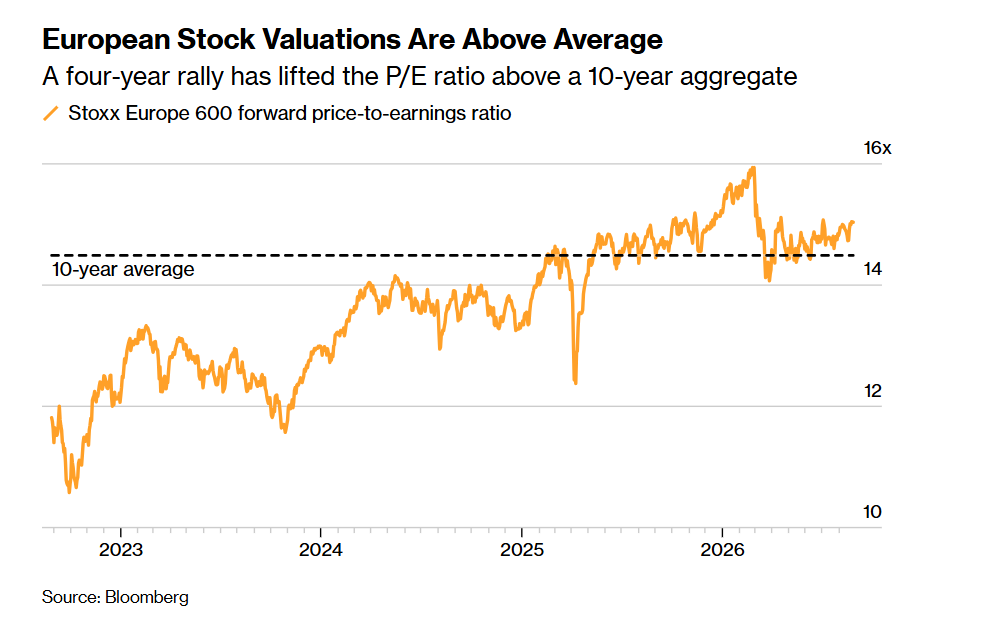
As shown in the chart above, European stock valuations are above average — four years of strong gains have pushed price-earnings ratios above the ten-year average.
Barclays Bank strategists recently warned that the US midterm elections in November could also trigger market fluctuations. A team of analysts led by the agency's strategist Emmanuel Kaur said, “A continued slow upward trend is still our benchmark scenario, but the usually volatile back-to-school season and September have always been a weak season, and a continued rebound may require the bond and oil markets to remain more calm.”