
Societe Generale Securities: The positive cycle of the new economy has broken through profits, leading the three main lines of prosperity
The Zhitong Finance App learned that Societe Generale Securities released a research report saying that profit has replaced valuation as the key to breaking the A-share market this year, and overall A profits have continued to exceed expectations. The bigger signal is that the boom is no longer focused on AI and resource products, high-end manufacturing, export chains, and some procyclical industries have taken over, and the breadth of profit recovery has reached a new high in recent years. Looking ahead to the future market, it is difficult to change the pattern where external liquidity suppresses valuation, but the high increase in profits and the expansion of the scope of recovery are the biggest source of confidence in the market this year. It is recommended to reverse the three major boom lines along the AI chain, export chain, and domestic demand, and price a wider range of fundamental restoration dividends.
Societe Generale Securities's main views are as follows:
1. Profits continued to rise above expectations
Full A's profit growth rate is expected to achieve double-digit growth in 2026. The main contradiction in the pricing of A-shares this year will also shift from valuation to profit, and profit will become the most important source of revenue for the market.
In last year's annual outlook, we were the most optimistic strategy team for this year's profit judgment, but the actual profit growth rate continues to exceed our most optimistic expectations:
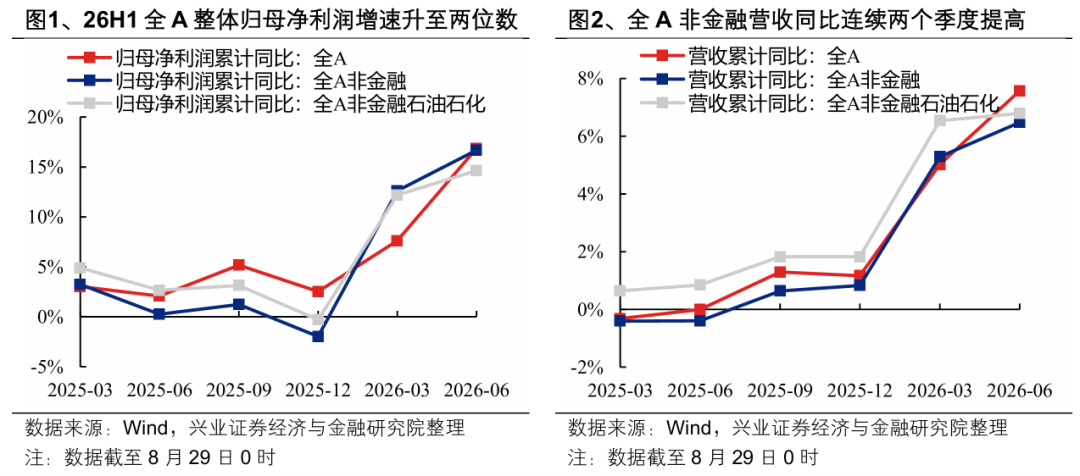
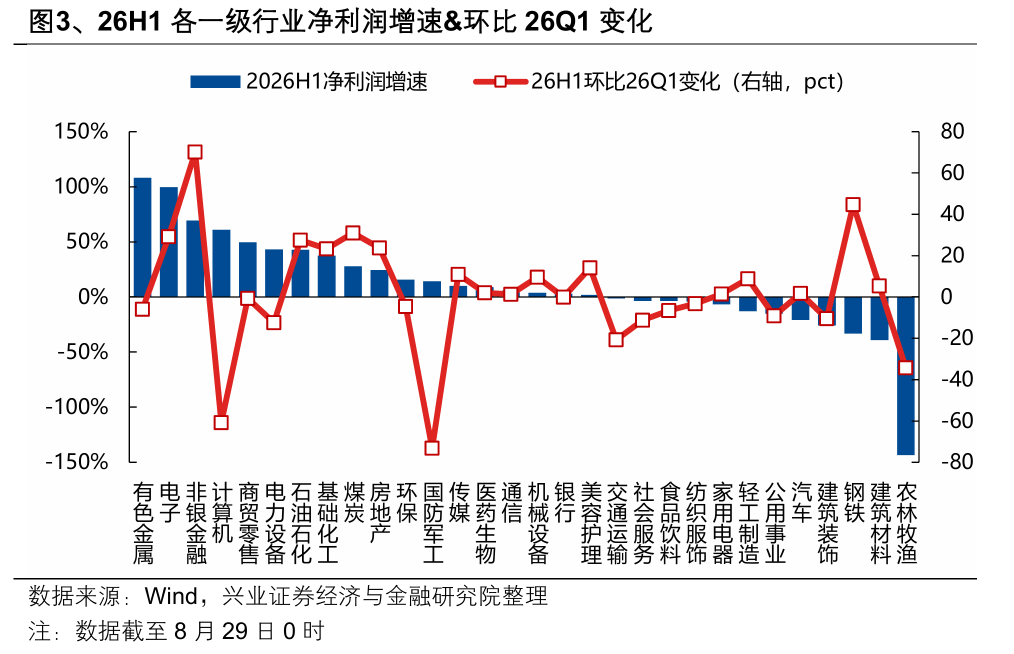
At the time of the first quarter report, full A's non-financial net profit was the first to achieve a double-digit increase of 12.61% year-on-year. However, in the interim report just disclosed, the full-A and full-A non-financial boom continued to accelerate, and profit growth rates were both in double digits: as of 0:00 p.m. on August 29, the cumulative year-on-year net profit growth rates for all A/A non-financial 26H1 were 16.86%/16.70% year-on-year, respectively, up 9.22/4.04 percentage points from 26Q1.
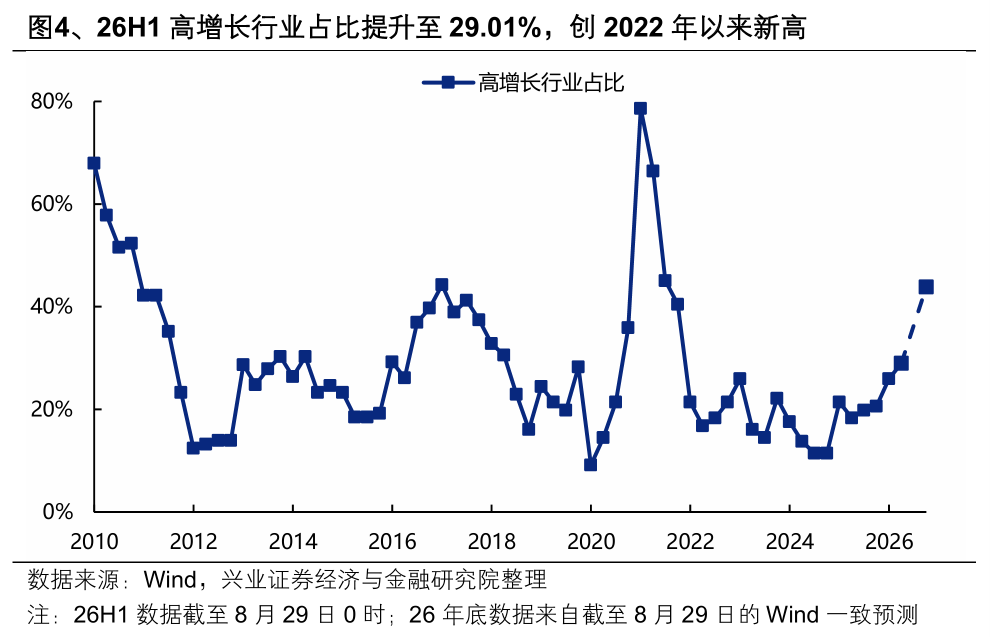
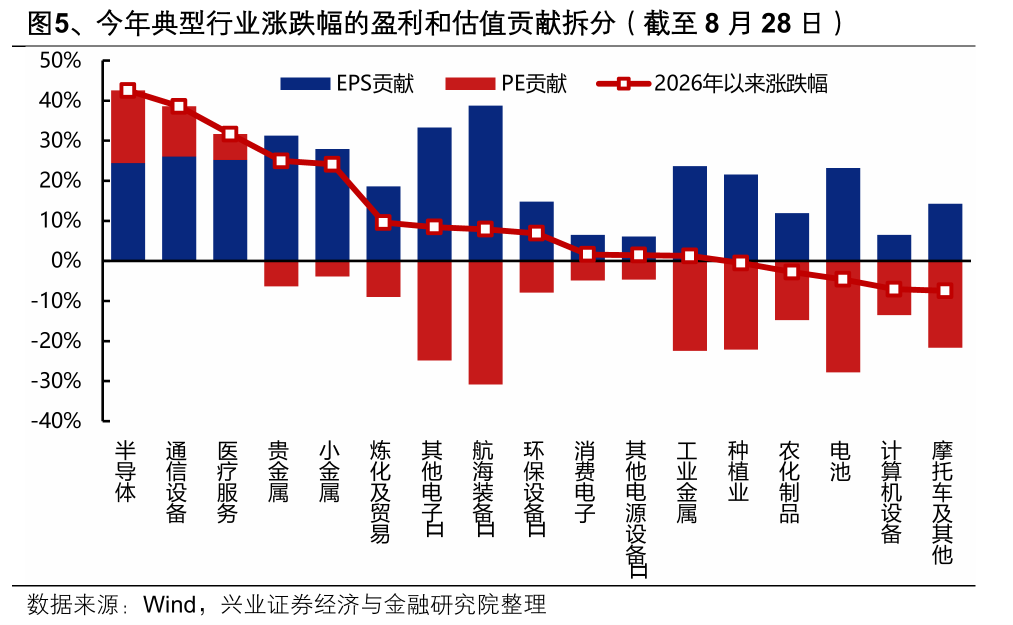
The highlight of this profit recovery is not only the growth rate, but also the increase in breadth. In this interim report, in addition to AI, TMT and resource products driven by price increases, high-end manufacturing, export chains, and some procyclical industries in a broader sense also showed signs of high profit growth or improvement. As a result, the share of the 26H1 high-growth industry (net profit growth rate > 30%) continued to rise to 29.01%, a new high since 2022.
Therefore, for this year's market, even if the tight global liquidity environment suppresses valuations, profit is still an important support for the overall stabilization of the market and the ability of some industries to break out of structural highlights. We have split the increase in typical industries since this year into profit and valuation contributions. As can be seen, valuation is no longer the main contribution, majority, or even a drag. Profit has become the main contribution to hedging valuation suppression and leading the market out of structural highlights this year.
Looking back, even if the market still faces concerns about tightening external liquidity and valuation suppression, the high increase in internal profits and the continued expansion of the scope of repair will still support the market and provide more grasped allocation opportunities. This is our greatest source of confidence in this year's turbulent market.
2. What has been verified by this year's profit recovery is that a new economic growth model is running through
Why did this round of profits continue to exceed expectations, and the breadth of recovery did not narrow as the market previously anticipated, but instead continued to expand?
The population agglomeration capacity and wealth effects brought about by the upgrading of the manufacturing industry will feed back real estate and consumer demand and bring new impetus to the growth of domestic demand.
Judging from the report data, such a path is already being interpreted. Let's summarize a few clues and paths for this round of high profit growth and economic spillover:
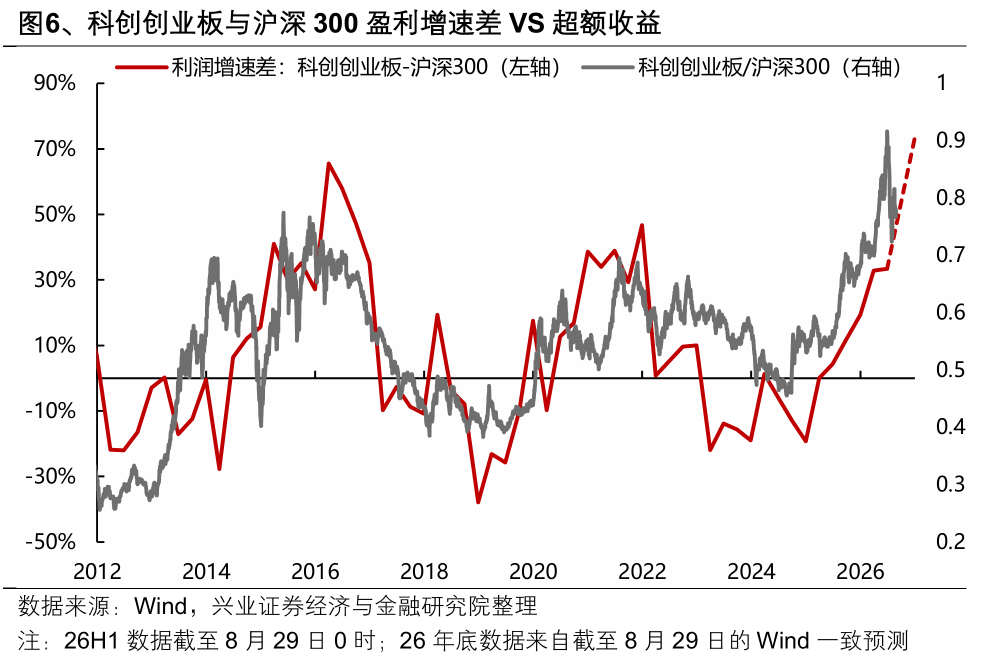
First, under the AI wave, the boom advantage of core hardware and technology assets continues: the net profit growth difference between the Science and Technology Innovation GEM and the Shanghai and Shenzhen 300 continued to rise from 32.88 pct in 26q1 to 33.45 pct in 26H1. Although the upward slope slowed after the expansion of profit recovery, the boom advantage of core hard technology assets continues in this round, and no downward inflection point has yet been seen.
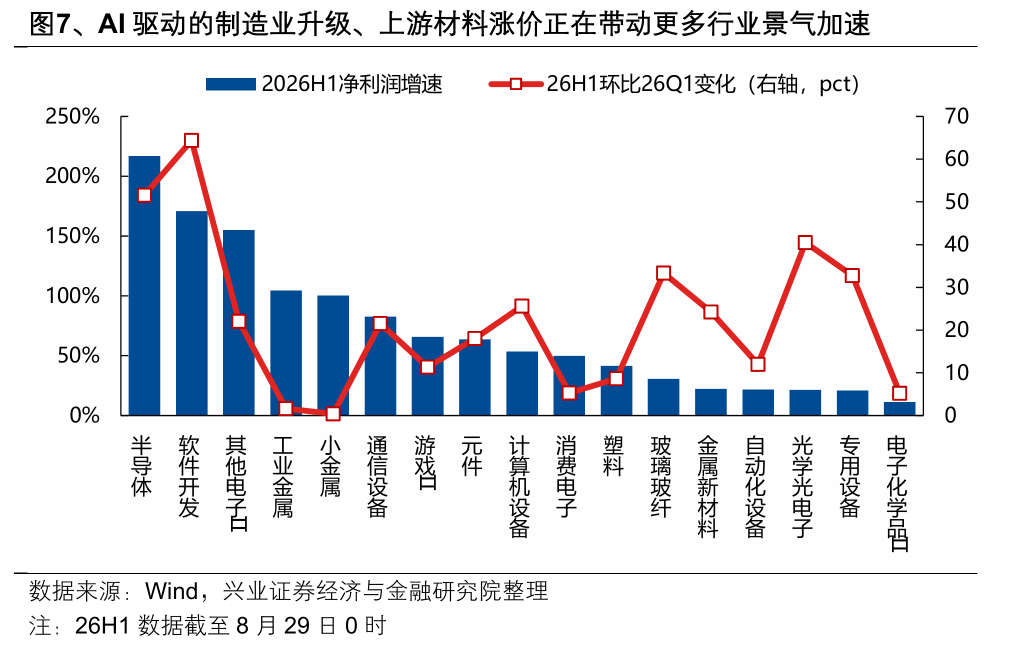
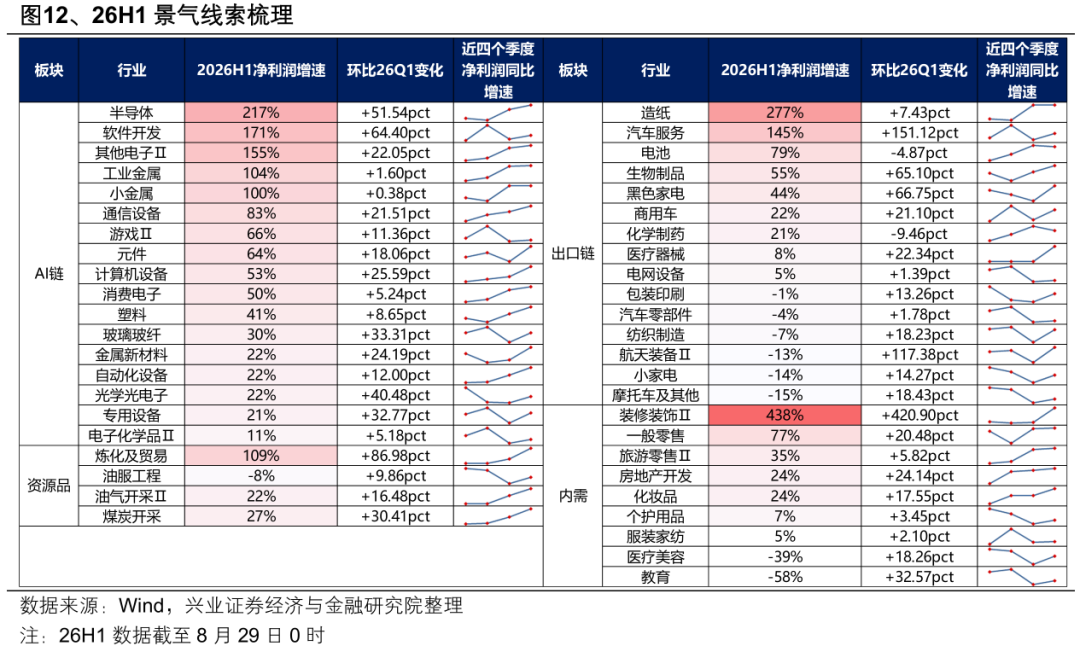
Second, AI-driven manufacturing upgrades and price increases in upstream materials are accelerating the boom in more industries: including computing power hardware (semiconductors, communication equipment, components, computer equipment), software applications (software development, games, consumer electronics), upstream equipment (automation equipment, special equipment), and upstream materials (industrial metals, small metals, plastics, glass glass fiber, electronic chemicals), etc.
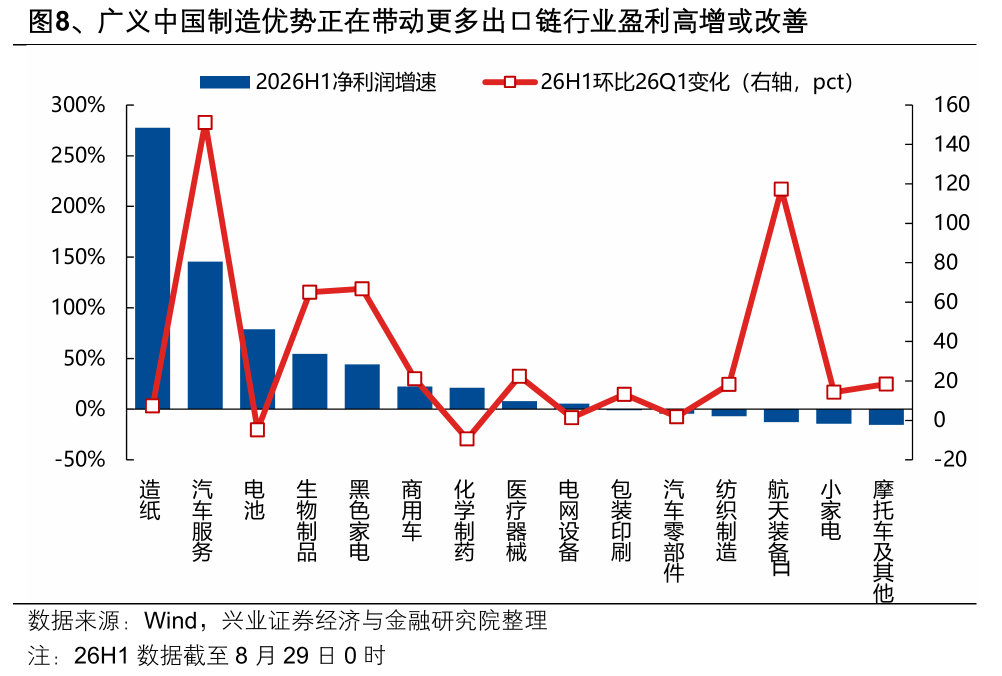
Third, manufacturing advantages in a broad sense are driving profits in more export chain industries: not only are manufacturing upgrades driven by AI, but manufacturing advantages in the broad sense are also driving increases or improvements in more export chain profitable industries such as pharmaceuticals (innovative drugs, medical devices), new energy (battery energy storage, power grids), automobiles (automotive services, commercial vehicles, parts, motorcycles), light industry (paper, packaging and printing), home appliances (black appliances, small household appliances), textile manufacturing, etc.
More importantly, these economic advantages brought about by economic transformation and the rise of new momentum are feeding back real estate and consumer demand through the transmission of population agglomeration effects and wealth effects, injecting new impetus into the improvement of domestic demand. This path has been first confirmed and reflected in some industries reported in this round:
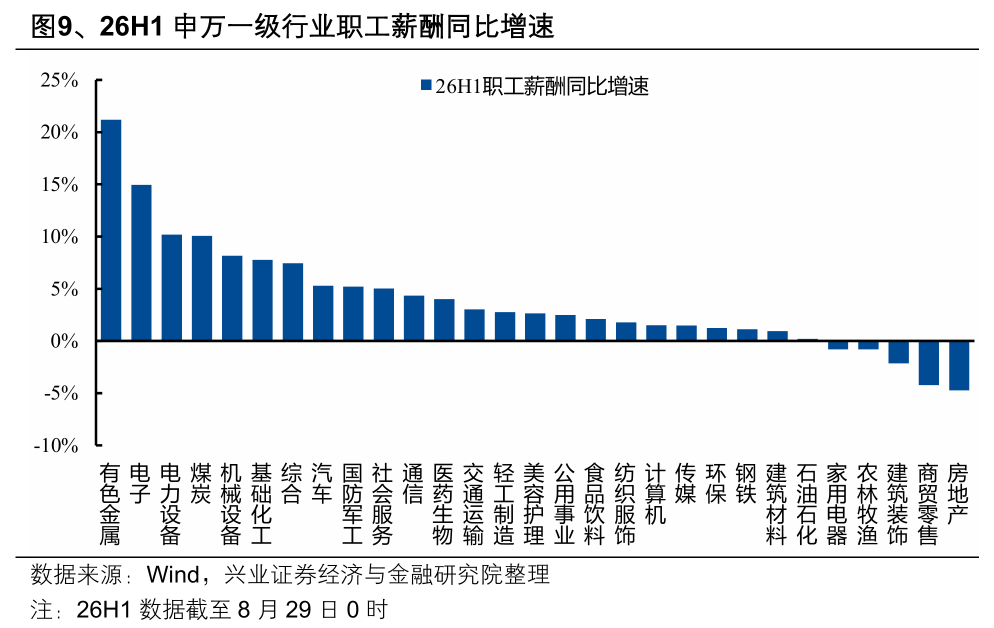
First, the year-on-year growth rate of employee remuneration in most 26H1 industries continues to rise, and the certainty of high profit growth in advantageous industries is continuously being transformed into an improvement in residents' purchasing power. Domestic industries where employee remuneration has grown rapidly in recent years are mainly concentrated in midstream manufacturing, especially advanced manufacturing. The increase in residents' purchasing power and transmission of wealth effects are taking the lead in these industries.
Second, the development of emerging industries has brought about an increase in population concentration capacity and purchasing power. “scientific content” has become a core variable affecting housing prices in various cities, and has driven housing prices in core cities to take the lead in improving. Since 2025, in 70 large and medium-sized cities, the revenue of listed companies in emerging industries accounts for a higher share of local GDP, and the overall increase in housing prices. The industrial structure is affecting urban fundamentals, attractiveness, and real estate purchasing power, thereby determining the resilience of housing prices.
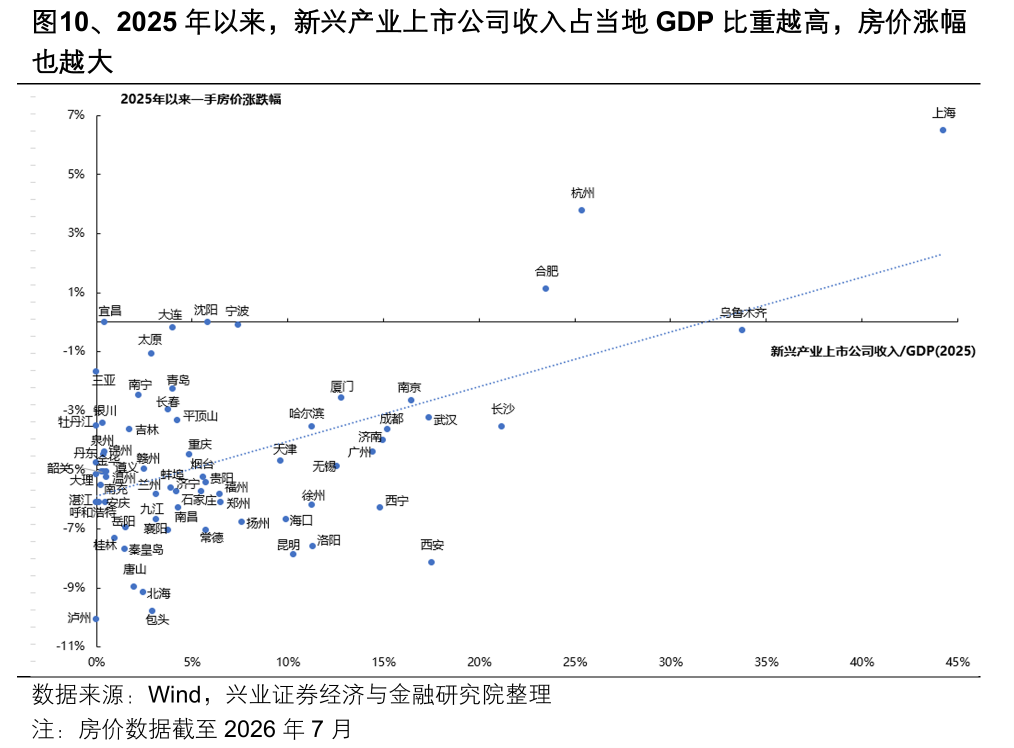
Therefore, with the transmission of wealth effects and the spillover of demand, more domestic demand industries have also shown clues of profit improvement in this interim report. Currently, this transmission path is pioneering in the real estate chain and service consumption & high-end consumption, including real estate development, retail, beauty care, education, etc.
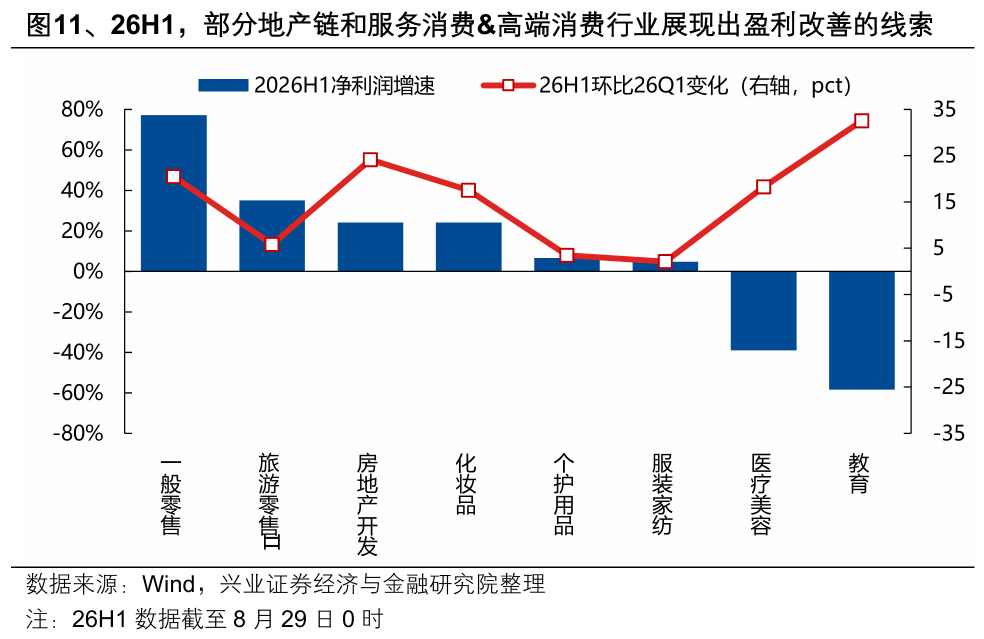
At this point, a new positive economic cycle model has been confirmed and is gradually being implemented: technology and high-end manufacturing have become the new engines of China's economic growth, while real estate and consumption have become “driven” in the later cycle under the influence of wealth.
In the future, we believe that the transmission path and boom spillover described above of “external demand drives domestic demand, and technological manufacturing drives real estate consumption” is expected to occur on a larger scale and in a wider range of industries.
And as more clues about the boom are gradually “seen” and “believed,” the market will continue to price a wider range of fundamental restoration.
3. Fundamental restoration of a wider range of pricing around boom clues
There are several clues surrounding this round of economic improvement, and pricing a wider range of fundamental repairs:
Accelerating the AI chain boom: computing power hardware (semiconductors, communication equipment, components, computer equipment), software applications (software development, games, consumer electronics), upstream equipment (automation equipment, special equipment), upstream materials (small metals, industrial metals, plastics, glass glass fiber, electronic chemicals);
Traditional export chain boom advantages: pharmaceuticals (innovative drugs, medical devices), new energy (battery energy storage, power grids), automobiles (automobile services, commercial vehicles, parts, motorcycles), light industry (paper, packaging and printing), home appliances (black appliances, small household appliances), textile manufacturing;
Reversal of the domestic demand dilemma: real estate development, beauty care, retail;
Geographically-driven price increases for resources: refining, coal.
Risk Alerts
Economic data fluctuated, policy easing fell short of expectations, the Federal Reserve's interest rate cut fell short of expectations, the geographical situation escalated, etc.