
Was Walsh's “mouthpiece” malfunctioning? Behind the huge shock in the bond market: investors are betting that the Federal Reserve is afraid to actually raise interest rates
The Zhitong Finance App noticed that bond investors from institutions such as ABN AMRO Investment Solutions and Brandywan Global Investment Management expressed skepticism about the growing market speculation that “Federal Reserve Chairman Kevin Walsh is about to raise interest rates”.
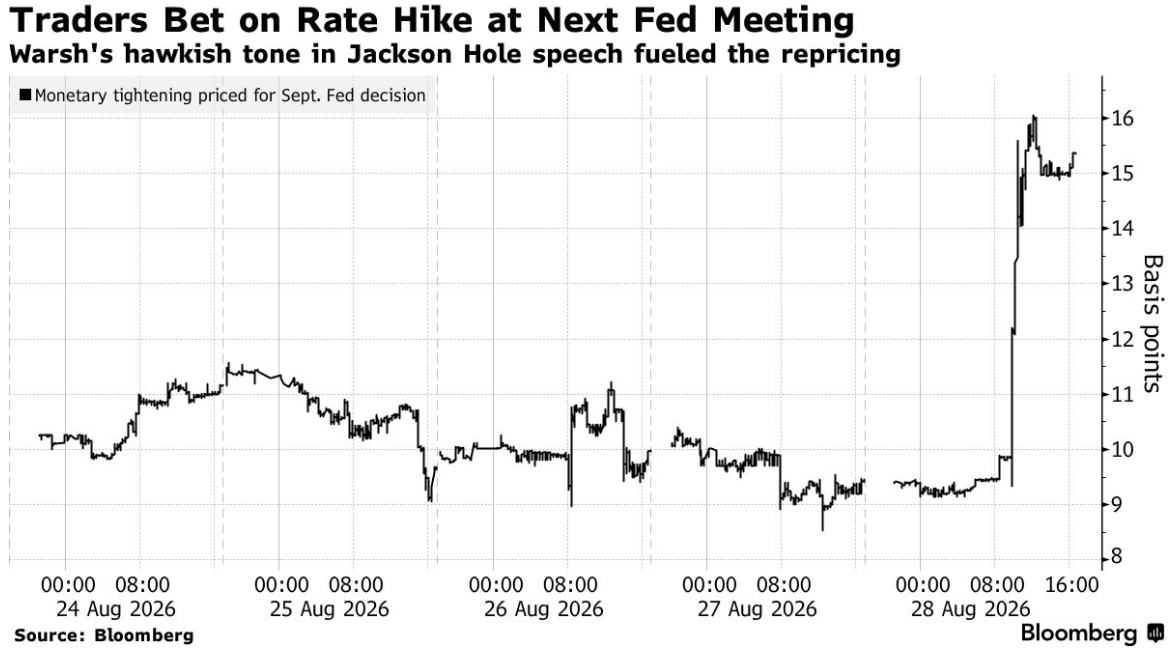
After Walsh reiterated his commitment to curb inflation in a high-profile speech last Friday, interest rate swap traders believe that the possibility that the Federal Reserve will raise interest rates at the next interest rate meeting in mid-September is over 50%. Although the final results largely depend on this week's employment data and subsequent inflation data, the policy-sensitive 2-year US Treasury yield recorded its biggest increase in more than two months.
However, despite the chairman's repeated vows to keep inflation down, his public appearances over the past few months have repeatedly caused market shocks, which has left some investors skeptical. They are preparing for the risk of “Walsh leaving interest rates unchanged again” — as he did in June and July — and this expectation further fueled market concerns about the Fed's credibility, which drove long-term yields to their highest level in about 20 years. TD Securities said on Friday that its benchmark judgment is that the Federal Reserve will stand still.
For AMRO's Christoph Buscher, Walsh's statement was not enough to convince him that policymakers would actually act. He is avoiding long-term bonds that are vulnerable to “the Fed's failure to manage inflationary pressure” fears.
The ABN AMRO chief investment officer said, “Its response mechanism is still unclear.” “If Walsh does not support the September rate hike this time and inflation remains high until then, then credibility concerns may indeed resurface.”
Since Walsh took office in May, investors have been trying to adapt to his communication style — compared to his predecessor, he provided less forward-looking guidance on interest rate policies. On Friday, the Dutch International Group (ING) stated in a research report that Walsh “is keen not to provide forward-looking guidance, but his wording is full of forward-looking guidance.”
At his first press conference as chairman in June, he committed to his promise to pull inflation back to the Federal Reserve's 2% target, appeasing investors who were worried that he would cater to US President Trump's desire to cut interest rates. The 2-year yield increased sharply, and the yield curve flattened.
In July, he triggered the opposite reaction, and the yield curve steepest since August 2025. Long-term yields climbed, and investors say he failed to provide a clear explanation for the Commission's decision to keep interest rates unchanged.
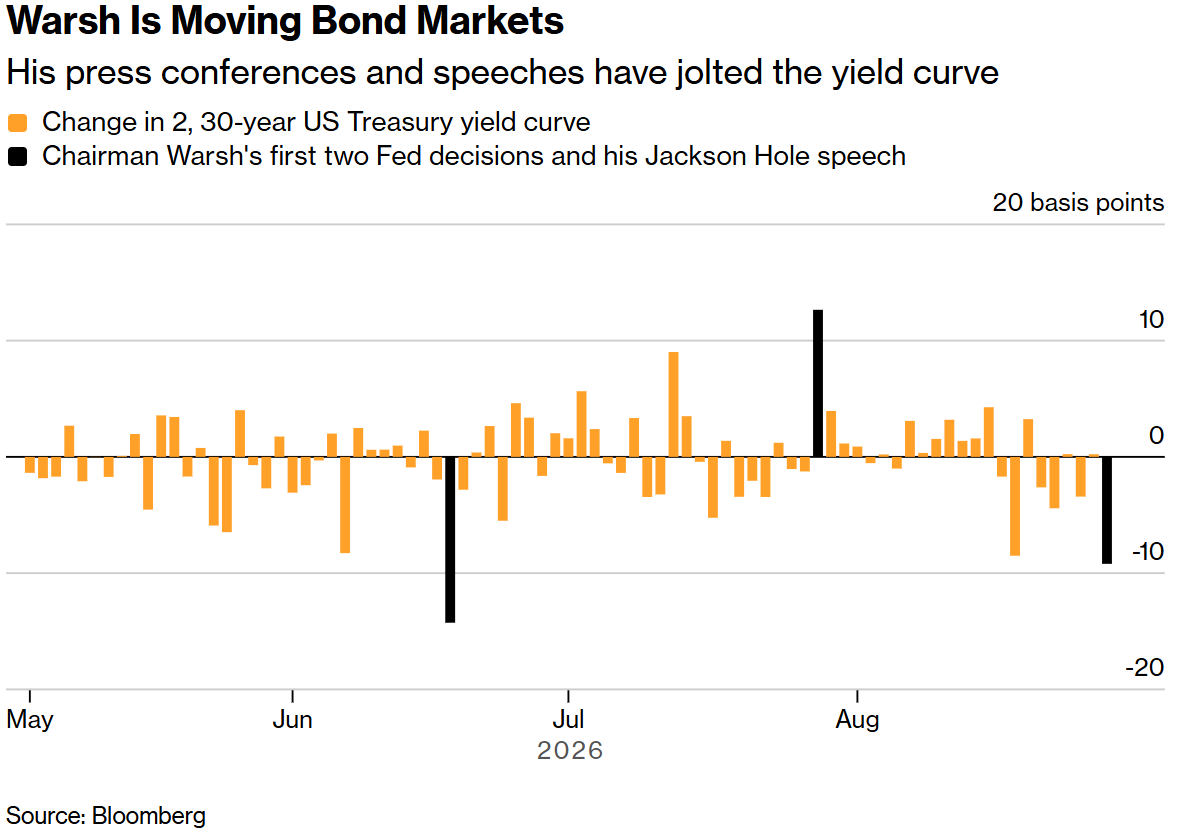
Walsh is influencing the bond market
“Just talk, don't practice”
Brandi Wan's portfolio manager Tracy Chen said last week that Walsh said what it wanted to hear about the bond market.
“But statements are statements,” she said. “Actions are persuasive.”
She insisted on a low-allocation stance on long-term US Treasury bonds, although she reduced this position after the US Treasury said this month that it would “at least double” the size of the 10-30 year stock debt it plans to buy back.
Of course, the economic data released earlier is important, especially Friday's monthly employment report — last week's data showed that in the past year up to March, US employment growth was more moderate than previously reported. Despite this, Walsh said that the US employment situation is “performing well,” and he is more concerned about price stability in the central bank's dual mission.
In this regard, the weaker-than-expected inflation report released since the Federal Reserve's interest rate decision in July proved the correctness of the standstill measure. Walsh said on Friday that although recent inflation data has improved, it is not enough to point to a meaningful trend.
The responsibilities of the Federal Reserve
George Catramboney, head of fixed income at DWS Americas, said, “There is a risk that the market continues to perform its duties for the Federal Reserve and may overestimate interest rates, yet the Fed has not implemented the action as the data softens.” “The problem is not the fact that we are above the 2% target itself, but in which direction the economy is moving.”
In his view, recent reports such as retail sales and employment did not signal a renewed economic acceleration. US Treasury bonds look “quite attractive,” he said.
Against the backdrop of questionable economic prospects and the absence of forward-looking guidance like before Walsh, interest rate swap traders are increasing their hedging for next month. Currently, the probability of interest rate hikes taken into account is about 60%.
Goldman Sachs Group researchers, including George Cole, said, “If there is no clear and moderate inflation news, follow-up action will be critical.” “If September is viewed as an evenly balanced choice, and the Federal Reserve once again remains on hold without a clear explanation, then there is a great risk that the yield curve will repeat the trend after the Federal Open Market Committee (FOMC) meeting in July.”
Strategist Edward Harrison said, “If the Federal Reserve actually follows up with interest rate hikes, a continuation of the initial market reaction — that is, a flat bear market — will be a likely outcome. However, given that the 30-year yield initially declined under Walsh's hawkish statements, this indicates that the credibility of the Federal Reserve has strengthened. Ultimately, this can support long-term fixed income assets by driving both actual yield and break-even inflation down.”