
2026 Mid-Report Nuggets: Delivery revenue in the same city increased by 24.4%, orders increased by more than 30%, and SF Express Tongcheng (09699) is eating the biggest dividend of trillion yuan in instant retail
When China's instant retail market officially broke through the trillion dollar threshold in 2026, a hidden racetrack is being repriced.
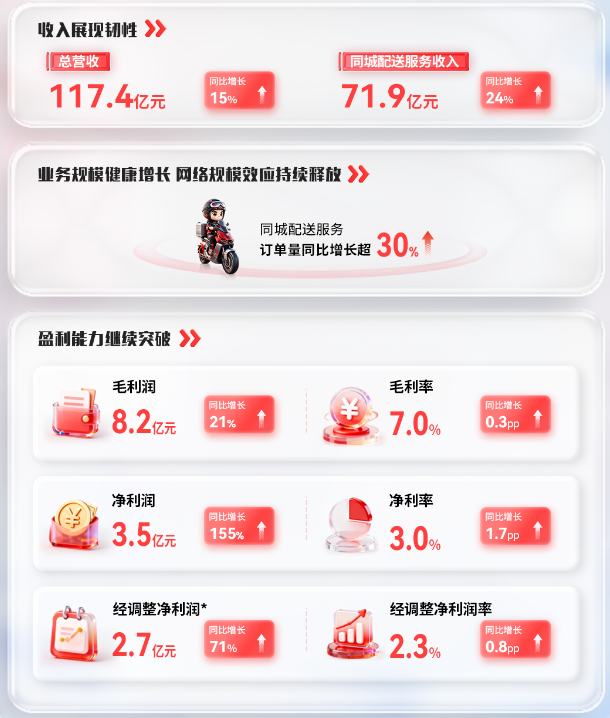
In this trillion dollar market with an average annual growth rate of 12.6%, SF Express Tongcheng (09699) handed over a very convincing answer — in the first half of the year, the company achieved revenue of 11.740 billion yuan, an increase of 14.7% year on year; net profit of 349 million yuan, a sharp increase of 154.9% year on year. Since the first profit was made in 2023, it has been the seventh consecutive cycle of the company's profitability, and profitability has continued to break through.
If the continued positive performance is a quantitative demonstration of operating capacity, then the HK$400 million repurchase is SF Express's public statement on long-term value.
SF Express Tongcheng launched a subsequent H-share repurchase and cancellation plan with a maximum limit of HK$400 million. All capital comes from the company's own cash flow. As far as the Hong Kong stock market is concerned, this type of substantial repurchase is not only a direct proof of an enterprise's abundant cash flow and a sound financial base, but also increases earnings per share and return on net assets through repurchases and cancellations, conveying a long-term commitment to shareholder returns to the market.
As can be seen, while the industry is still struggling with the inertia of burning money and expanding, SF Express has used continuous profits and large repurchases, sending a clear signal to the market: the company's value is far from being fully priced in the current valuation.
Trillion racetracks, 10 billion dollars in revenue, continuous doubling of profits, and repurchases of 400 million real money... When these factors are superimposed on the same company, what the market needs to re-examine is not only the investment value of SF Express itself, but also the strategic coordinates of immediate delivery by third parties within the trillion dollar retail landscape. From “distributors” to “new consumer infrastructure,” the value of SF Express in the same city is facing a revaluation window.
Multi-scenario resonance to establish long-term growth logic
For SF Express Tongcheng, continued growth in performance is not a short-term dividend of a single track, but rather a long-term result brought about by multi-scenario resonance as restaurants and non-food go hand in hand, the B-side and C-side break down at the same time, and new businesses continue to expand. The explosion of single orders depends on nodes, and the momentum for continued growth depends on the global layout.
The consumption calendar for the first half of 2026 was extremely intensive — the 618 promotion, the World Cup, and the Dragon Boat Festival were superimposed, and demand for multiple scenarios such as home procurement, game viewing economy, cultural tourism travel, and holiday gifts was released centrally. Driven by multiple consumer dividends, SF Express's financial performance in the first half of the year reached a new high. On the one hand, demand for food and beverage takeout and instant retail remained resilient, and the number of delivery orders in the same city increased by more than 30% year-on-year, driving the increase in revenue scale; on the other hand, relying on neutral and open third party positioning and ability to fulfill contracts across all scenarios and categories, enterprises maintain stable cooperative relationships with multi-level customers.
Behind the boom in orders, SF Express has built a stable stock of basic markets from catering and non-catering two-wheel drives in the same city.
On the catering circuit, as the domestic restaurant chain rate has climbed to 25%, the Wandian brand continues to expand, and the demand for unified omni-channel implementation and standardized services is becoming more and more urgent. SF Express is deeply tied to many leading restaurant brands. More than 4,300 partner stores were added during the reporting period. The cooperative market share of several leading customers remained leading and continued to increase, and the cooperative revenue of several high-potential fast food brands grew rapidly. Revenue from the tea and beverage category has maintained a high growth rate, and the “ballast stone effect” of the basic catering market continues to be evident.
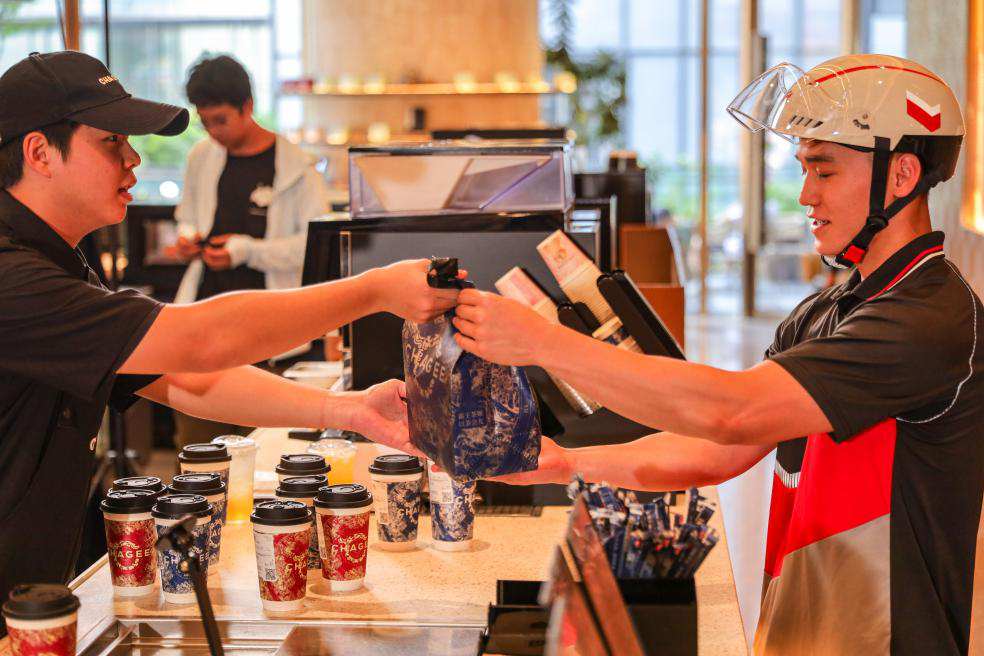
More momentum for growth comes from non-food racing tracks. Along with the continuous expansion of China's instant delivery industry and the accelerated evolution of the ecology, non-food orders in the industry have rapidly expanded. In this context, SF Express Tongcheng continues to iterate on “front warehouse+instant delivery in the same city” supermarket solutions, such as cooperating with head front warehouse customers while continuing to expand the chain Lightning warehouse customers to cover high-frequency consumption needs throughout the reporting period. The revenue of the supermarket industry increased by more than 50% year-on-year during the reporting period, and non-food categories such as beauty and fresh food products achieved impressive growth.
The sinking market also unleashed growth. Currently, SF Express's service network in the same city has covered nearly 2,400 cities and counties across the country, of which more than 1,500 have sunk down. As a core distribution partner, the company helps chain brands explore the sinking market, and further explores dominant local brands, and continuously optimizes network layout and operation efficiency by penetrating closed scenarios such as campuses and industrial parks.
In addition to consolidating the existing chassis, SF Express's full B-side link upgrade and C-side traffic breakers are also simultaneously broadening the boundaries of business growth.
On the B-side, SF Express Tongcheng is upgrading from a “capacity service provider” to a “full-link catering operation partner”. During the period, the company further deepened the integrated back-end service of cleaning and closing, extending the service from front-line delivery to store logistics operations. For example, in response to the cleaning characteristics of different business formats such as Western-style fast food and tea, SF Express Tongcheng has formed a “unified underlying standards+one store, one policy customization” model and launched three types of services: all-inclusive, half-package, and single-region. With mature implementation methodologies and digital control systems, services can be replicated and quality can be traced, leading to a significant improvement in the cleaning efficiency of partner stores.
Currently, SF Express Tongcheng has carried out cooperation or project verification with more than 10 chain brands, covering various business formats such as Western-style fast food, tea, and coffee. Relying on personnel scheduling and standardized delivery capabilities accumulated over ten years of delivery, the “delivery+store operation” integrated program created by SF Express in Tongcheng has not only deepened ties with leading customers, but also opened up a new revenue growth track.
On the C-side, SF Express's traffic entrances in the same city were broadened by leaps and bounds. As one of the first ready-to-use service providers to connect to Alipay and WeChat's AI ecosystem, SF Express has achieved a minimalist interaction of “one sentence called running errands”, drastically lowering the service reach threshold. Exclusive delivery services have steadily increased in the coverage of cities, and revenue from core categories such as cakes, flowers, and fresh food has all achieved high double-digit growth. Innovative scenarios such as unmanned vehicle freight transportation and cultural tourism delivery continue to be implemented, filling the gap between “small errands and large trucks” in the same city.
In addition to this, SF Express's “last mile” business in Tongcheng has also penetrated deeply into the logistics market in the same city. Relying on a flexible and flexible capacity network, the business gradually expanded from simple delivery to multiple scenarios such as door-to-door collection and same-city transit, expanding the business layout from immediate delivery to a wider logistics circuit in the same city. At the peak of 618 express delivery, flexible capacity gave full play to the role of cutting peaks and filling valleys, and maintained steady growth in last-mile revenue in the e-commerce scenario; at the same time, it continued to develop new customers and inject new momentum into long-term growth, relying on customized products and capacity matrices such as cold chain, bulky items, and four-wheel delivery.
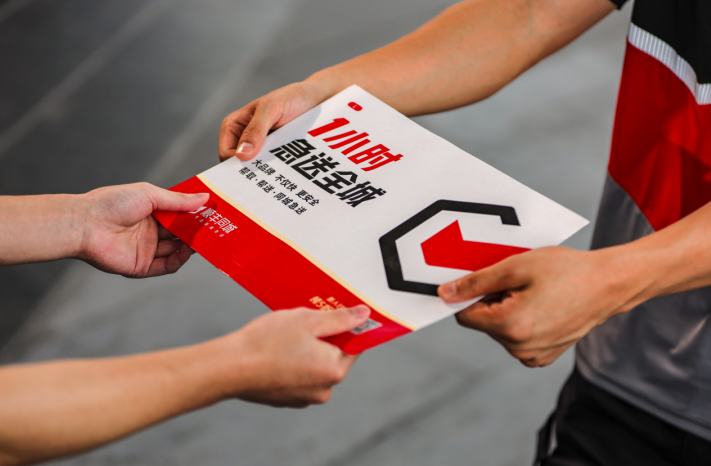
As can be seen, with catering and non-food services going hand in hand, the B-side and C-side breaking down at the same time, and the continuous expansion of new businesses, SF Express Tongcheng has undoubtedly also successfully opened up incremental space from trillion dollars of instant retail and has broken out of the growth ceiling of the traditional takeaway business.
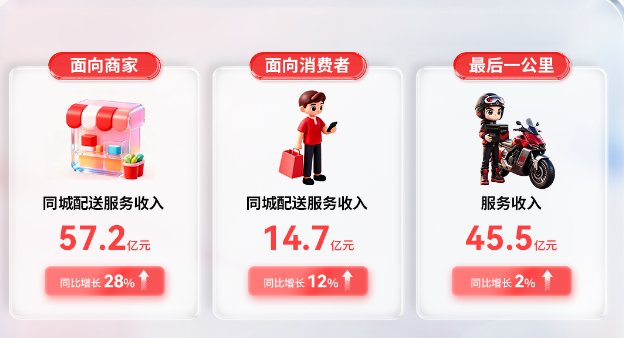
Numbers are the best litmus test. During the reporting period, SF Express achieved healthy growth in the revenue of various business lines in Tongcheng. The revenue from distribution services in the same city was 7.189 billion yuan, up 24.4% year on year; last-mile service revenue was 4.551 billion yuan, up 2.1% year on year. Furthermore, as of June 30, 2026, the number of active consumers in the company exceeded 27.03 million, and the number of annual active merchants reached 1.23 million, an increase of 44% over the previous year.
“Multi-scenario resonance” is not a simple business superposition, but a systemic resonance of full-scenario compliance capabilities, neutral third party positioning, and scale effects. It is this global collaborative business advantage that allows SF Express Tongcheng to completely break through the growth shackles of traditional takeout, deeply penetrate the trillion-dollar instant retail circuit, and continue to explore incremental dividends in all categories, regions, and scenarios.
The commercialization of AI+ unmanned delivery opens up more profit margins
If the global layout and multi-scenario resonance have established a basic market for revenue growth for SF Express, then large-scale commercialization of AI+ unmanned delivery has opened up a new space for SF Express to reduce costs, increase efficiency and expand profits over a long period of time with technology as the core leverage.
On the one hand, after years of refinement, AI scheduling has evolved from an “auxiliary tool” to an “infrastructure”, building a strong technical foundation for SF Express's large-scale expansion in the same city.
At present, the AI intelligent dispatching system has become an indispensable technical foundation for SF Express in the same city. After years of iterative refinement, the company's self-developed urban logistics system CLS continuously optimizes core modules such as order distribution, rider scheduling, and business district operation, and can also customize scheduling strategies for differentiated scenarios such as commercial oversized parts and multi-model delivery. At the same time, relying on big data and AI algorithms, the system can predict changes in global order density and adjust the capacity matching plan in real time based on business district traffic and rider dynamics. Faced with “order tsunamis” such as 618, the scheduling system can still smoothly handle large-scale fulfillment requirements and establish a strong technical foundation for the continuous large-scale expansion of the business.
On the other hand, with the support of a mature AI scheduling system, SF Express's unmanned delivery business in the same city has passed the trial stage and has begun large-scale actual operation.
According to information, SF Express's unmanned delivery in the same city is speeding up from the pilot phase of “one network, one line” to a critical window of large-scale operation of “one city, one network”. As of the first half of 2026, the SF Express Tongcheng unmanned vehicle network has covered 124 cities across the country, operating more than 1,000 vehicles, and an average of more than 60,000 active trips per month. The scale of unmanned vehicle applications continues to expand in “last mile” delivery scenarios such as same-city connections and network distribution, as well as instant delivery scenarios in the same city such as restaurants and campuses.
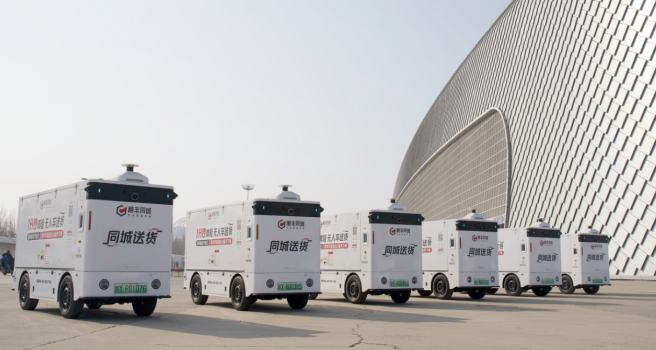
During the reporting period, the company also piloted an unmanned vehicle capacity sharing service, opening unmanned delivery capabilities to merchants and consumers, and improving vehicle utilization efficiency through shared capacity pools. Unmanned capacity has the characteristics of 7×24 hours of uninterrupted operation. As an elastic capacity resource, it can adapt to small-batch, high-frequency flexible supply chain requirements, take on scenarios where traditional human capacity is difficult to cover, such as nighttime delivery and regional delivery with low passenger flow, and provide support for the implementation of various innovative business scenarios.
In addition to this, the implementation of a full link of technological capabilities is also bringing the double benefits of cost reduction and business expansion to SF Express in the same city.
Specifically, SF Express Tongcheng has completed the construction of a full-scenario intelligent penetration system: for merchants and consumers, it is the first to connect to mainstream AI agents such as WeChat “Xiaowei” and Alipay's “Abao” to achieve minimalist interaction of “in one sentence”; for riders, the three major agents of planning, execution, scheduling, and customer service; on the organizational efficiency side, AI has covered business processes such as contract review, financial reimbursement, and BD Toker.
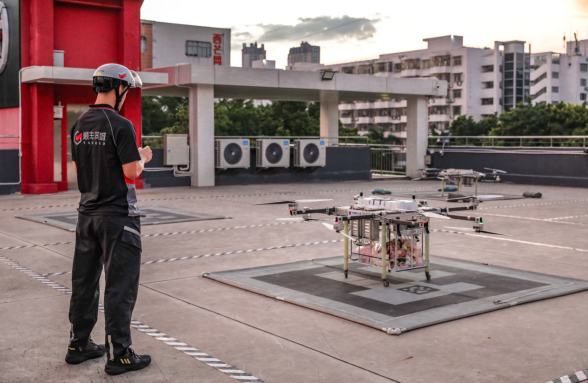
The more profound value is that AI+ unmanned vehicles are reconstructing the entire logistics link — freeing delivery agents from high-frequency and inefficient transfers to focus on customer service; eliminating scheduling bottlenecks and nighttime delivery pressure with all-weather capacity. As unmanned delivery networks continue to expand and operating density gradually increase, the cost reduction and efficiency advantages brought by wider application scenarios and large-scale operation will push unit fulfillment costs into a downward channel and release continuous profit flexibility.
And technology investment is also shifting from a “cost item” to a “profit engine.” In the first half of 2026, the company's gross profit was 823 million yuan, up 20.9% year on year, and gross margin was 7.0%, up 0.3 percentage points year on year. The application of AI technology drives front-end customer acquisition and back-office investment to improve quality and efficiency throughout the whole chain, which is one of the core driving forces for effective profit release.
Summarize
In summary, SF Express's continuous multi-cycle profit verification is no longer a phased market, but rather the result of long-term accumulation of global compliance arrangements and neutral third party positioning. As a scarce third-party listed company focusing on Hong Kong stocks, it can handle multi-polarized traffic with full-scenario capabilities and integrate “warehousing+transport+delivery” into retail infrastructure — this independence is both an irreplaceable moat and a fundamental source of scarcity premiums.
And the value of its growth goes far beyond that. In the short term, the overall scenario is balanced, the basic catering market is stable, non-food and e-commerce products are growing rapidly, and performance certainty is strong; in the medium term, B-side full-link services and new C-side scenarios continue to break through, the revenue structure is constantly being optimized, and growth space is gradually opening up; in the long run, large-scale implementation of AI and unmanned delivery will drive the continuous optimization of the cost structure and the profit model into an accelerated fulfillment channel.
Short-term performance has bottomed out, medium-term structure has evolved, and long-term efficiency has changed — the triple logic is progressive, and the 400 million repurchase plan has now built a solid valuation safety cushion. But even so, the scarce attributes of third-party leaders, and the growth dividends contained in the trillion-dollar instant retail circuit, are far from being fully priced in current valuations. As profit quality continues to be verified by the market and the value of technology cost reduction gradually becomes apparent, the company is expected to experience both performance growth and valuation repair.