
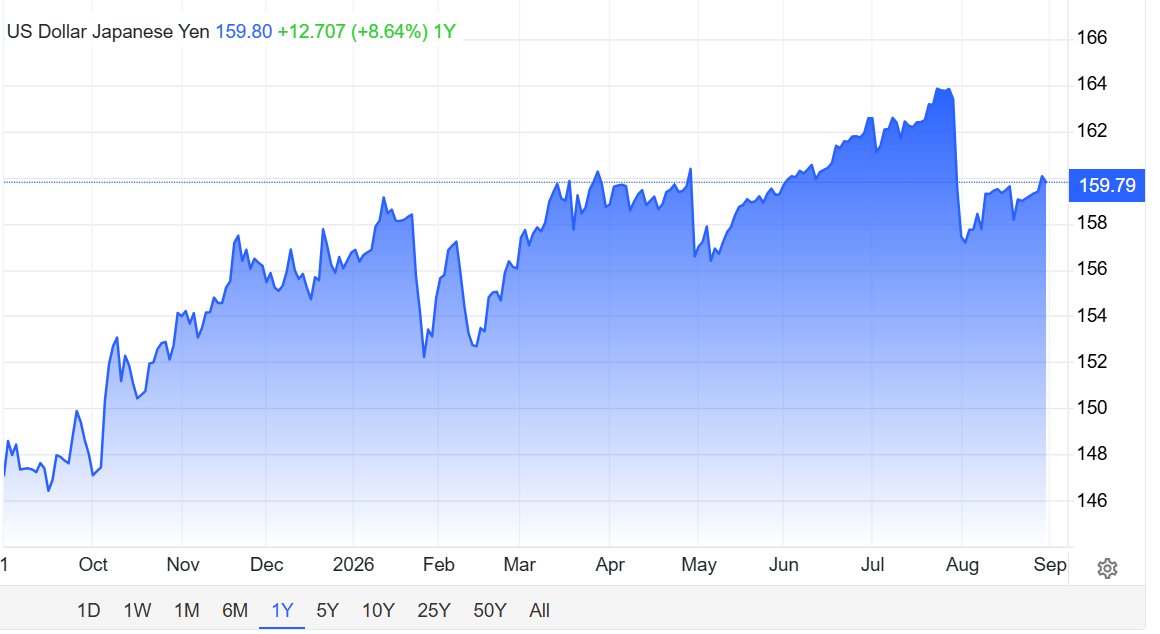
The yen broke 160 again, and Washington refused to release a signal of further intervention! The yen trading anchor turned to the September central bank meeting
The Zhitong Finance App learned that after the US and Japan boosted the yen with joint intervention measures on July 31, the yen once rebounded from about 163 to around 155, but then continued to regain gains, and depreciated again to more than 160 yen per dollar last Friday. In an interview on Sunday, US Treasury Secretary Bessent said that the yen exchange rate trend is “quite controlled” and is not “disorderly fluctuating”; in essence, it is an endorsement of the market's operation order rather than an endorsement of the strength or weakness of the yen. This also means that 160 points are not a fixed red line that automatically triggers intervention. The policy response function places more emphasis on the speed of depreciation, unilateral speculation, and the risk of contagion to Japanese treasury bonds and global financial markets.
As a result, the urgency of another joint intervention between the US and Japan has declined. The real line of defense for the yen has turned to the September 17-18 Bank of Japan meeting and subsequent interest rate hikes. In other words, after expectations of short-term intervention cool down, the Bank of Japan monetary policy meeting in September and whether to switch to quarterly interest rate hikes in the future will dominate the repricing of the yen.
Wall Street's biggest financial giants agree on the yen exchange rate that “intervention can only change the trend if it takes time to buy” — that is, the enduring appreciation of the yen requires the Bank of Japan to speed up normalization, a fall in the Federal Reserve's interest rate/US bond yield, or the return of Japanese capital to local assets; however, there is no consensus on the exact point.
Bank of America expects the dollar to fall to 149 against the yen by the end of the year, and Citi expects it to fall to 155; Morgan Stanley believes that the current fair value is still 165-167, but will gradually rise to 155 as the US interest rate environment changes; Goldman Sachs's target for the previous 12 months was 165, and J.P. Morgan Chase's forecast for the fourth quarter was 164.
Bezent says the yen's trend is “quite controlled” and is not fluctuating in a disorderly manner
US Treasury Secretary Scott Bessent said late on Sunday that the recent yen exchange rate trend is “quite well controlled,” which indicates that another decline in the yen was not viewed as the kind of disorderly fluctuation that prompted the rare joint intervention of Japan and the US last month.
The yen fell below the 1 dollar to 160 yen mark on Friday; this threshold is widely believed by investors to increase the possibility of intervention, and the market is therefore closely watching whether the US and Japan can step up the yen again.
In an interview with the media on Sunday, Bessent also said that when asked if the Bank of Japan should consider continuous interest rate hikes to contain the fall of the yen, he expects Bank of Japan Governor Ueda Kazuo to “do the right thing” in monetary policy with the support of Prime Minister Takaichi Sanae.
“I'm not going to tell them what to do,” Beisent said when asked if the Bank of Japan should be more aggressive in raising interest rates. “What I'm saying is that I do think we may have reached the end of Abenomics; Abenomics is a policy plan aimed at driving Japan's economy to re-inflate.”
Abenomics was launched in 2013 during the administration of the late Prime Minister Shinzo Abe. It aims to free Japan from long-term deflation through a combination of large-scale monetary stimulus based on zero or even negative interest rates, huge fiscal spending, and measures to enhance Japan's growth potential.
Bessent said he plans to meet with Kazuo Ueda during a two-day meeting of G20 finance officials. The conference will open Monday in Asheville, North Carolina.
Shifting from “Abenomics” to “high market economics,” did the Bank of Japan's interest rate hike in September become a real line of defense for the yen exchange rate?
“I've known him for 15 years. He is a brilliant economist. I think people have underestimated his market acumen,” Bezent said of Bank of Japan Governor Kazuo Ueda.
When asked if the yen was still fluctuating in a disorderly manner, Bezent answered, “Oh, no. I think the situation is pretty well controlled.”
Japan and the US implemented a rare joint intervention to buy yen on July 31, showing the determination of both sides to stop the sale of yen and Japanese treasury bonds and prevent their risk from spilling over to global markets.
Bessent's calm judgment on the yen contrasts with his statement when he confirmed the joint intervention of Washington and Tokyo a month ago; at the time, he described this action as being aimed at dealing with “disorderly” fluctuations in the exchange rate.
The weak yen has become a difficult issue for Japanese policymakers by driving up import prices and overall inflation. Part of the reason is blamed on the Bank of Japan's slow pace of interest rate hikes, which has kept the interest rate gap between Japan and the US high.
Bezent's remarks about the Bank of Japan come at a time when the central bank is about to hold a much-publicized monetary policy meeting on September 17 and 18. People familiar with the matter previously revealed to some media that the Bank of Japan may raise interest rates as early as September, and is considering continuing to raise interest rates at a more aggressive rate of about twice a year thereafter.
Bezent has called on the Bank of Japan to raise interest rates many times in the past. This is also one of the factors that prompted the market to almost completely take into account the probability of interest rate hikes in September; if interest rates were raised at that time, it would be another action following the June rate hike.
Some analysts say that if the Bank of Japan raises interest rates in September instead of October, it may strengthen the market's bet on raising interest rates once a quarter rather than maintaining the current pace of about twice a year.
Kazuo Ueda said last month that the Bank of Japan will focus on rising inflation risks; if the financial environment is considered too relaxed, it is not ruled out to increase the pace of interest rate hikes.
However, the Bank of Japan's hawkish communication failed to establish a sustainable and effective bottom for the yen.
Shareholder-friendly meets high pressure in the bond market: fiscal expansion collides head-on with monetary austerity
Bezent defines the current trend as “controlled,” meaning that whether to intervene again depends on the degree of market disorder rather than the single price of 160. However, foreign exchange intervention can only delay depreciation; whether interest rate hikes can be accelerated and the Japan-US spread narrowed is the core variable that determines the trend of the yen.
In an interview with the media late on Sunday, Bezent said that Japan has “overcome” deflation and switched to “Takaichi Economics” under Prime Minister Takaichi Sanae's leadership, so Japan can now enjoy the results brought about by past economic revitalization policies.
According to Beisent, “high market economics” is more shareholder-friendly, especially when large-scale deregulation has been implemented in the labor sector, which means that government intervention has been reduced.
“I think they should wait and enjoy the success of Abenomics so that its effects can continue to play,” Beisent said of his recommendations on Japan's fiscal policy.
Takaichi Sanae, known for supporting Abenomics, has proposed an ambitious spending plan aimed at boosting investment in growth sectors and mitigating the impact of rising living costs on households.
Critics say that this expansionary fiscal policy contradicts the Bank of Japan's efforts to contain inflation by tightening monetary policy.
As investors became increasingly uneasy about the size of Japan's huge debt, Takaichi Sanae's large-scale spending plan also pushed the yield on Japan's benchmark 10-year treasury bond to 2.945% earlier this month, the highest level in 30 years.