
Omdia: Global TV shipments increased 3.6% year-on-year in the second quarter of 2026 Western Europe and North America supported growth
The Zhitong Finance App learned that Omdia's latest research shows that despite the increasingly severe market environment, global TV shipments increased 3.6% year-on-year in the second quarter of 2026, reaching 48.8 million units, driven by FIFA World Cup and Amazon Prime members' daily schedule demand. Continued consumer inflation and tight memory supply are increasing the cost pressure on the entire industry, but the impact of these factors on the increase in TV shipments this quarter was limited.
Western Europe and North America support growth in global TV shipments
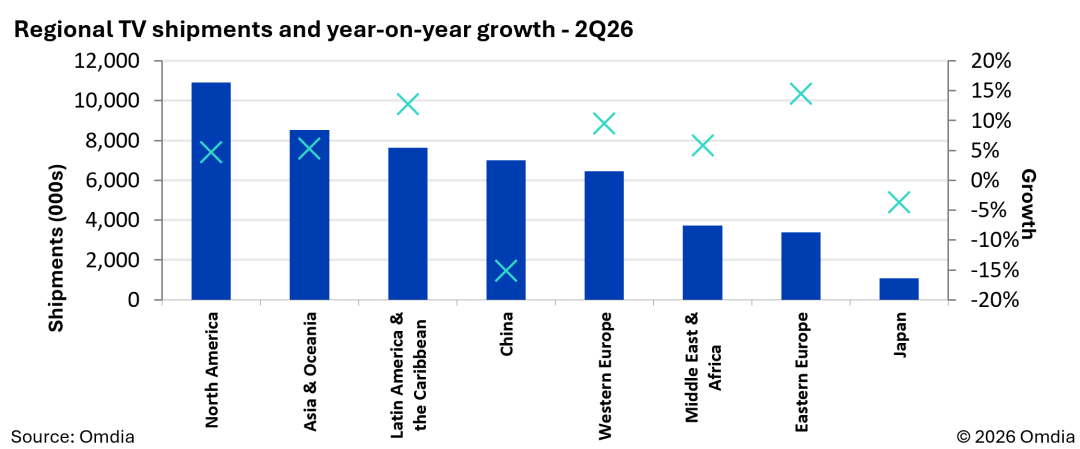
China is still the biggest source of pressure on the growth of global TV shipments. Shipments fell 15.1% year over year after the end of local consumption stimulus policies. In contrast, major developed markets performed strongly during the quarter. The Western European market grew 9.5%, while North America, home to two of the three World Cup hosts, grew 4.7%.
Emerging markets performed strongly. Shipments in the Eastern European market increased by 14.5%, while Latin America and the Caribbean increased by 12.8%. Against the backdrop of continued weakness in domestic demand in China, Chinese TV brands continued to expand shipments to overseas markets.
Memory supply pressure reshapes TV market prospects
In the second quarter of 2026, the impact of memory supply restrictions on TV shipments was limited, in part because brands continued to promote old product lines and use existing low-cost memory inventories. However, as memory supply is expected to continue to be tight and prices continue to rise, TV prices may face further upward pressure this year.
Omdia also expects brands to move further from low-resolution TVs to 4K models as low-capacity memories face particularly tight supply restrictions.
Competition for Mini LED TVs intensifies as more brands expand their product lines
In the second quarter of 2026, Mini LED adoption accelerated significantly, accounting for 13% of global TV shipments. Samsung and LG Electronics have expanded their Mini LED product line while reducing entry prices, increasing competition with TCL and Hisense, the original market leaders.
In the first quarter of 2026, TCL accounted for 30.2% of global mini LED TV shipments. By the second quarter of 2026, Samsung had jumped from third place to market leader, reaching 28.2% of shipments.
RGB LED TV market competition intensifies
Competition in the RGB LED market is also heating up rapidly, with shipments reaching 295,000 units in the second quarter of 2026. At the beginning of the year, Hisense (000921.SZ) dominated the market with a market share of 77.2%. Due to limited market competition, China accounted for 88.8% of the global RGB LED market.
By the second quarter of 2026, Hisense's share had fallen back to 42.9% as Samsung and Sony seize significant market shares.
Matthew Rubin, Research Manager of Omdia's TV Research Division, said: “The strong promotion of RGB LED TVs during the World Cup will certainly help raise consumer awareness of this technology. As adoption increases, RGB LED will compete more and more fiercely with OLED in the high-end market segment. Consumer preferences may depend on pricing and how clearly consumers can assess the differences between the two technologies.”