
Or trigger trillions of yen in capital rotation! Yield soared to reignite appeal, and calls for GPIF to increase Japanese bond holdings gradually began
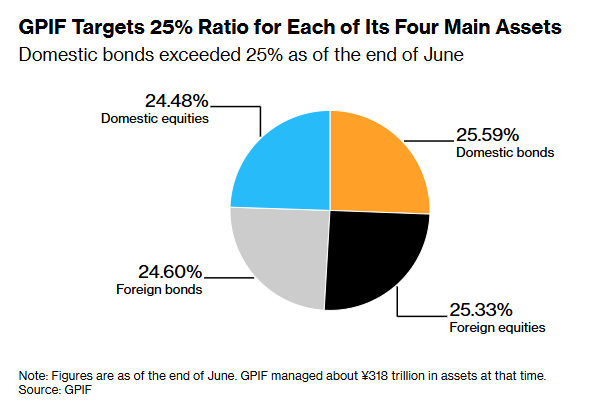
The Zhitong Finance App learned that with the sharp rise in Japanese treasury bond yields, analysts pointed out that one of the world's largest pension funds, the Japanese Government Pension Investment Fund (GPIF), may have good reason to consider raising the domestic bond allocation target from the current 25% in order to seek higher returns.
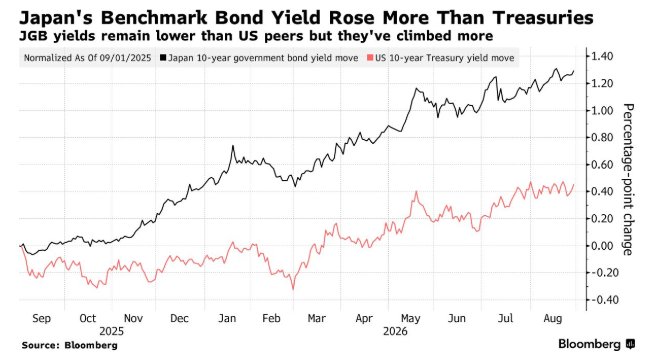
According to GPIF data, as of the April to June quarter of this year, the fund has recorded losses in Japanese domestic bond investments for seven consecutive quarters. The background of the loss is that the Japanese bond market continues to decline. The yield on the benchmark 10-year treasury bond once approached 3%, a high in nearly 30 years. However, analysts believe that the sharp rise in yield may make it attractive again to investors.
Koji Okuda, executive researcher at Dai-ichi Life Research Institute, said, “When rising yields improve the expected return on domestic bonds, it is reasonable to consider adjusting the allocation ratio.” He pointed out that compared to when the goals were initially set, the current economic situation has changed, and GPIF is now fully in a position to review whether its current weights are still appropriate.
Due to the extremely large size of the fund, GPIF's asset allocation decisions have attracted the attention of global market participants. By the end of June, the fund managed assets of about 318 trillion yen (about 2 trillion US dollars). This means that theoretically, every 1 percentage point change in the allocation ratio could trigger capital flows of more than 3 trillion yen.
Meanwhile, Japanese Prime Minister Takaichi Sanae and Finance Minister Katayama Satsuki have also increased pressure on pension funds, urging them to invest more money in the domestic market.
Okuda further stated, “After GPIF has fully assessed factors such as expected returns and risks in various economic scenarios, it would be worth considering increasing the domestic bond allocation ratio to 30% to 35%.”
Currently, there are signs of a recovery in domestic bond demand in Japan. Japan's largest life insurance company, Nippon Life Insurance, said last week that given the current interest rate level, the company intends to become a net buyer of Japanese treasury bonds in the next fiscal year.
Increasing the allocation of domestic bonds will also have an impact on the foreign exchange market. According to Okuda's estimates based on GPIF holdings data at the end of June, if foreign bond holdings are reduced and the share of domestic bonds is increased to 30%, it will be necessary to buy about 16 trillion yen; if the target is 35%, the purchase scale will expand to 32 trillion yen.
Japan's Minister of Health, Labor, and Welfare Kenichiro Ueno, who is responsible for overseeing GPIF, said in July, “If necessary, adjustments will be made to the basic investment portfolio.” But at the same time, he emphasized that the basic principle of investment is to generate income for pension beneficiaries.
A GPIF spokesperson said that the fund did not think there is a clear difference between the current investment environment and the original expectations of the portfolio.
The depreciation of the yen was also closely watched by investors. Kiyoshi Ishigane, executive chief fund manager of Mitsubishi UFJ Asset Management, said that considering foreign exchange risk, “it is not surprising to begin considering reducing overseas assets and increasing the domestic bond ratio.”
However, some analysts questioned the adjustment of the target allocation ratio.
Takahiro Niimi, a senior economist at the NLI Institute's Policy Research Department, pointed out that if GPIF increases the weight of domestic bonds, it may have to take more risks through other assets in order to achieve return on investment goals. “The adjustment threshold is high,” he said.
Kenji Shiomura, a researcher at Daiwa Research Institute and a former GPIF official, believes that if wage growth factors are excluded, interest rates have not risen significantly at present, so it is unclear whether the weight of domestic bonds should be increased.
The regulatory effect of GPIF
There are also opinions that instead of changing allocation targets, it is sufficient to rebalance GPIF assets. After experiencing a record rise, the Japanese stock market is already overvalued, and investors have begun to look at other assets such as domestic bonds. Masaki Kuwahara, senior interest rate strategist at Nomura Securities, pointed out that as part of the rebalance, GPIF injected 5.7 trillion yen into Japanese bonds in the April-June quarter, setting a record high in a single quarter since FY2020.
GPIF's current basic portfolio begins in the fiscal year ending March 2026 and is valid for five years. The combination aims to achieve nominal wage growth plus 1.9 percentage points of return over the long term, and aims to reach this level with minimal risk.
In the past, GPIF adjusted allocations in the middle of the planning cycle to achieve return goals. For example, in October 2014, based on expectations that deflation will soon ease, the fund drastically lowered its share of domestic bonds from 60% to 35%, while increasing the allocation ratio for domestic and foreign stocks from 12% to 25%, respectively.