
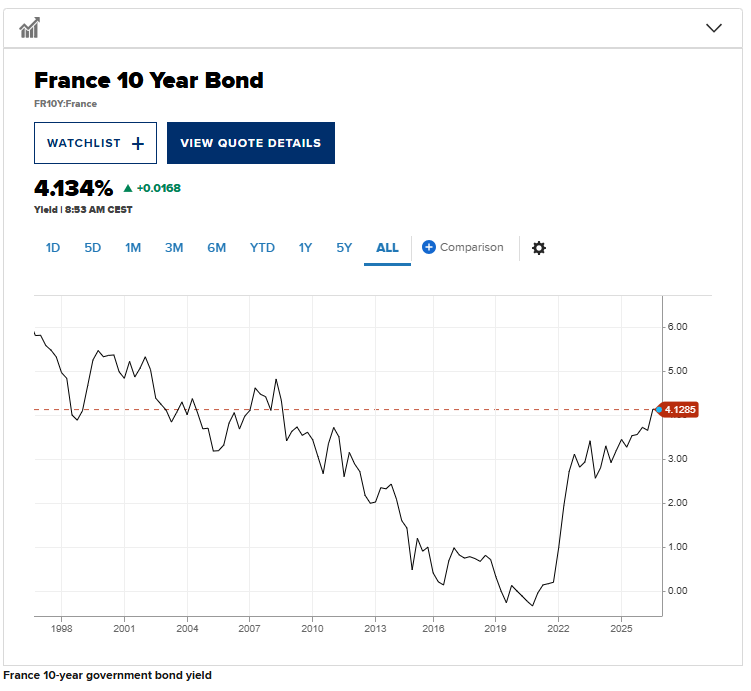
The yield on French ten-year treasury bonds broke through 4.1% and hit a new high since 2008. Is the “European debt crisis 2.0” about to come?
The Zhitong Finance App learned that as another difficult budget dispute is about to begin, France's worsening public finance situation and political impasse are making bond investors increasingly worried.
As the second-largest economy in the EU, France has been mired in the double predicament of political turmoil and increased fiscal pressure in recent years. The country has repeatedly violated the European Commission's regulations on budget deficits and debt ceilings. Many prime ministers stepped down one after another after failed attempts to implement reforms, cut spending, and raise taxes, and have never been able to effectively control the situation.
Currently, France is under the supervision of the European Union's “excess deficit procedure,” and the EU Council suggests that it should end its excessive deficit by 2029 — but France is still far from this goal.
According to the EU Treaty, the reference value for the government deficit rate is 3% of GDP, and the reference value for the government debt ratio is 60% of GDP. Last year, France's deficit rate reached 5.1% of GDP, and debt accounted for more than 115% of GDP.
The International Monetary Fund predicted in July this year that the total debt of the French government will account for about 118.5% of GDP in 2026, exceed 120% in 2027, and remain above this level until 2030.
Meanwhile, France's economic growth was weak, shrinking by 0.2% month-on-month in the first quarter of this year and stagnating in the second quarter.
This series of turbulence has put severe pressure on the French bond market. Over the past year, yields on French treasury bonds have risen sharply — and the war between the US and Iran has further boosted global borrowing costs, making France one of the top government borrowing costs in the G7.
Last week, the yield on French 10-year treasury bonds topped 4.13%, the highest level since 2008, and remained around 4.1% last Friday. The yield and price of bonds fluctuate in reverse.
The French National Assembly is deeply divided ideologically, causing the government to frequently face votes of no confidence, cabinet collapse, and national budget impasse.
France is expected to submit the 2027 budget plan to Parliament in early October. However, last year's budget was delayed for several months due to an impasse, and in the end, then-Prime Minister Sébastien Le Cornu forced Parliament to pass it.
Le Corneux was appointed Prime Minister in 2025, becoming the fifth person to head the Prime Minister's Office in just two years. However, he announced his resignation after only 27 days in office, saying that political differences made it too difficult to form an effective government plan. However, he was reappointed a few days after his resignation.
Another factor that continues to drag down the French bond market is the uncertainty of the 2027 presidential election. Currently, far-right candidate Marina Le Pen is leading the polls in the race to succeed Emmanuel Macron.
The “quintessential representative” of debt problems
John Stopford, head of multi-asset earnings at Ninety One, said that after the COVID-19 pandemic, war, and continuing energy crises, deficit expansion and slowing growth have become a global issue, but France is “particularly prominent.”
In a telephone interview, he stated, “This is not only a French problem, but it can be said that in many ways, France is one of the 'typical typices' of these issues. I don't think this is a phenomenon unique to France, but it is true that France's public finances have always been moving in the wrong direction.”
He also said that governments in developed economies generally face broader challenges, namely how to balance accounts and put debt on a more sustainable path. Stopford added that failure to do so is likely to eventually trigger “bond market riots.”
Speaking about France, he said, “I understand people's concerns. I can't see how it will end well at the moment.”
Stopford pointed out that the biggest uncertainty surrounding the French treasury bond market is next year's presidential election.
In the candidate debate last Thursday, Le Pen said the government “must cut spending drastically” and said she was “extremely concerned” about the trend in France's debt level.
But Stopford pointed out that the market is skeptical that Le Pen is willing enough to put public finance on a more sustainable track.
He said, “Obviously, after May next year, we may see regime changes or adjustments in policy priorities, but people doubt whether the government really has a strong will to carry out substantial fiscal consolidation. So I think we might be preparing a crisis, just not sure if it's going to break out right now.”
Few signs of improvement
Natixis CIB interest rate strategist Théophile Legrand said that his team has viewed French treasury bonds as “pre-pressured.”
He pointed out, “What may slow the recovery is not only domestic politics, but also the broader economic context. The market doesn't expect France to reduce its deficit rate to 3% by 2027, but it does want to see the 2027 budget plan in line with a credible path to stabilizing public debt in the medium term. And this path is becoming increasingly difficult to achieve. The war-related context and rising long-term interest rates have made the fiscal equation more complicated. Coupled with this summer's heatwaves and wildfires, they have added new uncertainties.”
Legrand added that the last few months of this year and the first quarter of 2027 may be a window period where French treasury bonds once again fluctuate sharply, because budget debates and presidential election dynamics will be more closely intertwined at that time.
He also said, “Having said that, we don't expect the 2024/2025 shock pattern to repeat. The valuation of French treasury bonds has shown clear pressure: our fair value model shows that even without factoring in the political risk premium, French treasury bonds are already about 15 basis points cheaper. Our year-end forecast is that if the budget is passed, the interest spread between 10-year French treasury bonds and German treasury bonds will be about 75 basis points; if France is not passed and France is transferred to a special budget bill, the spread will be about 80 basis points.”
Apriel Larousse, head of investment experts at Insight Investment, said that despite endless negative news relating to the French economy, “it is surprising that there are few signs that France is preparing to make the fiscal adjustments required by its debt situation.”
She pointed out, “Growth expectations are constantly being lowered, debt will continue to rise, and bond yields are at a high level not seen since the financial crisis. However, substantial spending constraints remain politically difficult. “Pension reform has actually been put on hold until after the 2027 general election, and the parliament is highly divided, and the government seems more concerned with maintaining political stability than addressing fundamental fiscal issues.”
She said that the question facing investors now is whether policymakers can muster political will to push public finance on a more sustainable path before market pressure intensifies.
“French treasury bonds are currently trading cheaper than Italian treasury bonds — which was unimaginable not long ago — but in a negative scenario, they may also become cheaper.”