
Geographical conflict and climate anomalies “double kill”! Prices of agricultural products may hit their biggest monthly increase in 14 years, and the food inflation alarm is sounding again
The Zhitong Finance App learned that due to the dual factors of geographical conflict and extreme weather disrupted supply, agricultural product prices are about to record their biggest monthly increase in more than 10 years, and market concerns about food inflation are once again heating up. As of August 29 (last Friday), the Bloomberg Agriculture Spot Index (Bloomberg Agriculture Spot Index), which tracks the 10 major agricultural products, has accumulated a cumulative increase of more than 13% since August, and is expected to record the biggest monthly increase since July 2012.
Among them, wheat became the leading force. Recently, prices hit a three-year high, mainly due to the attack on the Black Sea port, which drastically cut the export flow of this important production area. Sugar and cocoa prices have also risen by about 20%, and the continued strengthening of the El Niño phenomenon has further exacerbated weather-related concerns.
Although the rise in agricultural product prices is usually transmitted to terminal retail shelves, the current round of increases compounded the rise in energy and transportation costs caused by the Iran war, putting pressure on the price prospects for daily necessities such as bread to meat and dairy products, and concerns about inflation are heating up.
On the wheat side, Ukraine and Russia attacked each other's ships and ports, which led to a marked slowdown in grain exports between the two countries. According to reports last week, Russia is preparing to step up its attack after judging that the peace talks have reached an impasse.
Together, Russia and Ukraine account for more than a quarter of global wheat exports, and also account for a large share in varieties such as barley, corn, and sunflower oil. Australian consulting agency Lachstock Consulting (Lachstock Consulting) pointed out in a Monday report that this meant that the market could hardly find a clear alternative source of supply. Currently, the backlog of unsold grains continues, and the Ministry of Agriculture of Ukraine expects farmers to reduce the area planted with winter wheat during the 2027 planting season.
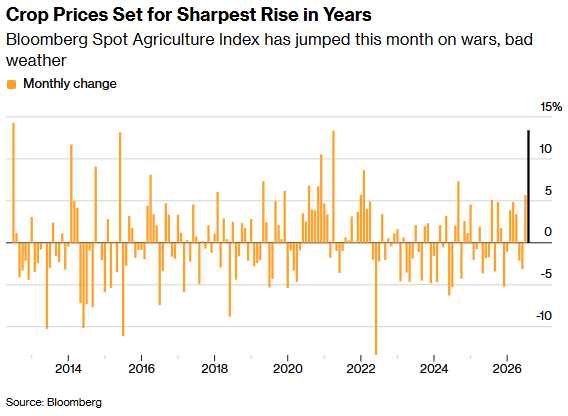
According to Raxstock's analysis, “The quality of Argentine wheat is questionable. Canada's export capacity is limited, Australia is constrained by port capacity, while American wheat is increasingly becoming an expensive surplus supply source. Unless Black Sea exports resume smooth, the market is increasingly likely to face a structural supply problem across quarters rather than short-term logistics disruptions.”
Weather factors also contribute to stress. Both the US and European corn growing regions were hit by the summer heatwave, which damaged harvests. Meanwhile, the strong El Niño phenomenon is expected to continue to pose a threat to next year's crops, which also boosted varieties such as cocoa — the market is worried that abnormal weather will affect crop growth in West Africa, the world's largest cocoa producing region.
New York raw sugar futures rose about 20% in August, the biggest monthly increase since 2015. Inventories in India, the main producer country, are tightening, while demand is rising during the holiday season. Recently, the government has rarely allowed some duty-free imports to calm prices.
The situation in the Middle East is once again tense, and it has once again raised market concerns about the supply and transportation of fuels and fertilizers that are critical to global agriculture. Last weekend, the US military carried out an attack on an Iranian rocket launcher. This is the first time in weeks that the US military has taken military action against Iran.