
Castle Securities sounded the alarm: the “curse” superimposed cheap options in September, and short-term risk and return on US stocks deteriorated dramatically
The Zhitong Finance App learned that September is usually the worst performing month of the year for US stocks, and the average monthly return for the S&P 500 index is at its lowest level throughout the year. The option price is now at the lowest level of the year — when the two are combined, the risk-reward ratio of buying fall protection is quite attractive.
This is a central point of view from Scott Rubner (Scott Rubner), head of stock and stock derivatives strategy at Citadel Securities (Citadel Securities), in a report to clients on Monday (8/31). Rubner pointed out that the bullish pattern that drove the S&P 500 index to a record high in August is changing.
“This is not a change in our long-term bullish stance on stocks, but a change in short-term risk-return.” Rubner wrote in the report. He cited earnings calendars, share buyback prospects, seasonal factors, and retail trading patterns as reasons to be cautious. “Taken together, they changed short-term asymmetry. The upward catalysts are becoming less obvious, while the catalysts for the downside are increasing.”
Sideways trading and low volatility after a record high
In August of this year, the S&P 500 index hit a record high of 7816.70 points in the intraday period, with a cumulative increase of nearly 7% from the end of July to the first week of August. However, since then, the benchmark index fell sideways and even declined slightly. Meanwhile, the Chicago Board Options Exchange Volatility Index (VIX) fell to 14.1 last week, the lowest level in the year.
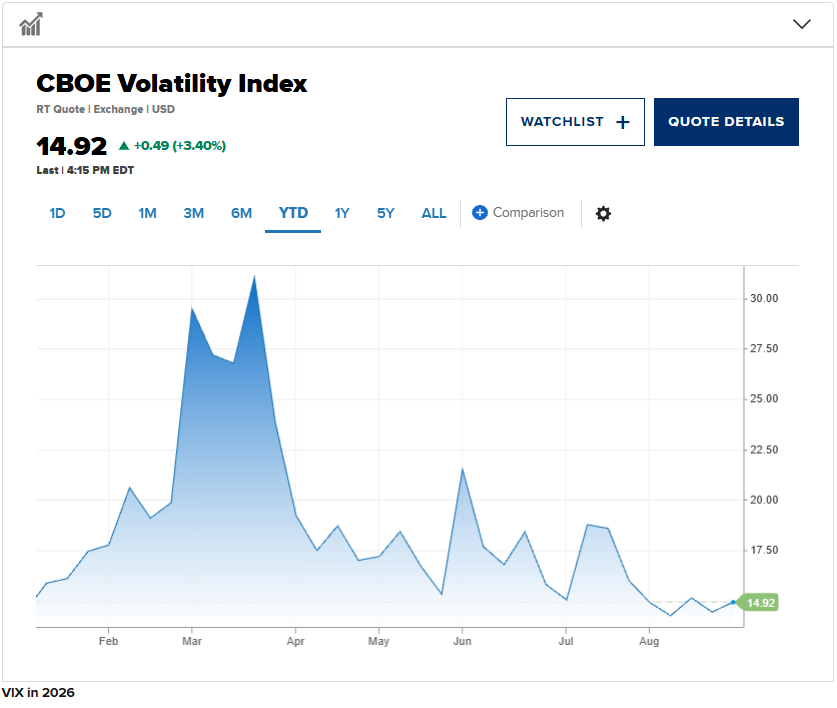
Mandy Xu (Mandy Xu), head of derivatives market analysis at Cboe, pointed out in a report on Monday morning that better-than-expected earnings reports — particularly Nvidia's (NVDA) performance last week — helped reduce the volatility risk premium in technology stocks, and concerns surrounding artificial intelligence trading have eased somewhat.
According to Cboe data, the premium for individual stock volatility, which was previously at a historically high level, compared to index volatility, has also declined. The spread of the VIXEQ index, which measures the implied volatility of the top 50 S&P 500 constituent stocks, has narrowed markedly; the spread between QQQ and SPY, which tracks the volatility of the NASDAQ 100, also fell from an all-time high in June to the lowest 20% fraction in the year.
Decline protection is “cheap”, but retail buying is weak
Rubner believes that because of this, it is currently relatively inexpensive to buy downside protection.
But September's challenge didn't just come from historical statistics. Rubner pointed out that among the retail trading activities tracked by Castle Securities, September was also the weakest month of the year for buying. Since 2019, the S&P 500 index has declined, and the average net purchase amount of retail investors during the trading day is only about half of the average for the whole year.
Furthermore, Rubner expects corporate repurchases to slow down — starting around September 12, listed companies will enter a quiet repurchase period, and related restrictions will gradually be tightened.
An intensive period of macroeconomic events has arrived, yet the protection premium is low
“Investors are entering a period of more intense macroeconomic events, yet they are paying a relatively low premium for protection.” Rubner said.
Just in mid-August, Rubner also judged that the “technical reset” of US stocks had basically been completed, and the systemic strategy was expected to be re-leveraged. At the time, he pointed out that the four forces of system capital, retail investors, passive ETFs, and corporate repurchases are forming a mutually reinforcing buying pattern. However, after a lapse of only half a month, with the arrival of September, the weakest month in history, his short-term stance has clearly shifted to prudence — upward catalysts have subsided, downside risks have accumulated, and protection costs are low, which constitute the core short-term conflict in the current market.
For investors, after enjoying the calm and rise of the summer, the September market may need more vigilance.