
“Kimchi Premium” is back! South Korea's retail risk appetite may reignite Bitcoin or welcome a new round of rise
The Zhitong Finance App learned that as rising cryptocurrency prices reignited risk appetite, Bitcoin was once again traded at a premium in South Korea, one of the most watched retail cryptocurrency markets in the world. On Tuesday, the price of Bitcoin won on Upbit, the largest cryptocurrency exchange in South Korea was about 1% higher than Binance's dollar price. Bitcoin has been trading at a premium in South Korea for the past week, the longest round of premiums since the beginning of May.
This spread is known as the “Kimchi Premium” (Kimchi Premium), or Bitcoin price difference between the Korean exchange and the global market, and is regarded as an important measure of the sentiment of retail investors in Asia. BTC Markets analyst Rachael Lucas said that historically, the resurgence of the “kimchi premium” has indicated a further rise in Bitcoin. He said, “Korean retail investors tend to actively buy when risk appetite rises, and capital controls mean that this kind of buying is more reflected in price spreads rather than arbitrage capital flows.” “Historically, a shift from discount to premium often indicates stronger returns for Bitcoin in the coming weeks.”
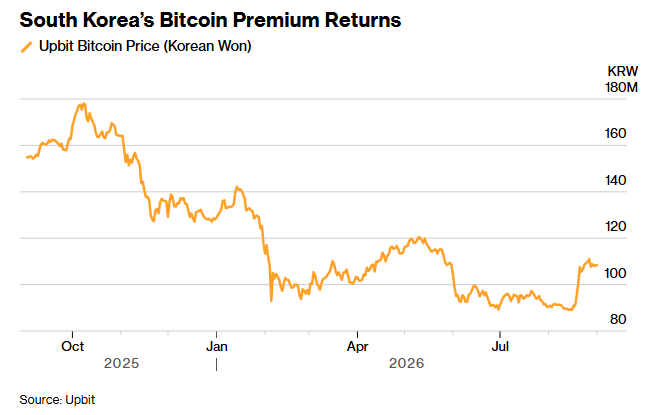
South Korea's Bitcoin Premium Returns
Bitcoin's price in September was around $79,000. The previous month, the price of Bitcoin once surpassed $80,000. This is the first time since May that it has reached this level. As optimism in the cryptocurrency market heats up again and the US Treasury's decision to increase long-term treasury bond repurchases boosted so-called “currency depreciation transactions,” the price of Bitcoin rose sharply in August, the strongest monthly increase since November 2024.
Investors' interest in spot Bitcoin exchange-traded funds (ETFs) listed in the US has picked up again as the price of Bitcoin rises. For the week ending August 17, these ETFs attracted around $1.92 billion in capital inflows, the strongest weekly inflow in 10 months. Last week, these ETFs attracted another US$923 million in capital inflows, but on August 28, an outflow of US$203 million occurred, ending 9 consecutive days of capital inflows.
Although the flow of US ETF funds increasingly reflects the needs of institutional investors, the price spread on Korean exchanges has historically been related to retail purchases in South Korea. Due to South Korea's capital controls and other financial regulations, it is difficult for arbitrators to quickly take advantage of price differences between different markets, so this spread is likely to persist.
However, the “kimchi premium” is also susceptible to speculative fanaticism, and there is no guarantee that Bitcoin will start a new round of growth. Markus Thielen, head of cryptocurrency research firm 10x Research, said: “Although the 'kimchi premium' has turned positive, spot trading volume has not increased at the same time, so we believe that in the early stages of Bitcoin's rebound, South Korea will not be the main driving factor, and many Korean traders will still focus on AI stocks.”
Notably, until recently, signals from the Korean market were pointing in the opposite direction. According to Upbit's data, Bitcoin was traded at a discount in the Korean market for most of this summer. At the beginning of June, the Korean price of Bitcoin was 3.1% lower than the international market price; the average discount in August was 0.25%.
As the inflow of US Bitcoin ETF funds began to slow at the end of August, the recovery in the South Korean market may still be just a brief burst of retail enthusiasm. Rachael Lucas said, “South Korea's Bitcoin trading volume still accounts for a limited share of global transactions, so this is just a small sign that South Korea's selling pressure has eased, rather than a new FOMO (fear of missing out) wave.” “The flow of funds from US institutional investors and ETFs continues to dominate the price trend.”