
Meta (META.US) enters the real-time voice transcription circuit: Benchmarks beat OpenAI and Google (GOOGL.US), API prices as low as $0.18 per hour
The Zhitong Finance App learned that recently, Superintelligence Labs (Superintelligence Labs) under Meta (META.US) officially launched the real-time speech recognition model Muse Voice Transcribe. The model surpassed similar products from competitors such as OpenAI and Google (GOOGL.US) in some benchmarks, and entered the market at an API price of $0.18 per hour. However, Meta confirmed that the model will not open weights.
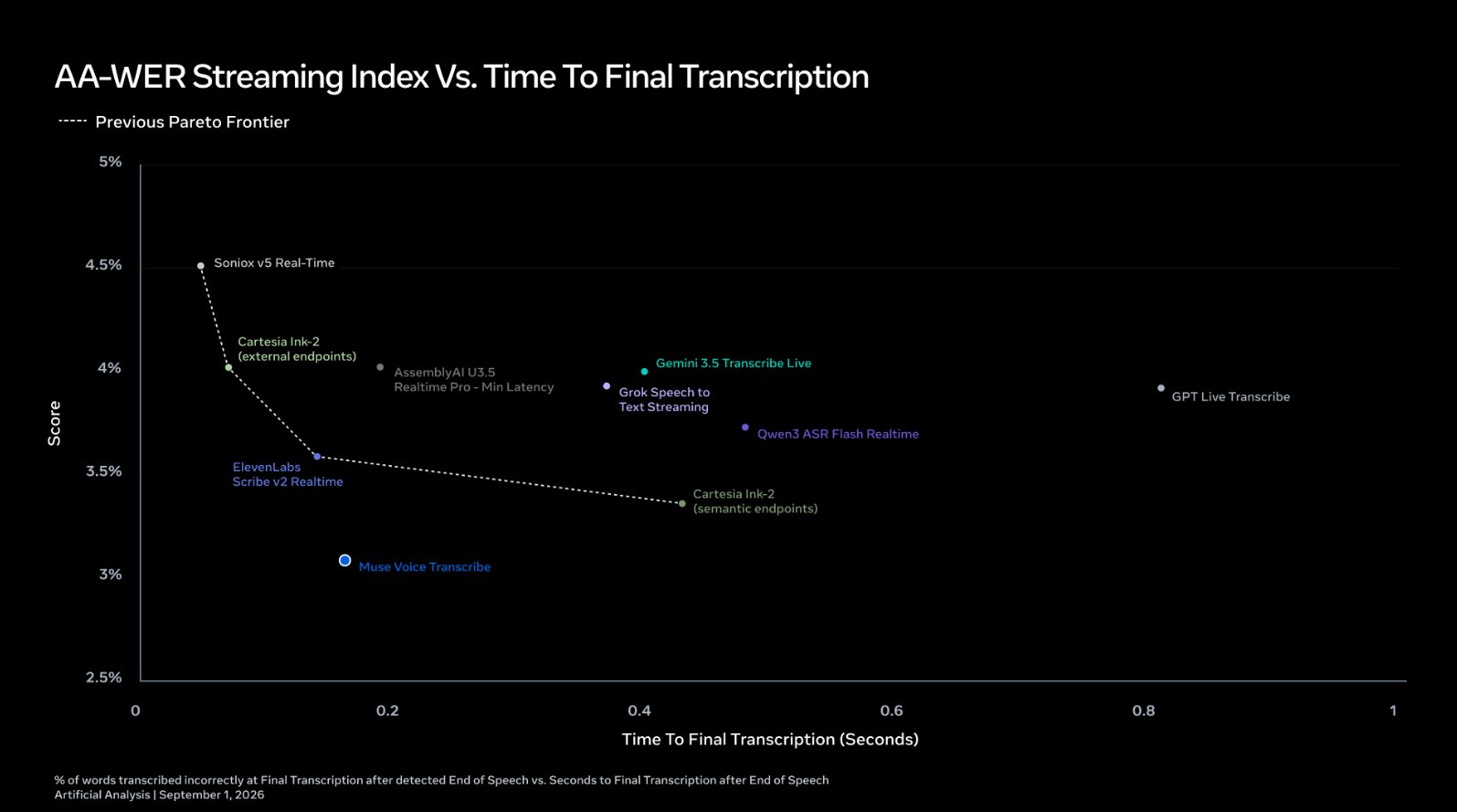
According to information, on Artificial Analysis' AA-WER streaming English speech transcription accuracy benchmark, Muse Voice Transcribe's word error rate is 3.1%, better than Cartesia Ink-2's 3.4%, ElevenLabs Scribe v2 Real-Time's 3.6%, OpenAI GPT Live Transcribe's 3.9%, and Google Gemini 3.5 4.0% of Transcribe Live.
In terms of the ability to distinguish speakers, the overall performance of each model is still difficult to satisfy users, but Muse Voice Transcribe is also in the leading position with an average error rate of 17.5% across multiple standard benchmarks.
According to Meta, the model can distinguish more than 20 speakers and supports more than 70 languages, 25 of which have been “extensively verified”, and can also handle multilingual people switching languages during conversations and long conversations over an hour.
Muse Voice Transcribe is currently available via Meta Model API, Meta AI for Mac, and Muse Code. The API is priced at $3 per 1000 audio minutes, or $0.18 per hour. Unlike Meta's previous practice of opening weights for the Muse Glimmer series, a Meta spokesperson confirmed to The New Stack that the model would not disclose weights.
Technically, Muse Voice Transcribe belongs to the Muse Spark family's autoregressive multi-modal model. The audio is input in 80 ms, about 12.5 blocks per second, and each block is compressed into a single soft token. The model makes a choice on each block: either output a text token or a special “next audio” placeholder and wait for more audio context. When the audio ends, the “empty audio” token triggers the model to output the rest of the text.
This mechanism allows the model to control the delay on its own, which Meta refers to as “adaptive delay.” Simple words can be transcribed almost instantly, while complex words get more audio context. This trade-off is trained during the reinforcement learning phase, and word error rate rewards and delay rewards are optimized by multiplying rather than adding. Speaker recognition also uses a similar mechanism.
This summer, real-time voice transcription has become one of the most competitive segments in the AI field. Recently, companies such as OpenAI, Google, xAI, and Alibaba (BABA.US) have all been intensively releasing streaming voice models within a few weeks, and professional vendors have also been deeply involved for a long time. However, Muse Voice Transcribe's current benchmark lead of 0.3 percentage points is difficult to maintain for a long time under this competitive intensity.
However, for Meta, core products such as smart glasses and Mac applications require real-time voice capabilities as underlying support. This endogenous demand is likely to drive Meta to continue investing in this racetrack rather than just pursuing external API market share.