
Profits in the milk powder sector have plummeted, liquid milk has not stabilized. Pan Gang, with an annual salary of 300 million, cashed out 1.6 billion dollars. Yili shares (600887.SH) dividends are easy to grow and difficult to grow
In March 2026, Yili Chairman Pan Gang drastically reduced his holdings of Yili shares (600887.SH) and cashed out 1.64 billion yuan.
Investors were initially shocked and soon relieved. This is just a microcosm of the era when Pan Gang ruled Yili for more than 20 years and directed Yili's big growth and dividends.
The downside between the US and China is that Erie still has a large dividend, but the era of high growth no longer exists.
1. Director Pan Gang's era of great growth and big dividends
In 2005, Zheng Junhuai, known as the “godfather” of China's dairy industry, walked down the Yili Temple due to embezzlement of public funds in the east window.
Along with Cheng Chun-huai, there was also an ambitious MBO (Management Takeover) program.
It was Pan Gang who succeeded Zheng Junhuai. With the addition of the three positions of party committee secretary, chairman, and president of the group in 2005, Pan Gang began to fully take over Erie.
At the time, Erie was still struggling domestically and abroad. Externally, Mengniu, which is rapidly rising, began to challenge Yili's dominance; internally, after Zheng Junhuai stepped down, the “dispute over control between the management and management” was unresolved. These huge burdens of history were left to the successor, Pan Gang, and also plagued Erie's progress.
How to rationalize control and stimulate internal management momentum has become a core problem that Pan Gang urgently needs to solve.
Pan Gang didn't keep the market waiting too long. Since 2006, Yili has given core executives a significant share of the company's shares through three rounds of equity incentives.
In 2014, Erie launched an even more aggressive 10-year employee stock ownership plan. Participants in the first phase of the plan covered 317 middle and senior management and business technical leaders of the company. Of these, 8 people including Pan Gang held 30.76% of the total share.
Since then, Pan Gang and other core management of Yili have also reached an astonishing number of hundreds of millions of shares in their hands through methods such as granting low prices and increasing their holdings in the secondary market.
Take Pan Gang as an example. Through equity incentives in 2013 and 2019, he was awarded 54.28 million shares and 50.66 million shares at ultra-low prices of 6.49 yuan/share and 15.46 yuan/share, respectively; in addition, he also continued to increase his shareholding ratio through dividends and increases in his holdings time and time again.
By the end of the second quarter, Pan Gang held 225 million shares of Yili and was the fourth largest shareholder of Yili. This is still after a major holdings reduction in March. Another core veteran of Yili, Zhao Chengxia, holds 92.42 million shares and is the 6th largest shareholder of Yili.
After fully motivating executives and seizing the company's bullish nose, Yili, where Pan Gang is in charge, achieved continuous growth for 20 years.
From 2005 to 2025, Erie's revenue increased nearly tenfold; profit increased more than 30 times.
High growth and generous equity incentives that have continued for 20 years have directly contributed to the advent of the “big dividend” era. This time, it has been recognized as a beautiful story created by Pan Gang for Yili.
In the 10 years from 2016 to 2025, the cumulative cash dividend of Yili Co., Ltd. was close to 59 billion yuan. In the 2023-2025 period alone, Erie distributed 24 billion yuan in dividends.
Not only is the dividend winning industry, but in terms of salary and compensation, Erie is also generous enough to management. Among these, Chairman Pan Gang is the most prominent. The average annual salary for the past 8 years has exceeded 20 million.
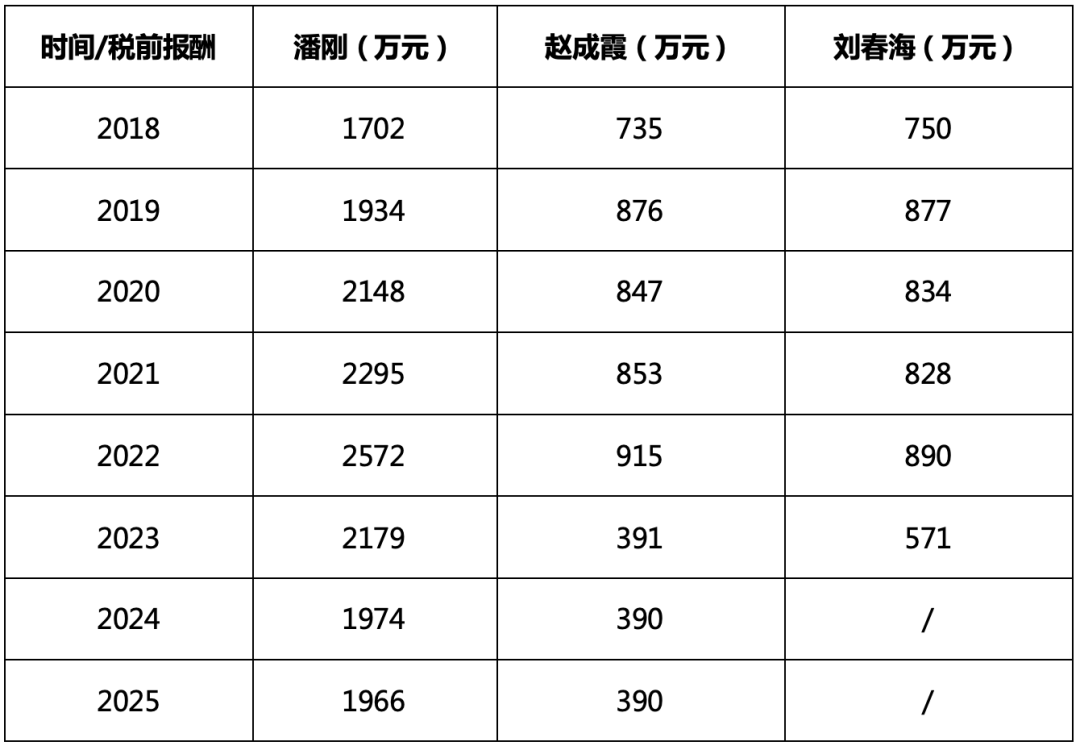
The wealth myth of Yili executives reflects an unusual path to becoming rich: they do not rely on family inheritance, no need to rely on venture capital, and only need to guarantee the enterprise's “high growth, high equity incentives, and high dividend mechanism” to achieve a net worth of 10 billion dollars.
This is no deliberate exaggeration.
According to the “Shareholder Return Plan for the Next Three Years (2025-2027)”, in 2025-2027, the total annual cash dividend of Yili shares accounted for no less than 75% of the net profit attributable to shareholders of the parent company in that year, and the amount of cash dividends paid per share was not less than the 2024 cash dividend of 1.22 yuan (tax included) per share.
This means that Erie executives, who hold a lot of shares, can easily get more real money than the number of shares every year. In terms of Pan Gang's current 225 million shares, this means an immovable dividend of nearly 300 million each year. In addition to his salary, Pan Gang earns 300 million yuan a year.
Of course, this does not include unconventional methods such as a one-time reduction in holdings and cash out. In March 2026, Yili Chairman Pan Gang drastically reduced his holdings of Yili by 619.03 million shares and cashed out 1,643 billion yuan.
Although Pan Gang had previously stated that he would reduce his holdings “to repay stock pledge loans,” the capital market did not buy it. Investors first panicked and were puzzled, then angrily sold off. Ten days later, Erie's market value evaporated by nearly 10 billion dollars.
The logic of investors' anger is that in a sensitive period of stagnant growth and low stock price fluctuations, the chairman's massive cash out is extremely irresponsible.
After continuing growth, Yili's revenue in 2024 rarely fell by 8.24%; in 2025, on the basis of the previous year's low base, Yili only achieved a slight increase of 0.13%. In the first half of 2026, Yili's revenue increased 4.13% year on year (same low revenue base), while net profit to mother fell 20% year over year.
In the capital market, Erie has declined from 44 yuan (previous high) at the end of 2021 to around 26 yuan today.
At such a critical point, no reasonable reason seems to be a reason for Pan Gang to reduce his holdings.
2. Liquid milk is struggling to stop falling, and the cost of buying Australian premium is huge
Pan Gang's drastic reduction in his holdings is just a “black swan” where the capital market is in turmoil.
Behind this, there is a deeper reason: investors are deeply concerned about the weak long-term growth of Yili's basic liquid milk business.
In 2023, Yili's revenue increased 2.49% year on year, the lowest growth rate in more than 30 years (outside of 2016). From the fourth quarter of 2023 to the first quarter of 2024, Erie recorded one of the few consecutive quarters of year-on-year decline in revenue.
An important reason for the decline in Erie's revenue is that liquid milk (liquid milk) products, which account for 70% of revenue, are in place. From 2021 to 2023, Yili Liquid Milk's revenue remained around 85 billion dollars, with little increase.
In 2024, Yili Liquid Milk's revenue fell 12.32% year on year to 75 billion yuan; in 2025, it fell 6.11% year on year again to 70.422 billion yuan. Behind a few simple numbers, it reflects the confusion, weakness, and decline of Erie's core business for many consecutive quarters.
The downturn in the industry has its own objective reasons. But that hasn't lifted the clouds over investors.
Fortunately, in the first half of 2026, the dawn of Yili liquid milk appeared. According to financial reports, Yili's liquid milk business achieved revenue of 36.590 billion yuan in the first half of the year, an increase of 1.3% over the same period last year. However, it must be acknowledged that the increase in the first half of the year was mainly due to 0.05% growth in the first quarter and the second quarter, which can be said to be very weak.
This is almost certain. Yili Liquid Milk's regaining growth has not stabilized; the critical third and fourth quarter will be a key point in determining its direction.
Just as liquid milk picked up, Erie was able to stand the test, and the net profit index unexpectedly appeared in Waterloo.
In the second quarter, Yili achieved net profit of 364 million yuan, a sharp drop of 84% over the previous year. According to the calculation, Ausu's goodwill depreciation was 1.55 billion yuan, and the price drop of inventory related to Ausu was 91 billion yuan (total impairment value of 2.46 billion yuan), plus 600 million yuan in tax supplements, which together caused a sharp decline in Erie's book profit.
Although the calculation of Australia's goodwill impairment is only an accounting treatment, it ultimately reflects deep issues such as actual business and management strategy.
If you grow melons, you get melons; if you grow beans, you get beans. Before we understand the big 10 billion dollar purchase in 2021, we also need to understand the industry situation that Elipids is facing.
In 2020, Erie proposed the ambitious goal of building “No. 1 in the global dairy industry by 2030”. To this end, Yili must speed up the improvement of the industrial layout and optimize the product structure. At this point, the high-margin milk powder business became the best support for Yili to reinforce its shortcomings and grow itself.
At this very moment, the increasingly saturated liquid milk market hindered Yili's aggressive pace, and betting and gambling on the milk powder business had to be accelerated.
Considering that endogenous cultivation was too slow after all, Erie chose more effective external mergers and acquisitions.
In October 2021, Golden Port Holdings, a subsidiary of Yili, acquired 34.33% of Ausu Dairy, the number one goat milk brand, for HK$6.245 billion, making it the largest shareholder of the latter. According to the financial report disclosed by Yili in 2022, Yili spent a total of 8.7 billion yuan on Ausu and competed for nearly 60% of the latter's shares.
At the time, Yan Weibin, chairman of Ausu, once said, “We value Yili's strength as a leading enterprise, and we value Chairman Pan Gang's outstanding charisma as a leader... Aoyou will deeply embrace Yili and collaborate to innovate the era.”
However, Erie and Australia are the best, but the honeymoon period is not long.
In September 2023, Yan Weibin resigned from all positions at Ausu Dairy. Ren Zhijian, a former Yili employee who joined Ausu in July 2022, became the company's executive director and CEO.
Also in 2023, the growth rate of Yili's milk powder business began to slow down. In 2023, the revenue growth rate of Yili's milk powder business fell to 5% from 62% last year. In 2024, the rate was 7.53%, which is also tepid.
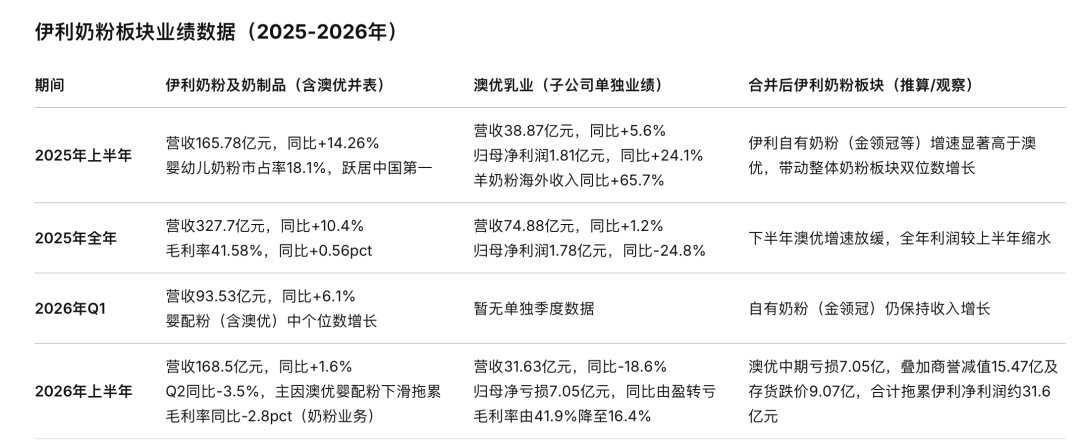
In 2025, Ausu is already lagging behind Yili's milk powder business. In particular, in the second half of the year, Ausu was already in a state of loss.
By the first half of 2026, Australia's excellent performance had deteriorated further. Revenue fell 18.6%, and the performance of changing from profit to loss of 705 million yuan caused Yili's entire milk powder sector to plummet from double-digit growth to almost stagnation.
However, after the pain of this depreciation, Yili Milk Powder has finally cleared its historical burden and can go to battle lightly in the future.
Unlike liquid milk, which has not yet clearly stabilized, and the milk powder business, which has been cleared up through Haoheng mergers and acquisitions, Yili's cold drink business has always been growing quietly.
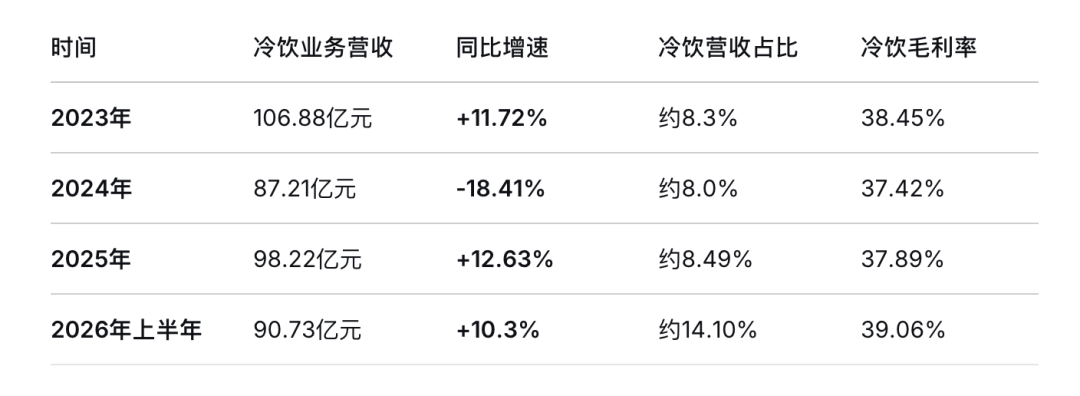
In 2023, the cold drink business of Yili Co., Ltd. broke the 10 billion mark for the first time, with a growth rate of 11.7%. However, there was a sharp decline of 18.4% in 2024, and it still hasn't reached the level of 2023.
Overall, however, from 2023 to the first half of 2026, Yili's cold drink business's share of revenue fluctuated and increased.
Compared with Mengniu outside of liquid milk and flying cranes outside the milk powder industry, Yili is currently the only one in the cold drink market. Erie's star products, such as Cholaz, Ice Factory, and Zhen Xi, have a long-tail effect.
3. High profits and high dividends. Erie urgently needs to solve the growth problem
Liquid whey has stopped falling, but it has not completely stabilized. The milk powder business has been drastically reduced in value, but the clean-up results are obvious. The cold drink business has fluctuated and declined, but it is expected to return to its peak this year...
Erie's three major businesses have their own highlights, but each one is deficient in the US and China. The three major businesses are combined into a whole, which is highly compatible with Yili's overall development trend: Yili has yet to return to its previous peak of growth.
Despite weak growth, Erie's ability to make money is increasing day by day, and it is becoming more and more profitable and profitable.
In 2023, Yili's net profit to mother increased 10.58% year-on-year to 10.4 billion yuan. This is also the first time in Yili's history that net profit has broken through the 10 billion mark. Since then, although there has been a sharp decline in 2024, it went further and reached 11.5 billion yuan in 2025.
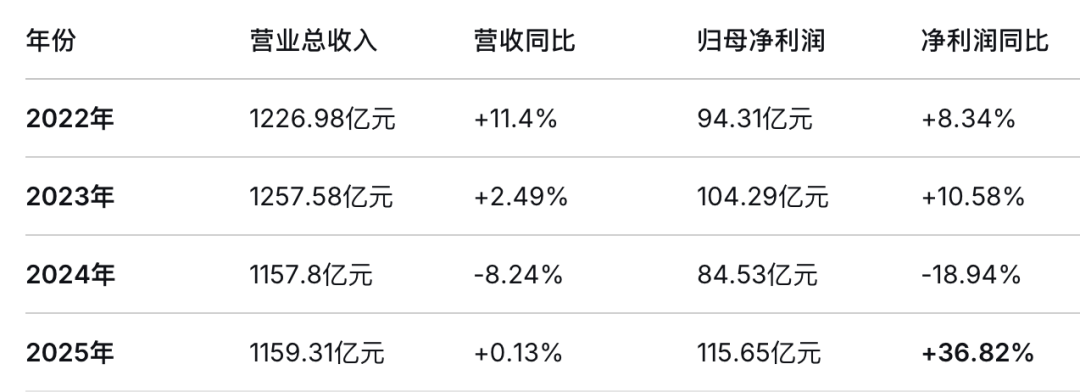
All of this also shows the change in the focus of Erie's development in recent years: from large-scale growth to a shift towards profit (rate) goals.
In 2021, Yili's revenue surpassed 100 billion dollars. In its annual report, Yili proposed the business philosophy of “taking high-quality development as the main line” for the first time.
Beginning in 2022, Yili began using high-quality development, stability, moderation and improvement as the annual theme, and emphasized not simply pursuing scale, but focusing on the quality of growth, operational resilience, cash flow, and shareholder returns.
At the 2023 performance briefing, Yili repeatedly reiterated the goal of a net profit margin of “at least 9%” in 2025. At the performance briefing on April 30, 2026, Yili management emphasized that Yili set a target net profit margin of 9%-10% in the “14th Five-Year Plan” strategic cycle and confirmed that it will be successfully completed in 2025.
The net profit margin is becoming an important connotation for measuring Yili's high-quality development, and Yili even did not hesitate to place the net interest rate index at a strategic level.
This also objectively echoes the 2.0 version of the “Era of High Growth and High Dividends” created by Pan Gang as described above: the “Era of High Profits and High Dividends.”
Judging from the underlying logic, Erie's “high dividends” are supported by business.
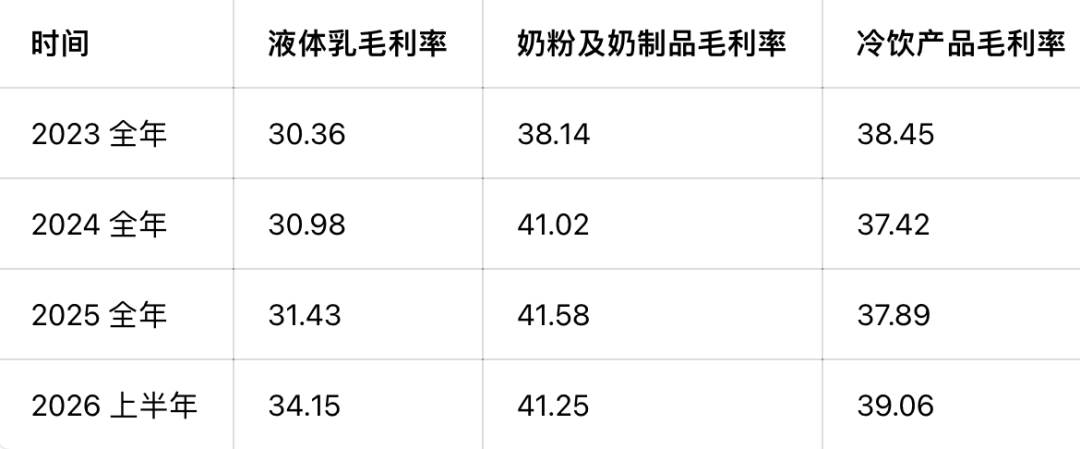
First, starting in 2023, the overall gross margin of Yili's three major businesses has been rising at an accelerated pace. Second, the only liquid milk business that has shrunk in recent years is the one with the lowest gross profit among the three major businesses, while the milk powder business and cold drink business with the highest gross profit have been continuously supported by strategies in recent years.
The contraction in revenue volume caused by liquid milk is being completely overshadowed by rising profits from milk powder and cold drinks. In the end, Erie completed a historic leap of “shifting” from high growth to asking for dividends when high profits need dividends.
In the first half of 2026, Yili's core operating profit margin increased to 13%, a record high.
However, I have to say that Yili's net profit fell 84% in the second quarter of 2026, and net profit fell 20% in the first half of the year, still slap myself in the face. Behind the book value, it reflects the actual operating pressure of Yili's milk powder business-Australian premium sector.
Behind Australia's sharp depreciation, the lightweight milk powder business still needs to prove itself in the future: after all, this is also the core source for Erie to raise profit margins in the future.
Through the 2026 quarterly results briefing, Yili Chairman Pan Gang sent a signal that “the hardest stage in the dairy industry has passed” and included “balancing revenue and profit” as a strategic goal.
However, it is undeniable that Yili is facing precisely the multiple pressures of stagnating growth in its core business, the “sequelae” of historical mergers and acquisitions not being fully resolved, and Chairman Pan Gang drastically reducing holdings and regaining confidence in the capital market. In the future, this will still be an important issue Pan Gang needs to solve.
This article is reprinted from the WeChat account “Wendao Business”, Zhitong Finance Editor: Chen Yufeng.