
Are European luxury stocks running out of luck? Consumer confidence has bottomed out, and the sector may rebound in the next 12 months or outperform the market
The Zhitong Finance App learned that holding luxury stocks has now almost become a reverse investment transaction, but signs that consumer confidence and profit growth are bottoming out suggest that this heavily hit industry may be able to gain some breathing room.
European luxury goods stocks were once behind the market by up to 25% as of May, then began to stabilize. However, the rebound has been very short, and these stocks are still lagging behind. Sales recovery has always been difficult to achieve. As a result, overall consumer stocks continue to be sluggish, and consumer sentiment is also depressed.
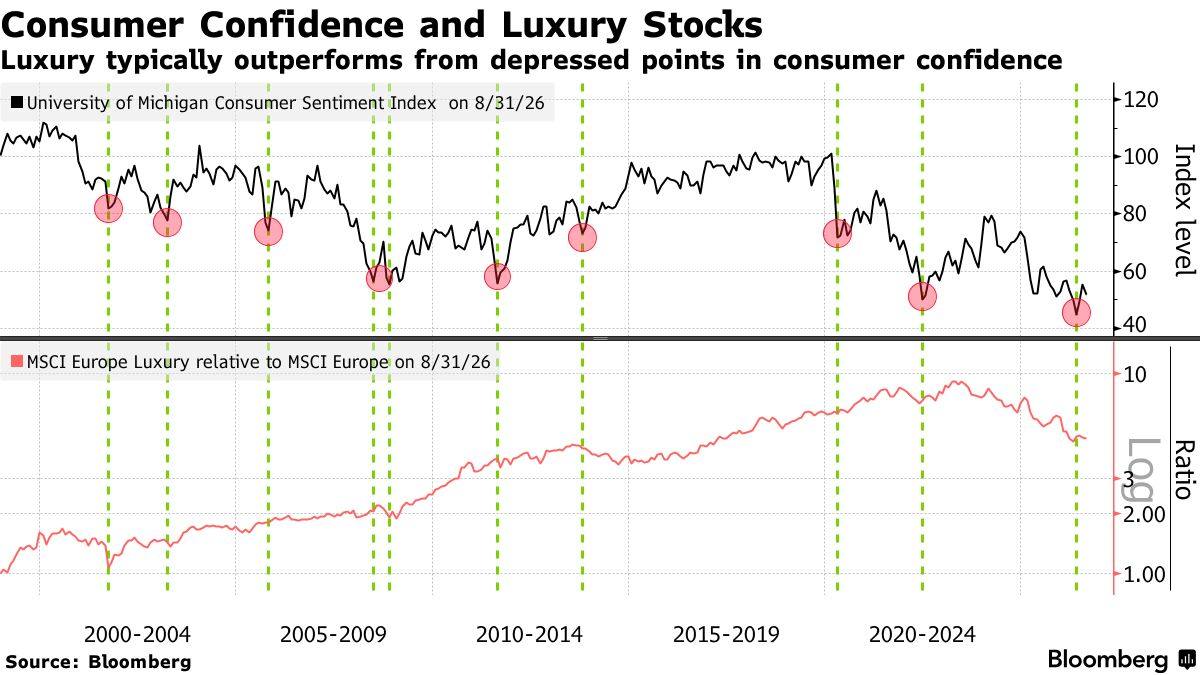
However, a team of J.P. Morgan strategists led by Mislav Matejka said: “What's interesting is that when consumer confidence is low — as has been the case recently — the consumer sector tends to outperform the market over the next 12 months.” They pointed out that under these circumstances, luxury goods are generally one of the best performing industries. “From an overall perspective, the cyclical consumer industry is still at the center of the storm, facing profit warnings and cautious performance guidance, but they may usher in better performance in the future.”
The strategist said that after the University of Michigan's consumer confidence index bottomed out, the European luxury goods industry was able to outperform the market by 9% and 12% on average. This view is based on potential future wealth effects. They believe that Korea is becoming a growth engine, and its retail sales performance is so strong that the Korean market is now more important than the Middle East market. At the same time, as the macroeconomic environment stabilizes, Chinese demand should also begin to improve.
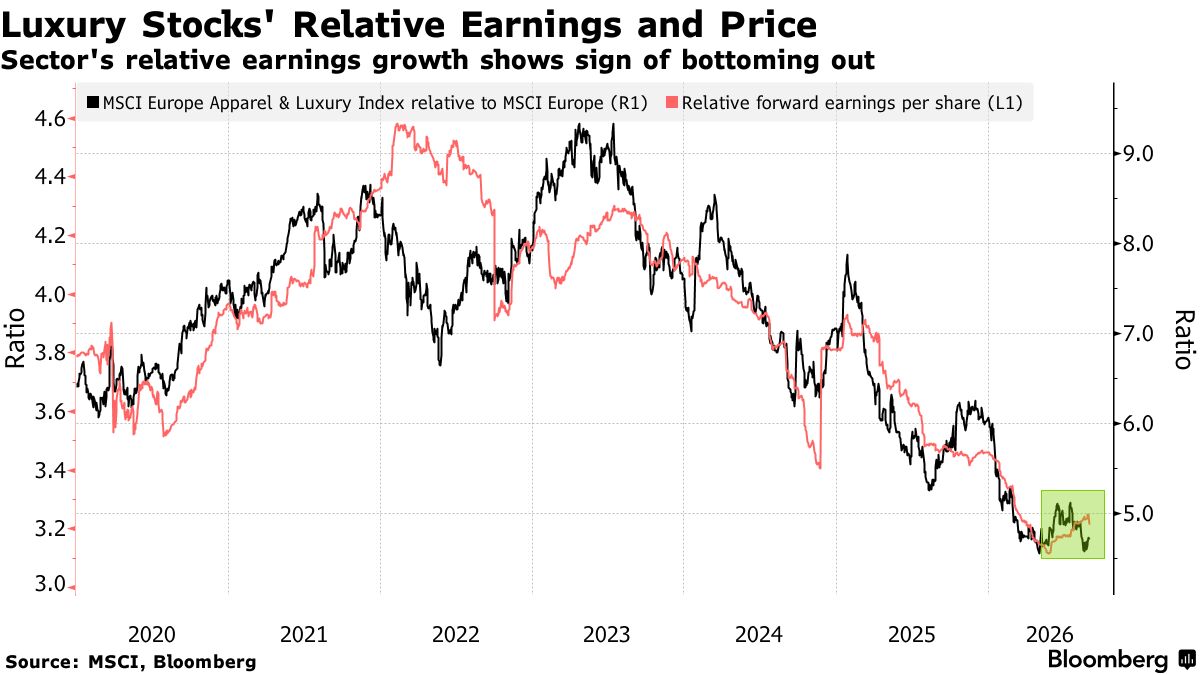
Profit growth has been sluggish for about two years, especially compared to the general market. However, this trend is finally beginning to show signs that the worst is over, and profit expectations now point to a rebound in growth.
Christina Carlsten, senior fund manager at Banque Piguet Galland, said, “If someone has no exposure to luxury stocks at all, then now they can consider starting to gradually open positions. This is an anti-consensus deal. So it's suitable for long-term investors, and it may take some time to work.”
That being said, any recovery is likely to be fragile. The Bank of America analyst team led by Ashley Wallace said, “The industry data we are tracking shows that the third quarter of 2026 is 3 percentage points slower than the second quarter, based on a region-weighted average calculation, showing that the third quarter of 2026 has slowed by 3 percentage points compared to the second quarter, and this data does not take into account the most severe year-on-year comparison base faced between September and September.”
The Bank of America team added that the slowdown was most pronounced in the US, Japan, South Korea, and Macau, China, and these markets performed the strongest in the second quarter. Meanwhile, the performance of the EU tourism industry has been more steady. They gave stocks including LVMH, Hermès International, and Richemont a “buy” rating, adding that the recovery in demand for luxury goods will be gradual and will not show linear growth.
Judging from the valuation, the luxury goods industry has now returned to close to the 10-year average, with a forward price-earnings ratio of about 25 times. However, if you look closely, you can see that there is a clear division among the different companies. For example, LVMH's current trading price is 25% off compared to its peers, which is at the highest level of the discount range in the past 10 years, making it one of the lowest-valued stocks in the industry.
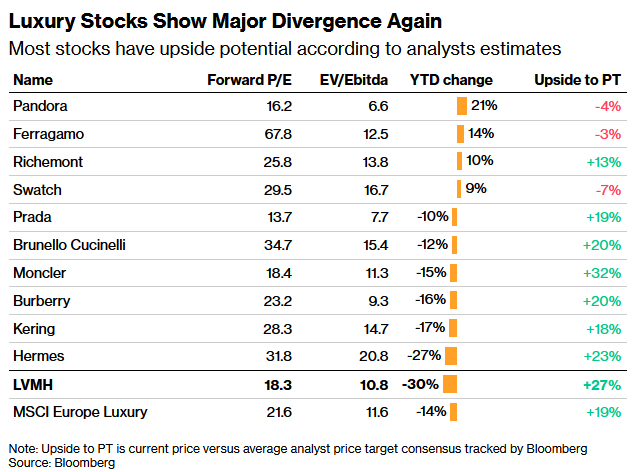
Luxury stocks are once again showing major differentiation
This means that investors need to adopt selective investment strategies. Investors are no longer rewarding diversified layouts and are favoring recovery stories and specific trends. For example, widespread pessimism among families is also reflected in consumer preferences that still buy luxury goods — they now prefer watches and necklaces rather than handbags and clothing.
Bank of America tracks a basket of high-end luxury stocks. Since the beginning of April, it has outperformed its corresponding basket of soft luxury stocks by more than 40 percentage points, which reflects a more steady profit trend among jewelry companies during the war. As a result, Pandora A/S and Richemont, the parent company of Cartier (Cartier), became one of the best-performing luxury companies in 2026, while fashion giants LVMH and Hermès lagged behind other companies in the industry, falling 30% and 27%, respectively.
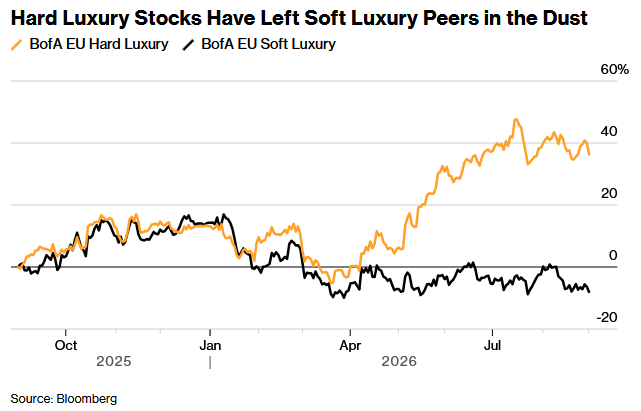
The performance of soft luxury stocks lags far behind high-end luxury stocks
Bernstein analysts Luca Solca and Maria Meita pointed out, “Jewelry remains one of the most attractive categories in the luxury industry, combining higher growth, lower luxury penetration, stronger pricing power, and wider price coverage than most personal luxury categories.” Analysts said this provided Richemont with a basis for investment, and investors still underestimated the extent of the company's “structural advantage” over the luxury industry as a whole.