
Federal Signal (FSS) Stock Looks Cheap On Cash Flow While Earnings Look Fair
Federal Signal stock has delivered a strong 5 year gain, yet the latest valuation checks suggest a more nuanced picture, with an intrinsic value estimate pointing to some upside while market based multiples look broadly in line with the current share price. Recent share price softness adds another layer for investors weighing what that mix really means for entry or exit timing.
- Federal Signal has returned about 193.7% over 5 years, which puts the recent pullback into context as more of a pause after a powerful multi year run.
- The company’s ability to convert its order book into consistent cash flow can support the valuation, while any setback in execution or margin pressure may limit how much of that potential is reflected in the share price.
- On Simply Wall St’s checks, Federal Signal shows a mixed picture on value, with 4 out of 6 tests suggesting the shares lean cheap rather than clearly expensive.
The issue now is whether the current discount to intrinsic value for Federal Signal offers enough margin of safety given that market multiples already look roughly in line with peers.
Compare Federal Signal's recent pullback with other potentially mispriced opportunities by scanning the hand picked 50 high quality undervalued stocks for ideas that match your risk and return preferences.
Is Federal Signal Still Cheap on Cash Flow?
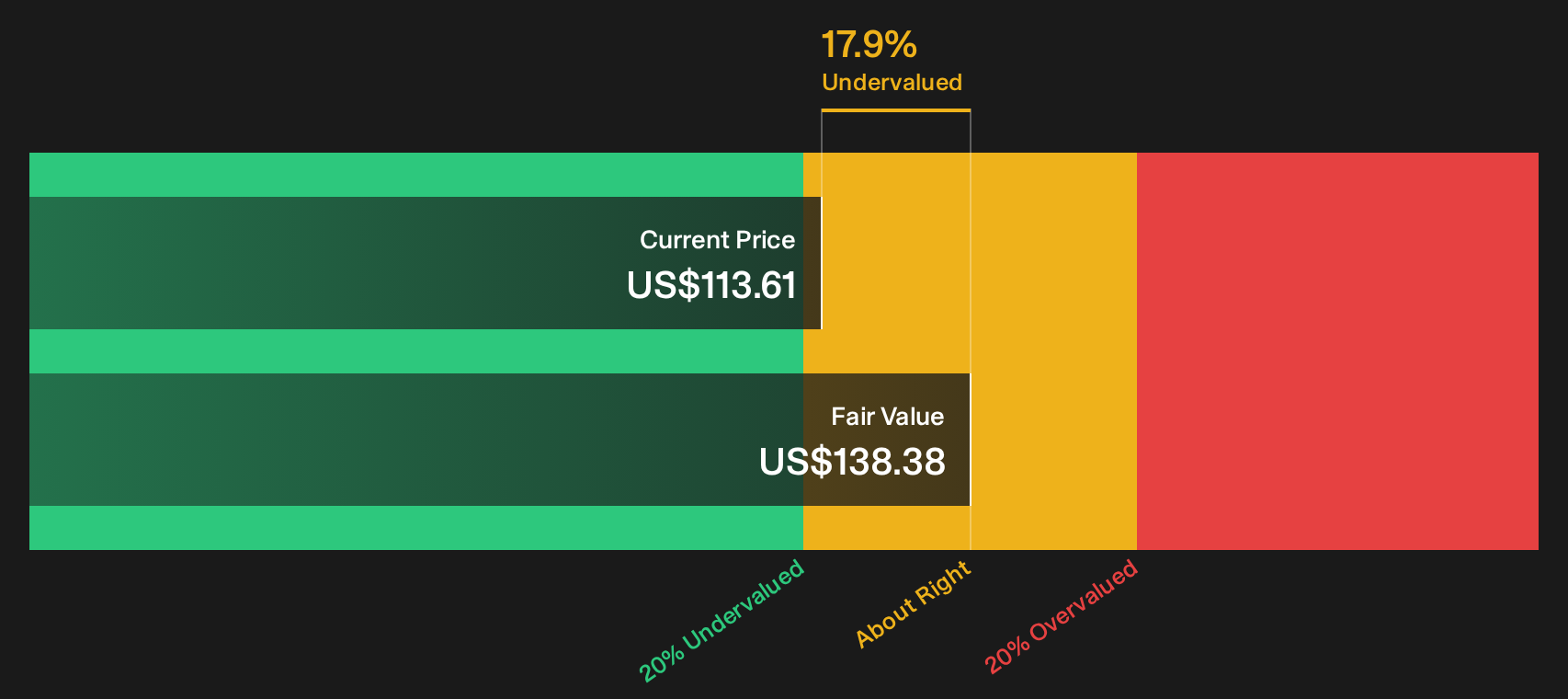
The Discounted Cash Flow (DCF) model here looks at the cash Federal Signal is expected to generate for shareholders over time. On the latest twelve month numbers, the company produced roughly $332.7 million of free cash flow, and the model assumes those cash flows keep growing rather than shrinking.
On that basis, the DCF points to an estimated intrinsic value of about $138 per share. This is above the current market price, which implies Federal Signal stock screens undervalued by roughly 17.9% on this set of cash flow assumptions. The gap is not extreme; however, it is meaningful enough that investors focused on cash generation may view the shares as offering a modest valuation cushion.
On balance, the DCF work suggests Federal Signal currently looks undervalued relative to its projected cash flows.
Our Discounted Cash Flow (DCF) analysis suggests Federal Signal is undervalued by 17.9%. Track this in your watchlist or portfolio, or discover 50 more high quality undervalued stocks.
Where Does Federal Signal Sit on Earnings?
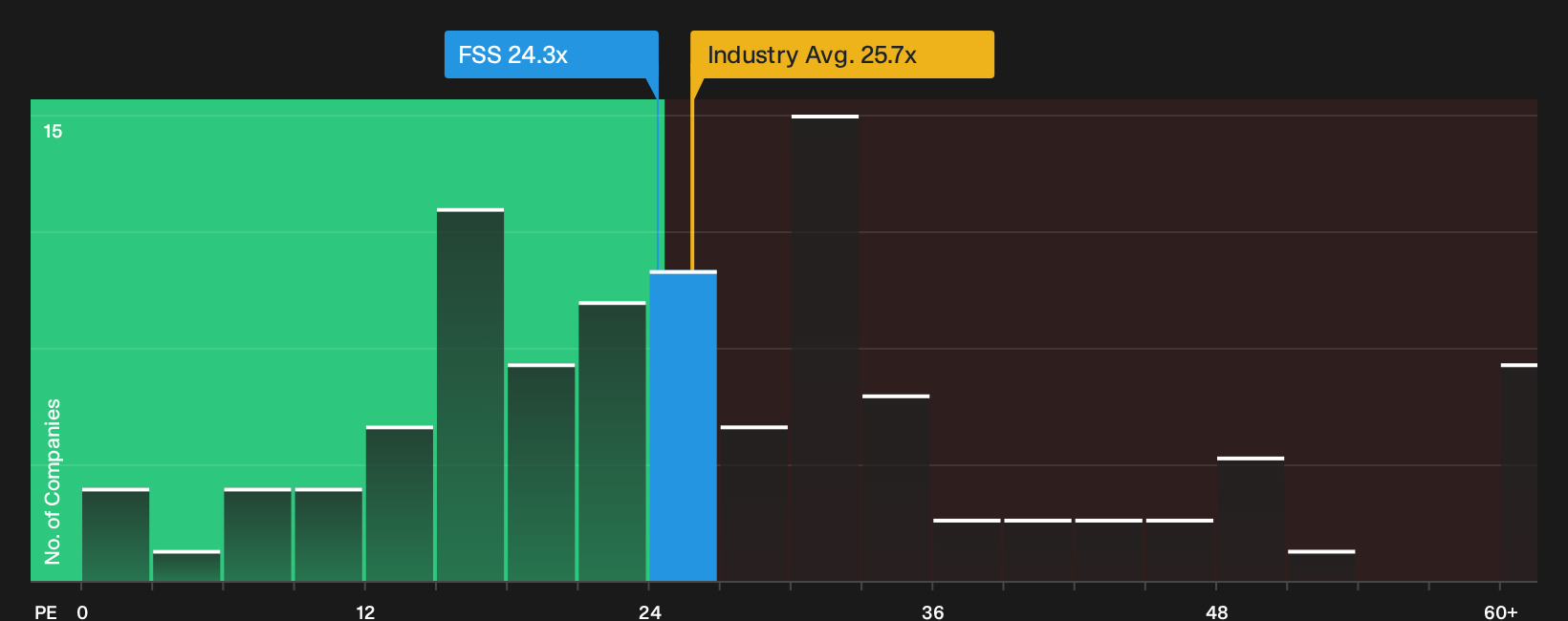
P/E is a useful cross check for Federal Signal because earnings are a central focus for many investors in capital goods stocks. Federal Signal currently trades on a P/E of about 24.3x, which is slightly below the Machinery industry average of roughly 25.7x and close to the peer group average of around 25.0x. That keeps it broadly aligned with other earnings focused industrial companies rather than suggesting a clear discount or premium.
Simply Wall St’s fair P/E estimate for Federal Signal is about 23.0x based on its profile, which is only a small step below the current market multiple. The gap is narrow enough that the P/E does not signal a strong mispricing in either direction, especially when set alongside the stock’s more neutral readings on other valuation checks.
Overall, Federal Signal appears roughly fairly valued on its P/E multiple compared with what the company’s characteristics and industry context might justify.
See what the numbers say about this price — find out in our valuation breakdown.
The Federal Signal Narrative: What Would Justify Today's Price?
Simply Wall St Narratives pick up where the Federal Signal valuation puzzle leaves off, and spell out which paths for growth, margins and earnings would need to play out for the stock to be worth materially more or materially less than today’s price on the Community page. Each one ties its figure to a clear view of how Federal Signal's growth, profitability and risk profile might evolve, which you can revisit as fresh information arrives.
You can add your voice to the Federal Signal story by sharing a Narrative that sets out a clear, number driven view on where its growth, margins and execution go from here. Put your thesis on the record and track how it holds up as new results and updates arrive.
Do you think there's more to the story for Federal Signal? Head over to our Community to see what others are saying!
The Bottom Line
Federal Signal screens as modestly undervalued on a Discounted Cash Flow (DCF) view, while its P/E multiple looks about right compared with peers. That mix points to a stock where the market already prices in a fair share of its qualities, yet does not fully reflect the intrinsic value estimate based on cash generation. The crux from here is whether Federal Signal can keep converting its order book into resilient cash flow and protect margins. If that holds, the current gap between intrinsic value and market pricing may look like an opportunity rather than a value trap.
This article by Simply Wall St is general in nature. We provide commentary based on historical data and analyst forecasts only using an unbiased methodology and our articles are not intended to be financial advice. It does not constitute a recommendation to buy or sell any stock, and does not take account of your objectives, or your financial situation. We aim to bring you long-term focused analysis driven by fundamental data. Note that our analysis may not factor in the latest price-sensitive company announcements or qualitative material. Simply Wall St has no position in any stocks mentioned.
Have feedback on this article? Concerned about the content? Get in touch with us directly. Alternatively, email editorial-team@simplywallst.com