
After Nvidia's performance “broke the game”, Broadcom (AVGO.US) needs the same “big results” tonight to stabilize market confidence
The Zhitong Finance App learned that after Nvidia (NVDA.US) ignited the market with a record quarterly report of US$96.2 billion and 70% growth guidance for the 2028 fiscal year, the spotlight has now turned to Broadcom (AVGO.US). The chip giant, with a market capitalization of about $1.75 trillion, will announce its financial results for the third quarter of the 2026 fiscal year after the US stock market on Wednesday. Wall Street expects this to be an “almost bound to be amazing” earnings report — but the real question is whether this surprise will be enough for investors to forget the night of June and re-believe in Broadcom's AI story.
Erasing 520 billion dollars in three months: a backphage of “perfect expectations”
Since reaching a record high on June 2, Broadcom's stock price has fallen by a cumulative total of about 23%, making it one of the 30 worst performing stocks in the S&P 500 index during the same period. The trigger for this round of sharp decline was that the AI semiconductor revenue guidance in the second fiscal quarter earnings report on June 4 fell short of expectations — the company expected AI semiconductor revenue for the third quarter to be 16 billion US dollars, far below analysts' expectations of more than 17 billion US dollars. The day after the earnings report was released, Broadcom's stock price plummeted by nearly 13%, the worst post-earnings performance since at least 2009.
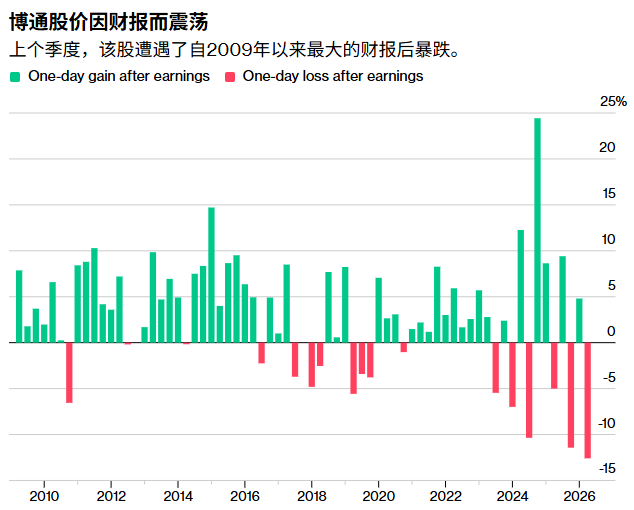
Investors reacted so strongly to this “actually still very strong” guidance because expectations have been pushed to perfection. Earlier, in the first quarter, Broadcom CEO Chen Fuyang predicted that AI chip sales would exceed $100 billion by 2027. This promise pushed market expectations to the extreme — when the $16 billion quarterly guideline “only” met the company's own goals, investors chose to vote with their feet.
Three months have passed, and Broadcom's stock price has pulled back more than 20% from its June high, and the valuation has been significantly compressed. The current stock price is about 21 times the expected earnings for the next 12 months, down from 42 times in December last year and 32 times in June — creating room for a “tactical layout” after the earnings report.
“People did have some concerns about Nvidia before; after all, some of its previous positive news triggered quite a few negative reactions. But last time it had a very positive market response,” said Joanne Feeney, portfolio manager at Advisors Capital Management, which holds Broadcom shares. She added that if management can also give reliable performance predictions, Nvidia's stock price could experience a similar reaction.
Tonight's Key Numbers: Wall Street's “Report Cards” and “Test Papers”
Wall Street analysts expect Broadcom's adjusted earnings per share to soar above $3.22 in the third fiscal quarter, and revenue will increase 84% to $29.4 billion. The numbers themselves are staggering enough — 84% revenue growth is almost unprecedented for a company the size of Broadcom. But as Morgan Stanley pointed out in its pre-earnings report: the real suspense is not whether the third quarter can meet the standards, but rather the fourth quarter's guidance and 2027 outlook.

Morgan Stanley expects fourth-quarter revenue to be around US$34.8 billion, and AI semiconductor revenue will increase 32% month-on-month to US$21.2 billion. The core variable that really drives the valuation — AI revenue forecast for the 2027 fiscal year — is the Morgan Stanley model of 120 billion US dollars, and some investors have already pushed the forecast to more than 150 billion US dollars. The gap between these two numbers is the source of tonight's volatility.
Broadcom had previously set its AI revenue guidance for FY2027 at a level “far above” $100 billion. Damo predicts AI revenue for the 2027 fiscal year, but some investors' expectations have quietly climbed to 150 billion US dollars or even higher.
This $30 billion gap between 120 billion and 150 billion dollars is at the core of the valuation differences. In the headline of the research report, Morgan Stanley stated bluntly: “The main risk before the earnings report is released is market expectations, not fundamentals.” The bank warned: “If it's $120 billion, Broadcom's valuation appears reasonable at the current stock price level; but if it's $150 billion, this stock seems very cheap.”
Feeney said, “They're talking about AI semiconductor revenue reaching 100 billion dollars or more. This 'even more' number is significant. If they could provide more specific information about this' or more 'number, I think the stock price could rise.”
Broadcom has a unique position in the field of AI infrastructure. The company has revealed that 99% of internet traffic goes through at least one Broadcom chip. In the customized ASIC chip market, Broadcom provides core computing power support for Google's TPU, Meta MTIA, etc., and network solutions also penetrate all aspects of data center operations.
Shareholders will also be concerned that demand for chips is not artificially created through revolving finance traders, and whether Broadcom's share in the custom chip market will be encroached upon by competitors such as Alphabet and Maywell Technology. Due to high memory costs, the gross margin of the entire chip industry is under pressure, so gross margin will also be the focus of attention. Additionally, the health of Broadcom's infrastructure software division is critical.
Broadcom is facing competitive pressure from many parties. Google has incorporated Mywell Technology into its custom chip supply chain, raising market concerns about Broadcom's share in Google's TPU business. However, J.P. Morgan analyst Harlan Sur believes these concerns are “exaggerated,” pointing out that Google is adding more partners to support its internal team and TPU ecosystem, but given the five-year agreement signed in early April, Broadcom's position as Google's main TPU partner will not be replaced.
Valuation and risk: A “tactical opportunity” for stock prices to fall back, but market sentiment remains cautious
Broadcom's current valuation has dropped drastically. The stock is currently trading at about 21 times the expected earnings for the next 12 months, slightly 18 times the 10-year average, but it has dropped sharply from 42 times in December last year and 32 times in June. Benchmark analyst Cody Acree pointed out that the stock price is currently trading 19.2 times the EPS estimate for FY2027 and 14.3 times the 2028 fiscal year, which is close to the lower end of the AI peer valuation range.
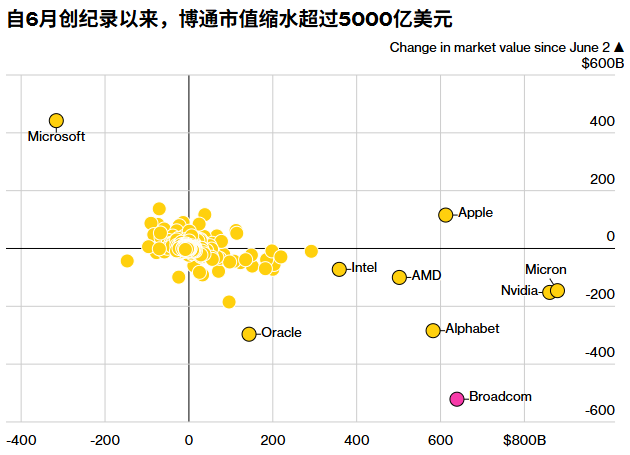
Acree believes this creates an opportunity for a “better tactical layout.” But the point is — if the guidance given on September 2 implied an estimate of $120 billion, then no matter how good the actual results this quarter were, investors expecting to reach $150 billion would be disappointed.
Of course, even if all factors eventually converge into a reliable report, Broadcom's stock price may still be hampered as investors are wary of many aspects of AI trading.
At the time of the release of this earnings report, major players in the artificial intelligence industry had mixed earnings season performance. Hyperscale data center operators are still planning to invest hundreds of billions of dollars in infrastructure construction, but resources are limited, and investors are increasingly concerned about return on investment.
“There is a sense of fear in the market,” said Jamie Meyers, a senior stock analyst at Laffer Tengler Investments, who holds Broadcom shares. “This fear is not just about Broadcom, but the entire industry is a problem.”
“I think they're all daunted now that the momentum has been hit hard,” said Kim Forrest, chief investment officer at Bokeh Capital Partners.
Meyers's summary hit the nail on the head: “Chen Fuyang's message is very clear — the growth trajectory is sustainable and is accelerating”. But as Jay Woods, chief market strategist at Freedom Capital Markets, said: “Nvidia has proven that the AI party is not over yet, and now Broadcom needs to prove that it has received a bigger invitation.”