
Is Analog Devices Stock Outperforming the Nasdaq?
Wilmington, Massachusetts-based Analog Devices, Inc. (ADI) designs, manufactures, tests, and markets integrated circuits (ICs), software, and subsystems products. Valued at $171.8 billion by market cap, the company's products are used in communications, computer, industrial, instrumentation, military, aerospace, automotive, and high-performance consumer electronics applications.
Companies worth $10 billion or more are generally described as “large-cap stocks,” and ADI definitely fits that description, with its market cap exceeding this threshold, reflecting its substantial size, influence, and dominance in the semiconductors industry. ADI commands a strong competitive position in high-performance analog and mixed-signal semiconductors, underpinned by its global leadership in data converters. Its moat is built on a deep proprietary IP portfolio, entrenched relationships in high-margin industrial, automotive and healthcare markets, and expanded signal-chain and power management capabilities from strategic acquisitions. The company further benefits from a resilient hybrid manufacturing model and strong pricing power, supported by the long, sticky lifecycles typical of critical analog components.
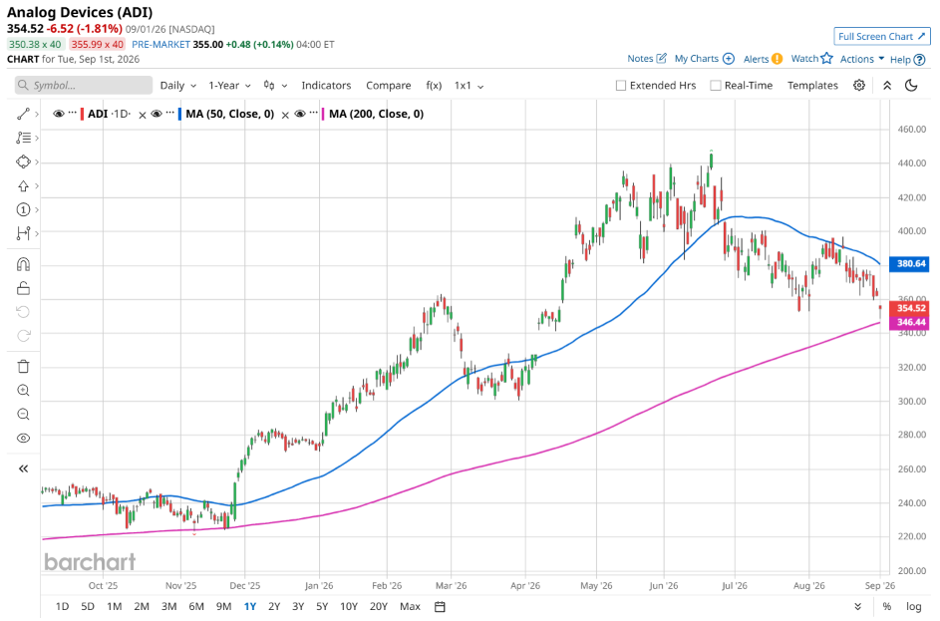
Despite its notable strength, ADI slipped 20.5% from its 52-week high of $445.91, achieved on Jun. 22. Over the past three months, ADI stock declined 12%, underperforming the Nasdaq Composite’s ($NASX) 3.6% dip during the same time frame.
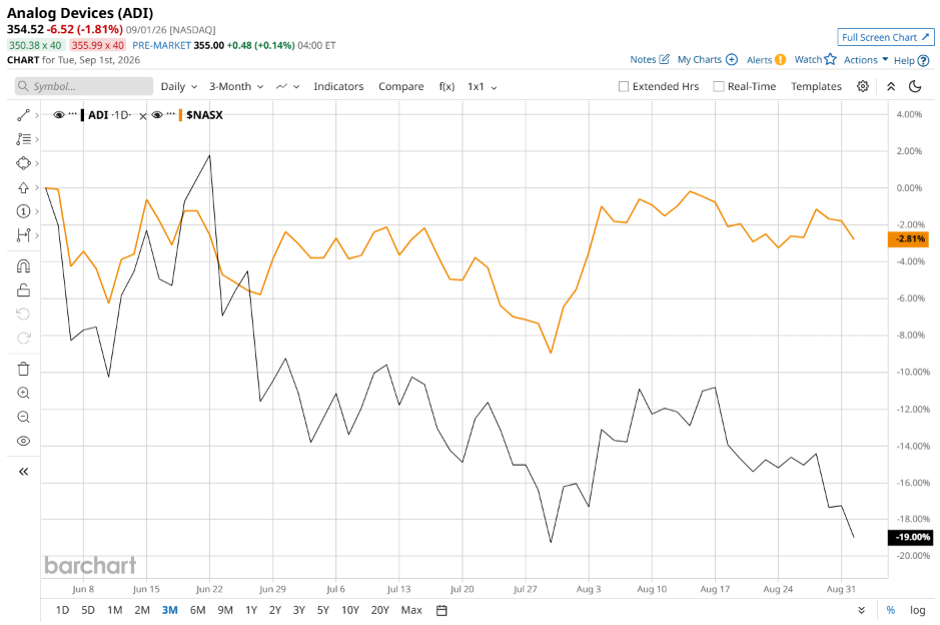
Shares of ADI rose 30.7% on a YTD basis and climbed 41.1% over the past 52 weeks, outperforming NASX’s YTD gains of 12.3% and 21.7% returns over the last year.
To confirm the bullish trend, ADI has been trading above its 200-day moving average over the past year, with slight fluctuations. However, the stock is trading below its 50-day moving average since late June, with minor fluctuations.
ADI’s outperformance reflects broad-based and strengthening demand for its analog solutions, increasingly tied to AI. While data center remains the primary growth driver today, its build-out and adoption are still in the early stages, and industrial demand is also gaining momentum. With strength expected to persist across segments, the AI-led semiconductor supercycle appears well-positioned to play out over multiple years.
On Aug. 19, ADI shares closed down marginally after reporting its Q3 results. Its adjusted EPS of $3.45 surpassed Wall Street expectations of $3.33. The company’s revenue was $4 billion, topping Wall Street forecasts of $3.9 billion. For Q4, ADI expects its adjusted EPS to range from $3.71 to $4.01, and revenue in the range of $4.2 billion to $4.4 billion.
In the competitive arena of semiconductors, Texas Instruments Incorporated (TXN) has taken the lead over the stock, with a 46% gain on a YTD basis, but lagged behind the stock, with a 25.1% uptick over the past 52 weeks.
Wall Street analysts are bullish on ADI’s prospects. The stock has a consensus “Strong Buy” rating from the 32 analysts covering it, and the mean price target of $463.35 suggests a notable potential upside of 30.7% from current price levels.
On the date of publication, Neha Panjwani did not have (either directly or indirectly) positions in any of the securities mentioned in this article. All information and data in this article is solely for informational purposes. For more information please view the Barchart Disclosure Policy here.