
Strategy’s Strategy Appears to Have Failed, and the Outlook of MSTR Stock Is Unfavorable
Although Bitcoin (BTCUSD) rallied in August and Strategy (MSTR) recently resumed buying Bitcoin after a two-month hiatus, Strategy's strategy has mostly been a failure. As of Sept. 1, the average price at which the company acquired Bitcoin stood at about $75,412. Even after President Donald Trump boosted Bitcoin prices with positive remarks about crypto last month and Treasury Secretary Scott Bessent pitched in with his bond buyback plan, the cryptocurrency was changing hands overnight on Sept. 2 at about $77,275. In other words, after a big rally by Bitcoin, its prices are still only slightly below Strategy's average purchase price. And after all the company's compensation, interest, and dividend costs, it certainly appears to be losing a great deal of money, not only on paper, but also in terms of its overall investment approach.
Reflecting this situation, MSTR stock, despite its recent rally, has still slumped 19% so far in 2026 and 63% in the year that ended on Sept. 1. Further, Strategy Executive Chairman Michael Saylor, by repeatedly selling Bitcoin earlier this year and indicating that the company will start lending on a massive scale, has implicitly admitted that the firm's current business model, which is basically entirely dependent on buying Bitcoin and hoping it goes up, is broken.
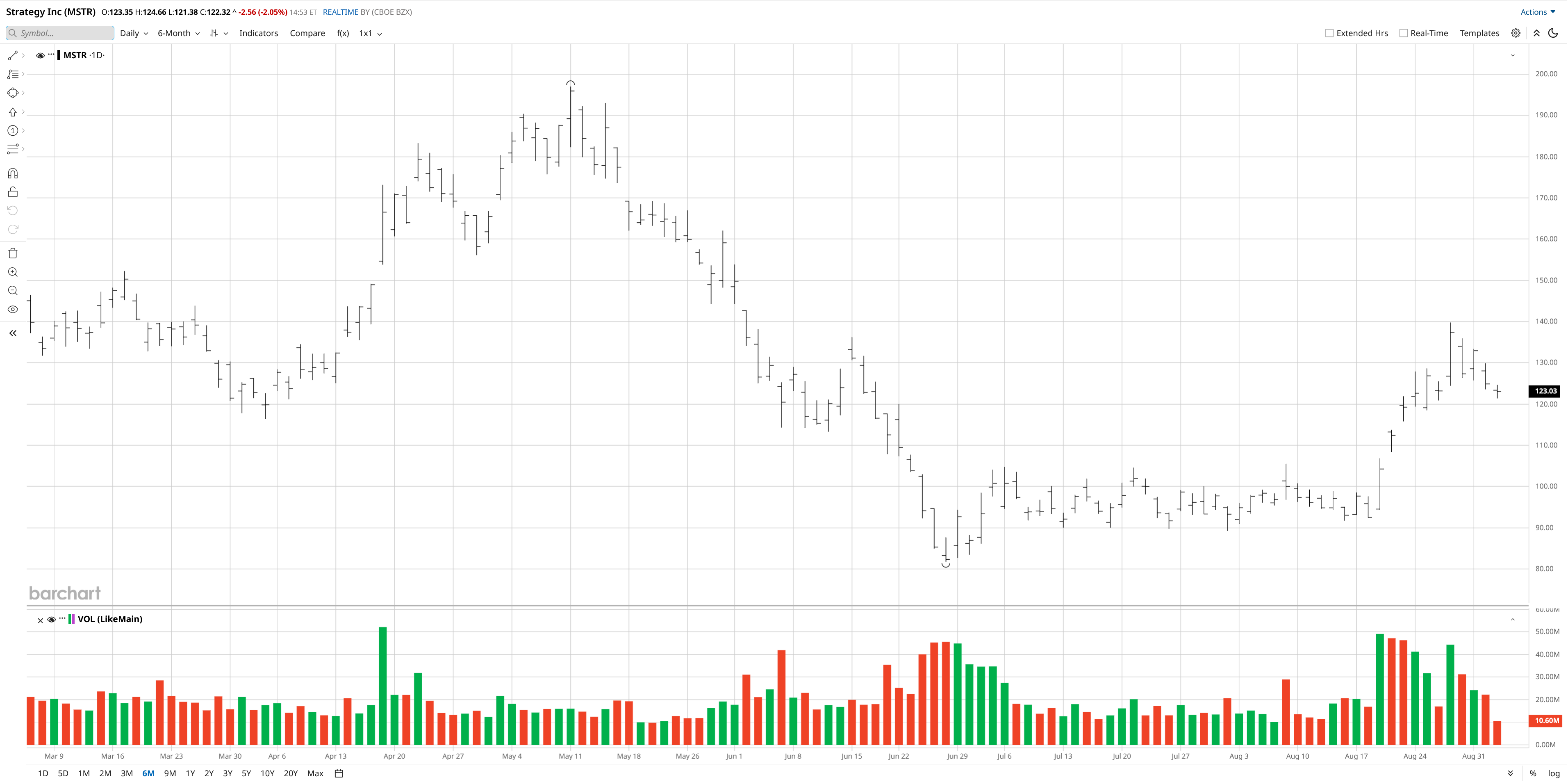
Moreover, for reasons that I'll discuss below, Bitcoin's medium-to-long-term outlook is not especially positive, and there's a good chance that Saylor's lending plan will not work very well.
The Macroeconomic Outlook Is Negative for Bitcoin
The cryptocurrency's biggest positive attribute was supposed to be its ability to retain its value more effectively than other assets, such as the dollar and gold. But even after Bitcoin's recent upturn, in the year that ended on Sept. 1, it plunged about 30%, and it has sunk nearly 40% from its all-time high.
As multi-billionaire Mark Cuban noted shortly after he sold the majority of his Bitcoin holdings in May, “I always thought (Bitcoin) was a better version of gold than gold. Well, gold just blew up... Bitcoin dropped.”
Indeed, Bitcoin was supposed to thrive if the dollar weakened, America's huge, ballooning debt continued to soar, and inflation stayed high. Instead, the exact opposite phenomenon has occurred, as the cryptocurrency, all else being equal, has tended to weaken as interest rates rise amid America's debt struggles and elevated inflation.
And with rates likely to stay elevated as these issues continue to fester, the macroeconomic environment for Bitcoin is unlikely to be positive for the foreseeable future.
The Political Environment Is Not Especially Favorable
The Clarity Act, a law being considered by Congress that would be positive for the crypto sector, is unlikely to pass in 2026, according to “many” within the space itself, CNBC reported on Sept. 1. And with Democrats, who are likely to obtain a majority in one or both houses of Congress next year, largely hostile to crypto, the political outlook for Bitcoin is likely to deteriorate further in 2027.
Trump may seek to help the sector with favorable regulations. But he's also historically tried mightily to boost the nation's large banks, and they appear to be at best wary of crypto. Banks, for example, have sought to derail the Clarity Act, and JPMorgan (JPM) CEO Jamie Dimon harshly criticized Coinbase (COIN), the leading crypto exchange.
Amid opposition to crypto by Congressional Democrats and big banks, the Trump administration will likely find it difficult to meaningfully help the sector.
Saylor's Lending Plan May Not Lift MSTR Stock Much
In August, Saylor stated that Strategy would look to get into the lending business. However, there are already many lenders and nonbank lenders in the U.S. As a latecomer to this crowded sector that does not have a significant retail customer base, Strategy may struggle to gain market share.
Providing evidence for this assertion is SoFi (SOFI). The latter company sought to transition from being primarily a provider of student loans to more of a general lender. In the five years that ended on Sept. 1, its shares had only risen by 17%, after they tumbled 35% in 2026.
For all of these reasons, I do not recommend that investors own MSTR stock.
On the date of publication, Larry Ramer did not have (either directly or indirectly) positions in any of the securities mentioned in this article. All information and data in this article is solely for informational purposes. For more information please view the Barchart Disclosure Policy here.