
Higher Bond Yields Are Changing The Case For Aon Stock And Global Life Insurers
Global bond markets have been under pressure since 2022, and higher long term yields are quietly reshaping where risks and opportunities sit in equities. That shift matters if you care about how rising real yields affect cash flows, balance sheets and valuations. This article walks through three life insurance and annuity stocks exposed to the latest rate moves, and explains how the same news can create opportunity or caution for your portfolio.
The stocks covered below are just a starting sample, and the full screen surfaced 10 more global life insurers and annuity providers with equally compelling narratives that are not included in this article.
To identify and analyze the highest conviction ideas tailored to your own risk and income goals, head straight into the Global Life Insurers and Annuity Providers Benefiting from Higher Long-Term Yields screener
Japan Post Holdings (TSE:6178)
Japan Post Holdings is a sprawling financial and logistics group built around postal services, banking and a large life insurance operation. This fits the screener’s focus on insurers and annuity providers that invest heavily in fixed-income assets and can potentially benefit from higher long-term reinvestment yields. Revenue is dominated by the Life Insurance Business at about ¥5,556b, followed by Banking at about ¥3,033b and Postal and Logistics at about ¥2,303b, with additional contributions from the Post Office Counter, International Logistics, Real Estate and Other segments. The company is sizeable, with a market cap of roughly ¥6,882b.
Japan Post Holdings gives you a mix of life insurance, banking and postal services that can all be influenced in different ways by higher long-term bond yields. The large insurance and savings portfolios are positioned to reinvest at higher rates, yet relatively low returns on equity and pressure on dividend coverage raise questions about how much of that benefit flows through to shareholders. Recent guidance for higher earnings and an increased dividend indicates that management is leaning into the yield opportunity, while ongoing cost pressure in the postal business and modest margin levels keep risk on the table. For investors seeking a large, domestically anchored financial group with a complex but yield-sensitive profile, this is one worth watching more closely.
Japan Post Holdings sits at the crossroad of higher reinvestment yields and tight dividend cover, which many investors may be overlooking. To see how that trade off really looks in the numbers, start with the 1 key reward and 1 important warning sign

Wüstenrot & Württembergische (XTRA:WUW)
Wüstenrot & Württembergische is a German insurer and annuity provider that fits this screener because its life and pension products are backed by large fixed-income portfolios that are sensitive to long-term bond yields. The group generates most of its roughly €6.6b in segment revenue from Property/Casualty Insurance at about €3.1b and Life and Health Insurance at about €2.3b, with Housing at about €1.2b and All Other activities at about €225 million. The company has a market cap of about €1.3b, which puts it in mid cap territory for German financials.
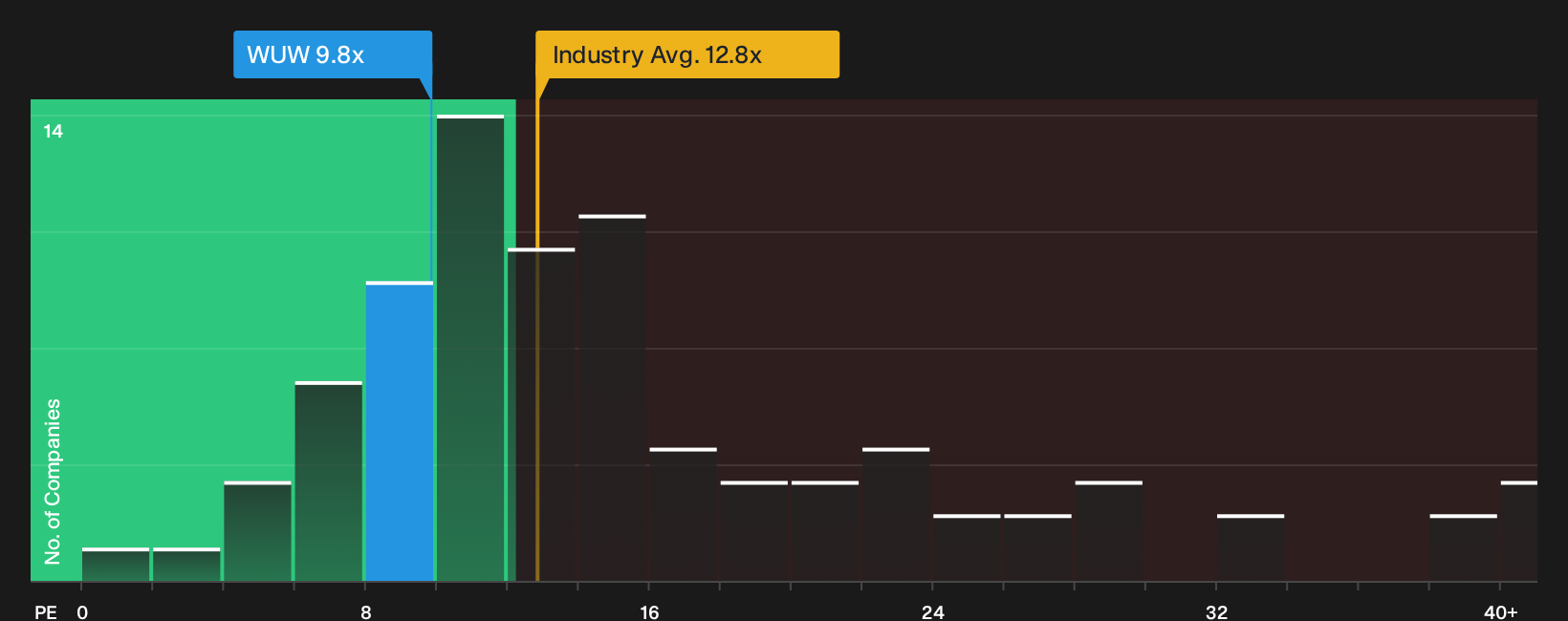
Wüstenrot & Württembergische brings together classic life and pension policies, property and casualty cover and a sizeable housing finance arm. This structure makes its balance sheet closely tied to long-term yields on bonds and mortgages. That link can help earnings if reinvestment rates improve, yet low current returns on equity and tight margins leave little room for error if funding costs rise. The stock trades on a low P/E with a 4.6% dividend yield, but dividend coverage from free cash flow looks thin, so income focused investors need to weigh the payout against the underlying cash generation. With earnings guidance out to 2026 and recent half year profits of €104 million showing some momentum, the key issue is how this insurer manages the trade off between higher yield opportunities and a highly leveraged funding mix that increases interest rate sensitivity.
Wüstenrot & Württembergische looks like a low P/E income play, yet thin free cash flow cover and a highly leveraged funding mix could be masking the real trade off. Get the full picture in the 3 key rewards and 1 important warning sign
Aon (AON)
Aon is a global professional services firm that advises clients on risk, reinsurance and human capital issues, so its link to higher long term yields comes mainly through client demand for pension risk transfers and investment advice rather than running large life insurance balance sheets itself. The Risk Capital segment generates about US$11.7b of revenue and the Human Capital segment adds roughly US$5.9b, with only small corporate eliminations. Aon is a large player in this space, with a market cap of about US$69.2b.
Investors looking at Aon today are really weighing a high quality, fee based business with strong pension and risk advisory capabilities against a heavier debt load and slower forecast earnings growth. Higher long term yields are helping fuel pension risk transfer activity and demand for advice, while the US$17b USI acquisition and ongoing deals build a much bigger middle market platform. The trade off is more leverage and a pause in buybacks. Future value depends on how well Aon turns scale, Aon Business Services efficiencies and its Sidecar X and reinsurance offerings into lasting cash flow. For investors who prefer a business that benefits more from client activity than from owning bond portfolios, Aon may warrant a closer look.
Aon’s pension and risk advisory engine appears structured for higher-yield conditions, yet the real story lies in how cash flow and leverage balance out in the analyst forecasts for Aon that could change the risk profile.

Seeking Alternatives Before Momentum Takes Off
Fresh ideas do not stay under the radar for long. Some stocks are already building breakout momentum while others are dropping into better value zones. Before the crowd catches up, consider taking action early.
- Target reliable income streams while rates move by scanning curated companies in the 1 dividend fortresses before yields are affected by a potential rush of new buyers.
- Track the next leg of infrastructure and electrification momentum by following potential beneficiaries in the 39 power grid technology and infrastructure stocks before capital flows reprice the strongest operators.
- Review potential AI infrastructure opportunities and explore the hand picked companies inside the 55 AI infrastructure stocks while valuations still reflect early stage expectations.
This article by Simply Wall St is general in nature. We provide commentary based on historical data and analyst forecasts only using an unbiased methodology and our articles are not intended to be financial advice. It does not constitute a recommendation to buy or sell any stock, and does not take account of your objectives, or your financial situation. We aim to bring you long-term focused analysis driven by fundamental data. Note that our analysis may not factor in the latest price-sensitive company announcements or qualitative material. Simply Wall St has no position in any stocks mentioned.
Have feedback on this article? Concerned about the content? Get in touch with us directly. Alternatively, email editorial-team@simplywallst.com