
Workday (WDAY) Adds Government Wins And Buyback Support, Is The Upside Already Priced In?
Workday (WDAY) is back in focus after a string of customer announcements, including fresh wins across U.S. state and local governments and new partnerships that plug its HR and finance platform into broader enterprise ecosystems.
Those government wins and ecosystem partnerships come on the heels of a busy few weeks for Workday, including second quarter results, fresh subscription guidance and a new US$4.0b share repurchase plan. They also coincide with a sharp 30 day share price return of 21.70% and a 90 day share price return of 35.81%. This contrasts with a year to date share price return that is slightly down 2.39% and a 1 year total shareholder return that is down 13.95%, indicating that recent momentum has improved even as longer term holders are still sitting on losses.
Compare Workday's recent momentum and government wins with a curated set of other enterprise software stocks using the 19 high quality undiscovered gems as a starting point for fresh ideas.
Workday now has recent results, AI products and government wins to point to, and a US$4.0b buyback behind it. After a 35.81% 90 day move, is this strength sensibly priced today or already reflected?
Most Popular Workday Narrative: 63.5% Undervalued
According to the most widely followed Workday narrative, a fair value of $550.10 sits far above the recent $200.87 close. This frames today’s rebound in a different light.
The multi-year path this points toward is incremental, not speculative. Existing customers expand into agent-based workflows on top of subscriptions they already pay for. Backlog continues converting into recognized revenue at a predictable pace, and margin continues widening as the AI investment amortizes across a larger revenue base.
Want to see why this narrative still points far above the current share price? The key levers are backlog conversion, margin shaping and how Workday prices its AI driven add ons into that existing customer base.
According to John_Eric, the fair value hinges on how quickly contracted backlog turns into cash, how efficiently Workday scales profitability and how much incremental contribution comes from AI agents on top of the core HR and finance subscriptions. The interesting part for readers is how those moving pieces combine into a valuation that is far above where the stock trades today, even after the recent rebound.
Result: Fair Value of $550.10 (UNDERVALUED)
Have a read of the narrative in full and understand what's behind the forecasts.
However, this Workday narrative still hinges on assumptions that could break. Slower backlog conversion or weaker AI add on uptake would quickly challenge the current fair value case.
Find out about the key risks to this Workday narrative.
Another View On Workday’s Valuation
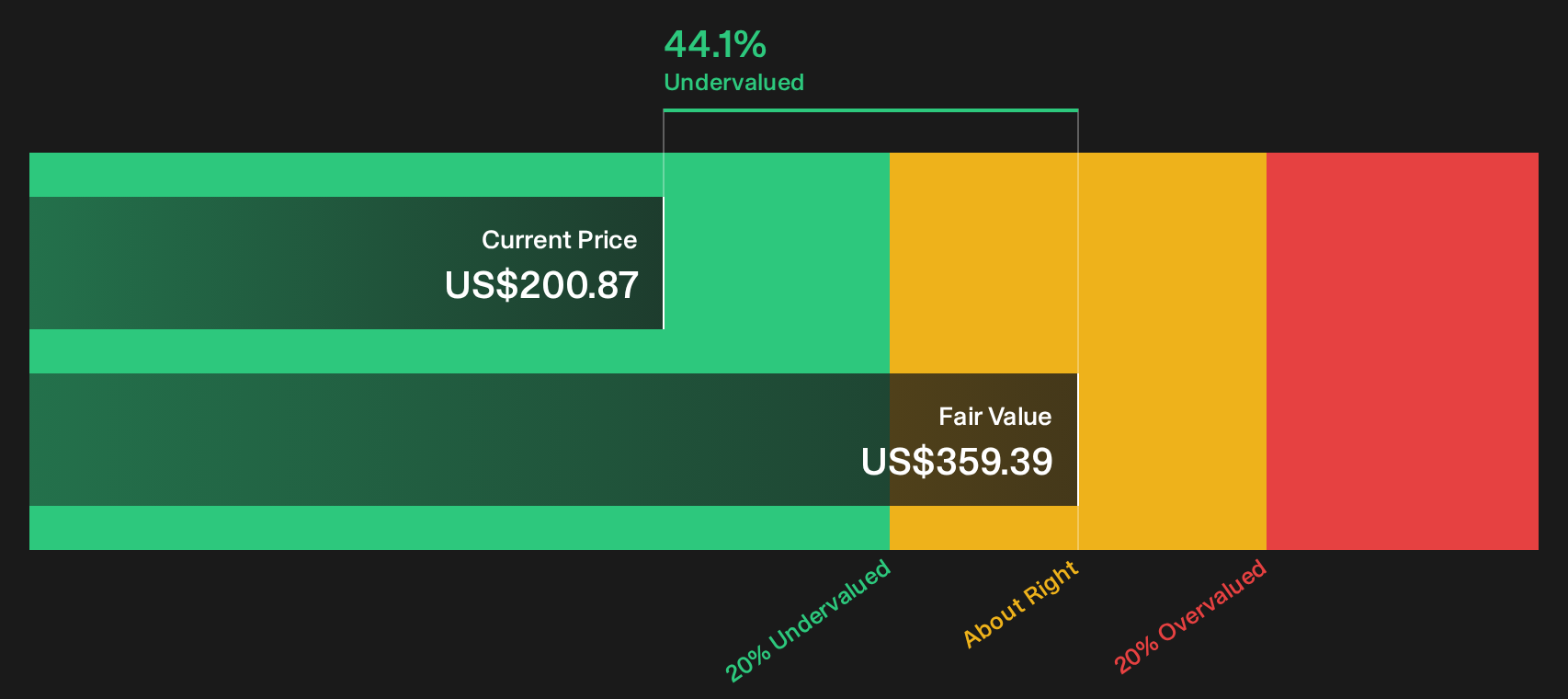
The user narrative points to a fair value of $550.10, however our DCF model presents a more restrained picture. On Simply Wall St estimates, Workday at $200.87 trades about 44.1% below a future cash flow value of $359.24, which still implies upside but on a smaller scale. Which version of “undervalued” appears more realistic to you?
If you want to see exactly how this second view is constructed, the full SWS DCF model for Workday is broken out step by step in the Look into how the SWS DCF model arrives at its fair value.
Next Steps
With sentiment on Workday clearly mixed, use this as a prompt to move quickly through the key facts and form your own stance using the 3 key rewards.
Looking for more investment ideas beyond Workday?
If you stop with Workday, you might miss other opportunities that fit your style and risk comfort, so widen your search now with focused screeners.
- Target potential mispricing by scanning a focused group of companies that may trade below their fundamentals using the 54 high quality undervalued stocks.
- Strengthen your focus on balance sheet resilience by checking companies with robust financial footing through the list of solid balance sheet and fundamentals (52 results).
- Spot opportunities that others may overlook by reviewing a curated 19 high quality undiscovered gems.
This article by Simply Wall St is general in nature. We provide commentary based on historical data and analyst forecasts only using an unbiased methodology and our articles are not intended to be financial advice. It does not constitute a recommendation to buy or sell any stock, and does not take account of your objectives, or your financial situation. We aim to bring you long-term focused analysis driven by fundamental data. Note that our analysis may not factor in the latest price-sensitive company announcements or qualitative material. Simply Wall St has no position in any stocks mentioned.
Have feedback on this article? Concerned about the content? Get in touch with us directly. Alternatively, email editorial-team@simplywallst.com