
After Trump announced the Venezuelan oil agreement, Chevron (CVX.US) and ENI (E.US) led a deal to increase production by tens of billions of dollars
The Zhitong Finance App learned that executives from Chevron (CVX.US), GE Vernova (GEV.US), and ENI Group (E.US), along with US Secretary of Energy Chris Wright and Acting Venezuelan President Delcy Rodriguez, jointly announced a series of energy agreements aimed at increasing crude oil production in this South American country.
The companies announced these agreements at a signing ceremony in Caracas on Wednesday. Wright said at the ceremony that these deals represented “tens of billions of dollars” of investment and marked “Venezuela's transformation.” Rodriguez said that these historic steps will soon boost economic growth, while thanking US President Trump and his administration for their efforts to reach a “win-win” agreement.
These deals represent the largest capital investment by energy companies in the country since US special forces captured former Venezuelan leader Nicolas Maduro in January this year. Just nine months after Maduro stepped down, the Trump administration made significant progress in its goal of drastically increasing American crude oil production.
Venezuela has the world's largest fossil fuel reserves, yet years of mismanagement, corruption, and sanctions have decimated its fossil fuel industry.
Trump announced a plan late last week to take control of a majority stake in Venezuela's huge oil wealth in an unprecedented move. Officials say the move will create the world's second-largest private oil company with reserves. However, the plan has also been heavily criticized. Critics believe that Venezuela will become a modern resource colony similar to the so-called “banana republic” a century ago, which may pose long-term risks to oil companies operating in Venezuela.
The US government reached an agreement with Venezuelan entrepreneur Alejandro Betancourt (Alejandro Betancourt) to acquire 35% of its shares in North American Blue Energy Partners (NABEP). The company is a privately owned company with 100-year concessions for 17 oil fields in Venezuela. Betancourt is a controversial figure in Venezuela, but the Trump administration defended its decision to cooperate with this investor.
America's current action is only a few months away from Trump putting forward his so-called “Tang Luo Doctrine” concept. The “Tang Luo Doctrine” is the 21st century version of the Monroe Doctrine, which aims to warn European powers not to interfere in Western hemisphere affairs. These developments have prompted analysts and scholars to look back to the early days of neocolonialism, when the US had too much influence over Latin America and its natural resources.
Wright said at the ceremony, “We have a strong interest in expanding energy production in the Americas. This is our turf.”
Chevron plans to invest $7 billion over the next five years through its joint venture partnership to more than double Venezuela's crude oil production. This is the largest capital investment in the US government-led plan to boost Venezuelan crude oil production so far. Chevron said in a statement on Wednesday that the company has obtained the rights to develop two giant oil fields in the Carabobo region of the Orinoco oil belt. The two oil fields are the Carabobo 1 oil field and the Carabobo-2-South-A oil field, respectively, and are adjacent to the PetroIndependence joint venture in which Chevron holds 49% of its shares.
CEO Mike Vos said in an interview: “We are establishing a very strong position in one of the regions with the best geological conditions in Venezuela. It contains billions of barrels of oil.”
Worth declined to comment on the US investment in NABEP, but he appreciated the Trump administration's commitment to finding a “business solution” that would benefit both countries. “The US government realizes that Venezuela's energy resources can be both the engine of America's energy security and the engine of Venezuela's economic recovery.”
He said Chevron set up “important protections” in the agreement to protect its investment, but declined to disclose contract details. He also said that the company expects to write off some of Venezuela's oil reserves a few years ago and then put them back on the books.
Claudio Descalzi, CEO of Italy's ENI Group, announced at a ceremony held at the presidential palace in Caracas that the ENI Group will commence drilling operations in the Junin 5 block on Thursday. Descalzi said the Junin 5 block contains more than 35 trillion cubic feet of natural gas and has “huge potential.” The Eni Group said in a statement that its 25-year contract makes it the sole operator of the Junin 5 block. The ENI Group plans to announce the development plans for this plot in October.
According to details revealed at the ceremony, GE Vernova has promised to establish a strategic alliance with the Venezuelan National Petroleum Company (PDVSA) to restore and enhance power and energy infrastructure. The Venezuelan National Electricity Company (Corpoelec) also signed an agreement with GE Vernova. According to the US Department of Energy, GE Vernova plans to add 1 gigawatt of power generation capacity within the next 24 months and 5 gigawatts over the next 4 years. One gigawatt is equivalent to the electricity generated by a conventional nuclear reactor.
In an interview in Caracas, Wright said that efforts are also currently being made to restructure Venezuela's debt. In an interview, Wright said, “Venezuela is burdened with a heavy historical debt. The development of these oil fields will benefit the people of Venezuela, the American people, and the global energy market.”
In a separate interview in Caracas, Vos said that the increase in Venezuela's supply will “gradually” affect the market and will not quickly resolve the problem of disrupted shipping in the Strait of Hormuz. “The progression cycle of these things varies, and investing in Venezuela takes years,” he said.
Until now, smaller private companies have dominated the US-Venezuela oil deal negotiations. Progress is slow, and they don't have the financial resources like Chevron to buy large-scale drilling and production equipment to increase production.
Chevron expects that by 2031, its oil production in Venezuela will reach about 600,000 barrels per day, more than double the current production. The company said in a press release that Venezuela's rich oil potential will continue for “decades,” and the total cost is expected to be less than $20 per barrel.
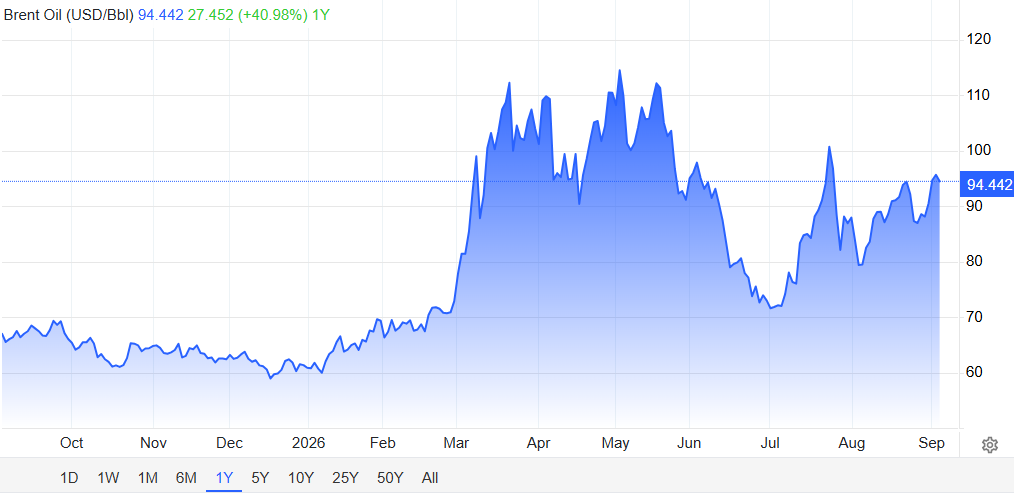
The price of Brent crude oil was around $95 per barrel on Wednesday, which meant that profit margins were considerable. Chevron usually exports its Venezuelan crude oil to refineries along the US Gulf Coast, which process it into products such as gasoline, diesel, and aviation kerosene.
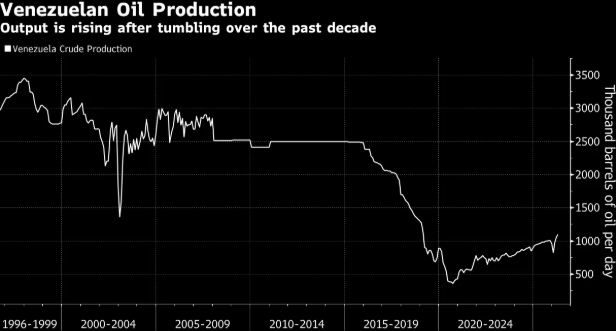
Chevron will supply an additional 300,000 barrels of crude oil per day over the next five years, increasing Venezuela's crude oil production by nearly 30% to about 1.1 million barrels per day. Even so, without further investment, Venezuela's crude oil production would still be far below the nearly 3.5 million barrels per day in the late 90s, when former Venezuelan President Hugo Chávez had not nationalized the oil industry.
Competitors ExxonMobil (XOM.US) and ConocoPhillips (COP.US) withdrew from Venezuela after their assets were nationalized in the mid-2000s. However, Chevron chose to stay and reached an agreement through negotiations, allowing it to continue extracting crude oil. This unusual arrangement has drawn criticism in both the US and Venezuela.
American critics accuse the company of sending money to corrupt regimes, while some in Venezuela see it as an enduring symbol of American imperialism. Over the past ten years, Chevron's business has been greatly restricted due to the sanctions that the US sometimes imposed and lifted from time to time. This mainly limited its business to maintaining equipment and recovering debts owed by its partner, the Venezuelan National Petroleum Company (PDVSA).
Chevron, on the other hand, said that its presence in Venezuela helped stabilize the country's economy, provided dollars during periods of hyperinflation and economic turmoil, and also supplied crude oil to the global oil market. Furthermore, after the Trump administration overthrew Maduro's regime earlier this year, Chevron was in an advantageous position as a result.
Voss said the deal was due to the good state of Chevron's existing business in the country. “This is thanks to the dedication and commitment of these amazing employees who have overcome years of uncertainty and anxiety.”