
The turbulence in the bond market and the “curse” of September became a key test for US stocks! Barclays calls for investors to reduce risk exposure
The Zhitong Finance App learned that Emmanuel Cau, head of European equity strategy at Barclays Bank, said that seasonal factors in September, upcoming midterm elections, interest rate fluctuations, and upcoming artificial intelligence (AI) related IPOs are further strengthening the reasons for stock investors to selectively reduce risk exposure.
Emmanuel Cau said that after a “complicated” summer, investors are now facing an unsettling September, and multiple catalysts over the next few days are likely to determine the tone of the market. Among them, rising bond yields are a major concern facing stock investors. The market is increasingly worried that rising oil prices will drive up inflation, which has pushed 10-year US Treasury yields to 4.8%, approaching 5%, which is generally viewed as bad for stocks. Market speculation that the Federal Reserve will be forced to raise interest rates is also increasing, which has also boosted bond yields. He stressed, “If the bond market does not achieve a certain level of stability, it is difficult to see the stock market continue to rise. I think there are reasons to selectively reduce beta exposure now.”
Emmanuel Cau believes that interest rate trends are the “elephant in the room” facing the stock market, and the Fed's reliance on data is driving market fluctuations. He said that if the US inflation and employment data released in the next few days weaken, the stock market may continue to rise; conversely, if the data is stronger than expected, “the market will begin to become more tense.” He added: “The market is once again becoming more sensitive to interest rate fluctuations. If the 10-year US Treasury yield reaches 5%, I doubt people will be more concerned about its impact on the stock market.”
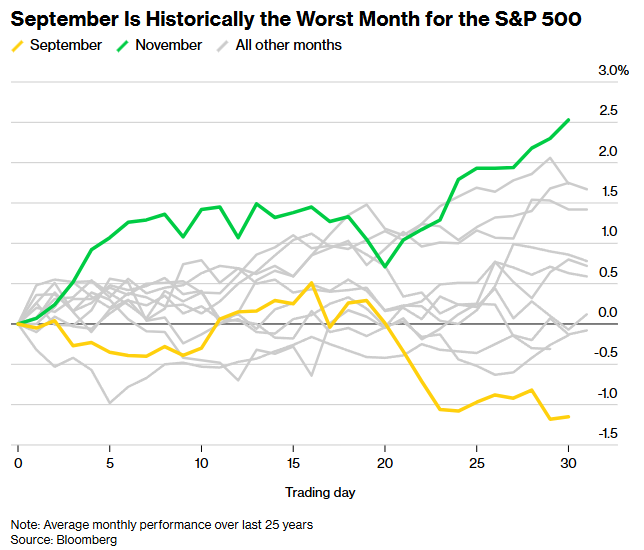
September has historically been the worst performing month for the S&P 500
Judging from statistics, September has always been a month of weak stock market performance. In addition to the bond market currently dominating market trends, Emmanuel Cau also mentioned possible upcoming large-scale IPOs because investors are concerned that these new stock issuances may suck out liquidity from the market.
It is worth mentioning that Grace Peters, head of global investment strategy at J.P. Morgan Chase Private Bank, also recently stated that as the stock market enters a historically weak September, rising bond yields pose a major risk to global stock markets. She believes that both the US and European stock markets have room for further growth this year, but at the same time warned that before risky events such as the US midterm elections in November arrive, the stock market may experience a 5% to 8% correction. However, she sees this as a healthy return to profit rather than a structural collapse.
Grace Peters said, “The 5% yield will have a psychological impact, and I think the stock market may react in a knee-jerk manner to this. Especially considering the seasonal factors in September, the midterm elections, and the catalytic effects of the second-quarter earnings season are over.”