
Societe Generale gave a “hawkish prediction+an antidote to the bull market”: the Federal Reserve will raise interest rates three times, but historical rules point to “buying on falling” US stocks
The Zhitong Finance App learned that after Federal Reserve Chairman Kevin Walsh delivered a hawkish speech at the Jackson Hole Global Central Bank Annual Meeting, Société Générale officially raised its forecast for the Fed's interest rate path, becoming one of the most aggressive investment banks on Wall Street. As the Federal Reserve enters the countdown to its September interest rate meeting, Societe Generale expects the Federal Reserve to raise interest rates three times in September, December, and March 2027, by 25 basis points each. However, Manish Kabra, head of US stock strategy at Societe Generale Bank, added a “bull market antidote” to this hawkish prediction: historical rules suggest that investors should buy in the midst of any stock market weakness caused by the Federal Reserve's interest rate hike.
Inflation is “intransigent”: the three major drivers of the shift from Societe Generale to interest rate hikes
In its report, the bank detailed the three core drivers that prompted the bank to move from “suspending rate hikes” to “supporting interest rate hikes.”
First, core inflation continues to be higher than pre-pandemic levels. Core personal consumption expenditure (PCE) inflation — particularly in the service sector — has yet to fall back to pre-pandemic lows and is structurally high.
Second, the impact of oil prices and tariffs is compounded. The war in Iran pushed oil prices back above $90 per barrel, compounded by the Trump administration's new round of tariff policies, which together boosted price increases.
Third, Walsh made a hawkish statement at Jackson Hole. The bank stressed that in his speech, Walsh “acknowledged that concerns about continued high inflation are growing,” which indicates that the Federal Reserve's policy considerations have moved from “maintaining suspension of interest rate hikes” to “re-tightening.”
According to the CME FedWatch tool, the current market pricing has a probability of an interest rate hike of about 60% in September, and the two rate hikes before December are the most likely outcome. Market expectations have resonated somewhat with Societe Generale's hawkish stance.
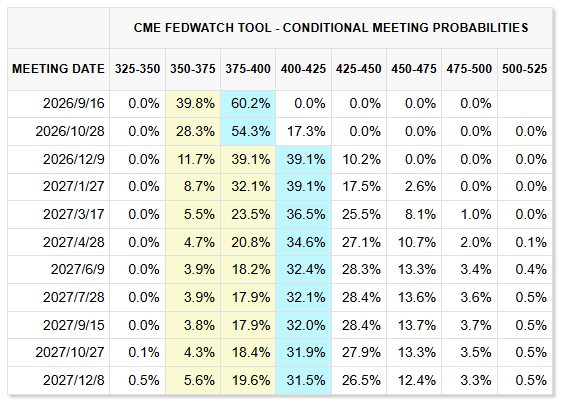
The strategist wrote in the report: “As potential inflation persists and the Fed's concerns about high inflation are becoming more and more obvious, the need to keep interest rates unchanged is weakening. Now is the time to support expectations of interest rate hikes instead.”
The valuation of the S&P 500 has been drastically revised but not fully priced, but historical rules indicate a good opportunity to buy
Facing the upcoming interest rate hike cycle, Manish Kabra, the chief US stock strategist at Societe Generale Bank, gave a seemingly conflicting but critical judgment: investors should not panic, but rather view any stock market weakness caused by interest rate hikes as a buying opportunity.
Kabra's core arguments are built on two key pieces of data. First, the S&P 500 has been “discounted early” by about 15% — its expected price-earnings ratio has dropped from 23.5 times to about 19.5 times. This means that the market has partially absorbed the risk of the Fed restarting interest rate hikes. However, Cabra also warned that the stock market has yet to fully reflect the full impact of the “new cycle of interest rate hikes.”
Historical rule: An average drop of 3% in the first month, and an average increase of 4% after six months
Kabra's analysis of historical data provides investors with a clear time frame: within a month after the first rate hike, the S&P 500 index fell by an average of 3%; within six months after the first rate hike, the index rebounded an average of 4%.
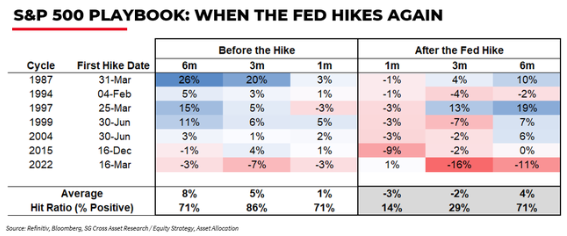
From the first rate hike to the last rate hike, the S&P 500 recorded positive annualized returns in every complete austerity cycle, ranging from 0.1% to 7.8%, with a median increase of 5.6%
Kabra said, “After restarting the Federal Reserve's austerity policy, the stock market usually weakens for the next 1 to 3 months, but after six months, the market has often recovered to a new high.”
Whether the yield curve is inverted: the “key signal” that determines success or failure
Kabra emphasized that there is a key exception to the historical rule: when 2-year US Treasury yields exceeded 10-year yields, that is, the yield curve was inverted, the stock market experienced a decline of about 20% in history.
Societe Generale's core judgment is that in most scenarios, the yield curve will not be inverted. As long as this premise holds true, “the curve is not inverted = interest rate hikes in the middle of the buying cycle.” Kabra summed this up in the report as “the curve is king” — the key indicator that determines whether a policy is “tight” is the shape of the yield curve, not the valuation itself.
2022's “exception”: when austerity comes too fast
Kabra specifically pointed out that 2022 was an exception to this historical rule — the Federal Reserve carried out extremely aggressive austerity in a short period of time, making it difficult for the stock market to absorb such large-scale tightening. At the same time, the yield curve was inverted, causing the stock market to not recover lost ground as scheduled within 6 months.
However, Societe Generale expects that under most scenarios, there will be no inversion of the yield curve during this round of interest rate hikes. This means that the “curve is not inverted = buy rate hike” strategy is still applicable in the current cycle.
However, Societe Generale believes that there is an essential difference between the current situation and 2022: the Federal Reserve adopts a “prudent interest rate hike strategy” and raises interest rates three times within six months. This gradual pace allows policy makers to monitor the impact of interest rate hikes on economic activity.
Kabra's core point can be summed up in one sentence: don't panic because of the Fed's interest rate hike, but establish positions when the market falls due to expectations of interest rate hikes. Historical data shows that 1 to 3 months after the start of the interest rate hike cycle is the “digestion period” of the market, but it is also the best buying window. As long as the yield curve remains normal, the market is likely to reach a new high after 6 months.