
SpaceX Mulls Changing AI Team Amid Data Center Delays. What This Means for SpaceX Stock.
In its S-1 filing for its IPO, Elon Musk's SpaceX (SPCX) had earmarked a market opportunity of $28 trillion. Out of this, the company, most popularly known for its rockets and Starlink broadband services, attributed more than 90% of this opportunity to AI. Some skeptics raised concerns; however, there was no stopping Musk as the company's data center buildout continues in full swing, and compute deals with the likes of Alphabet's (GOOGL) (GOOG) Google and Anthropic give SpaceX the much-needed AI street cred.
Yet, when Musk is involved, nothing is as smooth as it seems.
Out With the Old, in With the New?
According to a report in The Information, SpaceX is seemingly looking to restructure its AI infrastructure team after engineering issues developed at its facilities in Tennessee and Mississippi. Allegedly, to increase computing capacity at a rapid rate, some data center sites continued operations without adequate power backup and cooling systems.
As a countermeasure, SpaceX brought in former senior production leader for the Falcon and Dragon programs, Wesley Salandro, and Logan McConnell, a product-support director at SpaceX’s Starbase facility, to the AI team. Further, apart from appointing a Neuralink engineer, the company has put up job listings for several civil engineering positions.
Thus, it is quite apparent that AI is a crucial piece of the whole SpaceX jigsaw. But with the recent churn, who and how is the current leadership keeping the SpaceX rocket on course when it comes to AI ambitions? Let's find out.
Credible Leadership
The leadership picture changed materially after the recent data center problems earlier this year, and the person with ultimate responsibility now appears to be Michael Nicolls. He became president of SpaceXAI in April 2026 and was later given oversight of the infrastructure turnaround. Nicolls joined SpaceX in 2020, which gives him about six years inside the company.
He is not a conventional data center executive, but his background is relevant in a different way. He holds three electrical engineering degrees from Cornell, including a doctorate; previously cofounded LeoLabs; and served as its chief technology officer. At LeoLabs, he helped develop radar systems, orbital tracking technology, and a software platform for space safety.
He later led Starlink engineering across satellites, user terminals, ground equipment, network software, and constellation operations. That last role is probably the best preparation for his current assignment because Starlink is a complex physical and digital network that must operate continuously across millions of users and thousands of satellites.
Then there is the aforementioned Wesley Salandro, who brings the industrial execution side of the new team. He joined SpaceX in 2019. Before SpaceX, he worked in production and quality roles at BMW (BMWKY), helped lead manufacturing at Lucid Motors (LCID), and held an executive position at Vector Launch. He has a doctorate in automotive engineering from Clemson and an undergraduate degree in mechanical engineering from Penn State. His career has revolved around factory design, assembly flow, production quality, composites, testing, and scaling complicated physical systems.
At SpaceX, he managed teams responsible for assembling Falcon 9 stages and Dragon spacecraft, where poor quality control can destroy a mission rather than merely interrupt a computing job. His move into AI infrastructure is therefore easy to understand. SpaceX needs someone who can turn an improvised construction effort into a repeatable production system. Salandro has done that kind of work before, although with rockets and vehicles rather than server buildings. His success can be judged indirectly through the production organization he helped lead.
Finally, Logan McConnell supplies another piece of that operating model. He previously ran production support operations at Starbase, covering tooling, factory reliability, maintenance, automation, controls, and the supporting systems needed to keep manufacturing and testing moving. SpaceX has not disclosed its precise title within the new AI infrastructure organization; the assignment will likely encompass operational reliability across power, cooling, construction support, and maintenance, but that remains an informed reading rather than confirmed reporting.
Other key players include Daniel Dueri, who, during the April reorganization, was placed in charge of compute infrastructure. Dueri has a doctorate in guidance and control and comes from the software and network side of SpaceX rather than construction. His role should cover the computing layer itself, including cluster operation, networking, scheduling, and the software needed to keep large groups of accelerators functioning as one system.
Overall, the new executives' first test is not reaching another headline capacity number. It is proving that existing capacity can operate reliably, serve external customers, and generate acceptable returns. If they succeed, SpaceX will have transferred its strongest organizational skill, rapid industrial scaling, into AI infrastructure. If reliability remains weak, then moving rocket executives into the division will look more like an emergency repair than a durable competitive advantage.
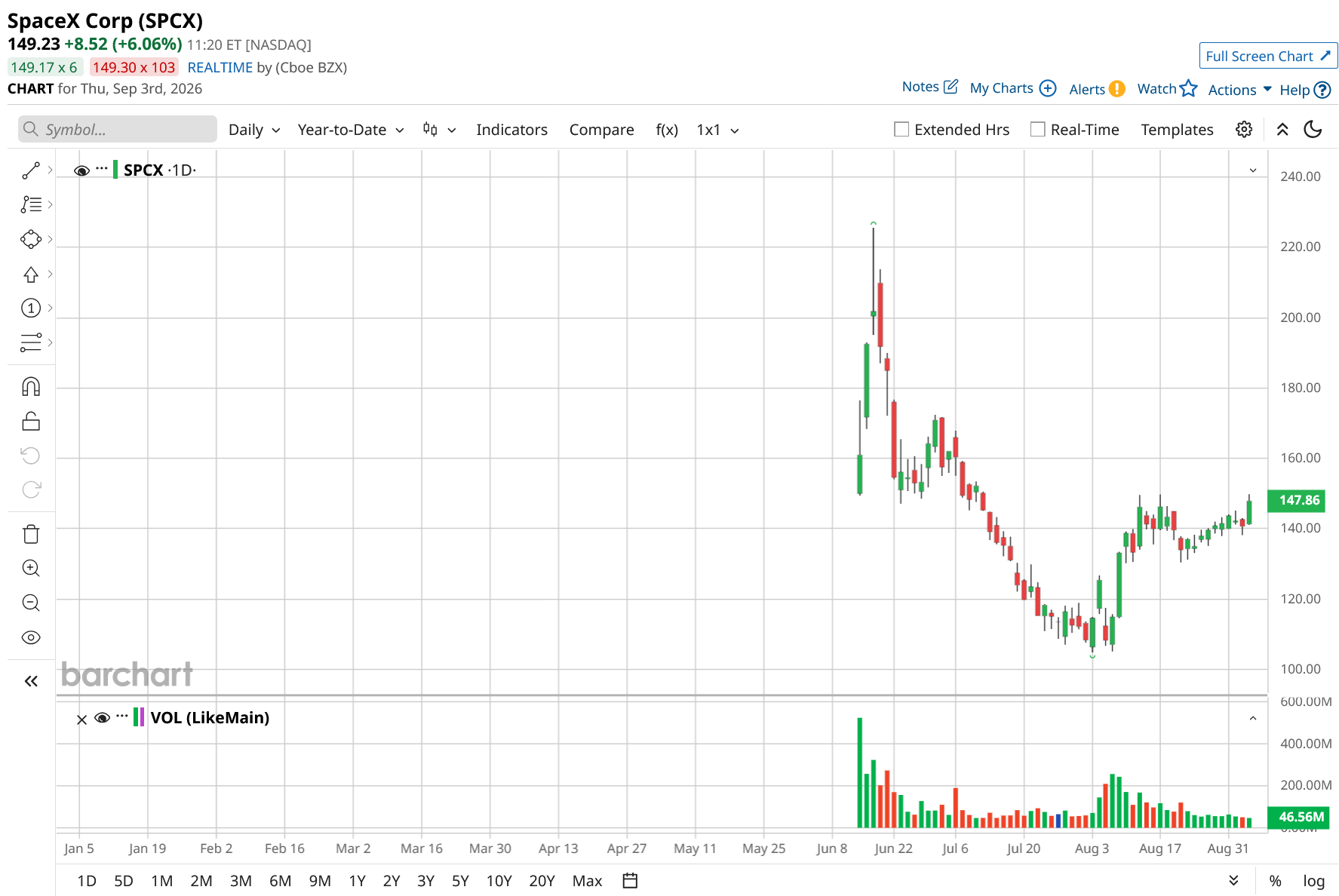
Valued at a market cap of $1.9 trillion, SpaceX's stock is down 12% since its IPO.
Analyst Opinion of SPCX Stock
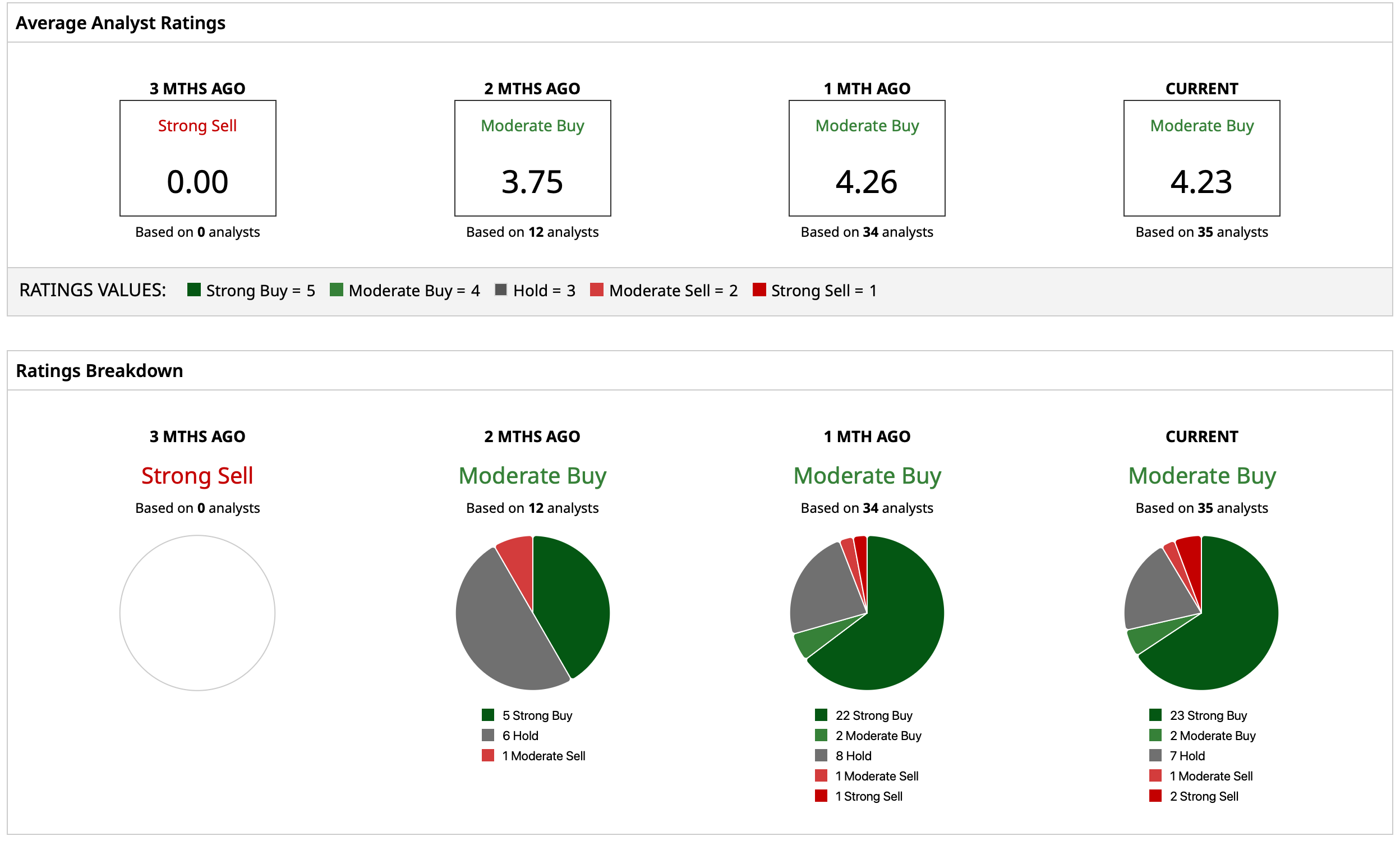
Wall Street remains cautiously optimistic about SPCX stock and has earmarked for it a consensus rating of “Moderate Buy.” The mean target price of $217.85 indicates a potential upside of about 46% from current levels. Out of 35 analysts covering the stock, 23 have a “Strong Buy” rating, two have a “Moderate Buy” rating, seven have a “Hold” rating, one has a “Moderate Sell” rating, and two have a “Strong Sell” rating.
On the date of publication, Pathikrit Bose did not have (either directly or indirectly) positions in any of the securities mentioned in this article. All information and data in this article is solely for informational purposes. For more information please view the Barchart Disclosure Policy here.