
The collapse of arbitrage trading boosted the yen's sharp rise, and expectations of the Bank of Japan's interest rate hike continued to heat up
The Zhitong Finance App learned that as traders increased their bets on further interest rate hikes by the Bank of Japan, large-scale liquidation of yen financing arbitrage transactions pushed the exchange rate of yen against the US dollar to the highest level in a month.
The yen surged more than 2% on Thursday and maintained gains on Friday. The exchange rate was close to the level when Japan's Ministry of Finance intervened in May. Earlier, Bank of Japan Governor Ueda Kazuo and review committee member Takada Hajime made hawkish remarks this week, implying that interest rates may be raised sharply at the September 18 policy meeting, further igniting market expectations.
According to data from the Chicago Mercantile Exchange, the volume of USD/JPY call options due this month, which was executed on Thursday, reached more than two and a half times the volume of put options, indicating that traders are concentrating on closing short positions in yen. When the yen appreciated against the US dollar, the value of the call option increased.
Sagar Sambrani, a senior foreign exchange options trader at Nomura Securities in London, said, “Currently, the market is experiencing significant liquidation of Japanese yen financing arbitrage transactions, while showing strong interest in holding yen in the medium term compared to other G10 currencies. The market generally believes that the era of easy arbitrage is over, and the scale of Japan's cross-border capital flows to the US may have substantially changed.”
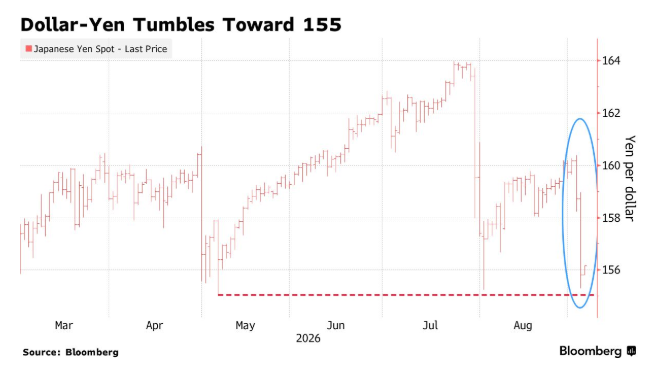
The yen has long been regarded as an ideal financing currency, due to Japan's extremely low borrowing costs. Arbitrage traders borrow yen and invest in high-yield assets. As long as the yen stabilizes or weakens, they can earn interest spreads. However, as market expectations for the Bank of Japan's tightening policy heat up, the yield on Japanese treasury bonds rose, the yen strengthened, and volatility increased, and this trading logic is under tremendous pressure. The yield on Japan's two-year treasury bonds has risen by about 14 basis points this week. The swap market pricing shows that there is a high probability that the September 18 meeting will raise interest rates by 25 basis points, and it is expected that there will be about three interest rate hikes by the same margin by July next year. Compared to the average pace of two annual rate hikes since 2024, this means that the pace of interest rate hikes will accelerate significantly.
The US dollar wasn't the only currency affected by arbitrage liquidation yesterday. High-interest currencies such as the Brazilian real, the South African rand, and the Mexican peso all fell by more than 1% against the yen.
Strategist Brendan Fagan said, “The yen surged 2% in a single day against the US dollar, which is the clearest sign so far, that a more active Bank of Japan is the best antidote to a weak yen.”
There is still room for the yen bears to make up for the market. According to the latest data from the US Commodity Futures Trading Commission, leveraged funds had net short positions in yen of 81,619 contracts and 18,284 short positions with asset management companies for the week ending August 25. The market's judgment on the Bank of Japan's interest rate hike this month and maintaining a flexible pace of subsequent austerity is prompting investors to continue to cut short positions.
Traders said that Japanese exporters have also increased the selling power of the US dollar against the yen, further boosting the yen's upward trend. Bank of America said that the current round of yen rebound reflects a broad shift in market sentiment.
Ivan Stamenovic, head of transactions in the Asia Pacific region of Bank of America's G10 currency in Hong Kong, pointed out: “The trend of the dollar against the yen did not come from a unilateral operation in a certain market, but rather a reflection of the reconfiguration of the overall risk position driven by the events of the past 48 hours.”
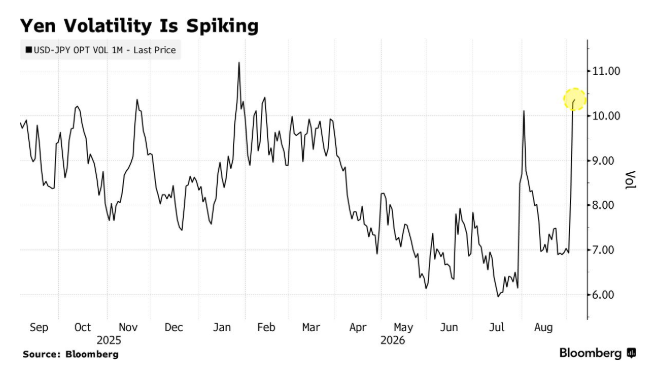
Back in the London market, discussions about the “collapse” of Japanese yen financing arbitrage trading have spread to various trading platforms. Mizuho Bank said there was a clear shift in market sentiment this week, which prompted investors to speed up clearance of crowded Japanese yen shorts and Japanese treasury bond short positions.
Masayuki Nakajima, Mizuho's senior strategist in London, concluded: “The core driving factor is the large-scale liquidation of Japanese yen short positions, particularly hedge fund accounts. At the same time, market expectations for a further tightening of the Bank of Japan's policy also continue to grow.”