
The war between the US and Iran reignited, and the two straits in the Middle East were hit by supply shocks, and crude oil headed for the strongest weekly gain since July
The Zhitong Finance App learned that as hostilities between the US and Iran escalate again, heightening market concerns about the long-term blockage of energy in the Strait of Hormuz and the Mander Strait, the international oil price benchmark, the Brent crude oil futures price, is expected to record the biggest weekly increase since July.
The conflict between the US and Iran escalated again after a short period of easing. In particular, the US air raided Iranian targets this week. Tehran then attacked US military bases in the region, merchant ships passing through the Strait of Hormuz, and fired missiles at Jordan, Kuwait, and Bahrain; Israel warned that if attacked by Iran again, its current operational restrictions would lapse. Although the US has downplayed the “all-out war” characterization, military operations, negotiations, and Iran's expansion of the blacklist of ships mean that the market is not a one-time loss of supply, but that the straits have been in a high-risk state of “limited navigation and attack at any time” for a long time.
The two major maritime throats are creating a combined risk. On September 1, Kpler detected that only 4 commodity carriers passed through the Strait of Hormuz, far below the 10-day average of about 13 ships; the Mander Strait also had only 18 ships on the same day, lower than the 10-day average of about 24 ships. Looking at the longer term, the average daily traffic volume of the Strait of Hormuz before the war was about 130-140 ships, but at the height of the crisis it fell below 10% of normal levels; overall shipping volume in the Red Sea and the Strait of Mande also dropped by more than 50% due to Houthi attacks.
What is particularly dangerous is that Hormuz restricts energy exports to the Persian Gulf, and the Mander Strait also threatens an alternative route for Saudi ports to bypass the Red Sea-Suez Canal. Simultaneous blocking of both will significantly reduce the orbiting flexibility of the global energy supply chain, leading to a rise in maritime shipping costs along with the prices of crude oil, refined oil products, and natural gas.
Military artillery fire returns to Hormuz, and the risk premium is once again ignited
At the beginning of the Asian market on Friday, Brent crude oil rose slightly to close to 96 US dollars per barrel, with a cumulative increase of more than 7% this week; West Texas Intermediate crude oil (WTI crude oil), the price benchmark for North American crude oil, traded around $92 per barrel. The current escalation of the US-Iran conflict occurred after a period of relative calm: the US launched a bombing operation earlier this week, and Iran then retaliated against US bases in the region.
The Iranian military continues to attack ships passing through the Strait of Hormuz and fire missiles at Jordan, Kuwait, and Bahrain. Israel said it was ready to resume fighting if necessary, and said that Iran's attack would make it no longer subject to existing restrictions, thus increasing the possibility of a new round of military escalation.
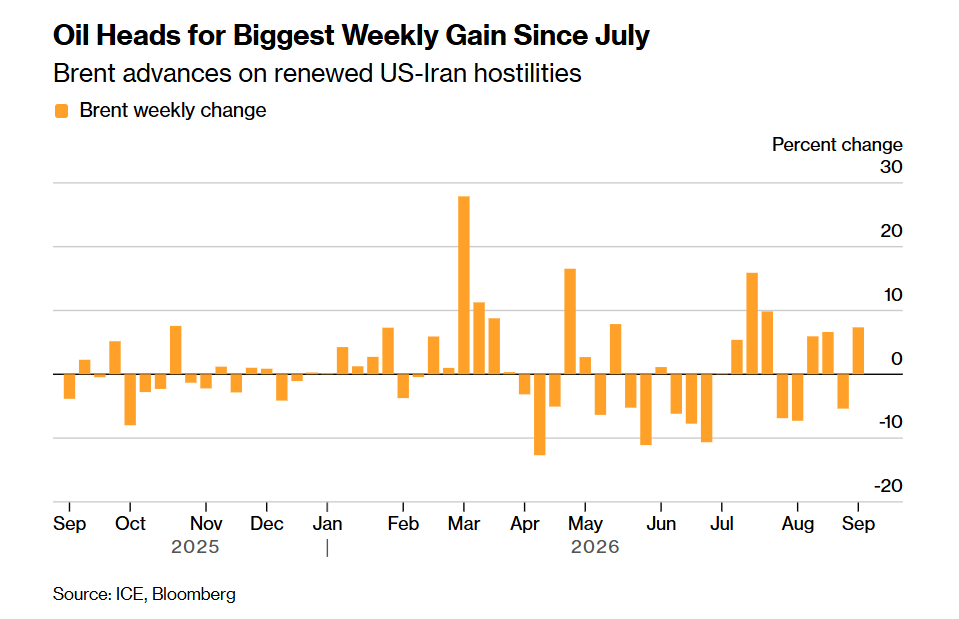
As shown in the chart above, the international crude oil price trend is expected to hit the biggest weekly increase since July — the resumption of a new round of hostilities between the US and Iran is driving Brent crude oil to rise at an accelerated pace.
Despite renewed fighting this week, US Vice President JD Vance downplayed the scale of the conflict, saying he wouldn't call it a war since large-scale operations ended weeks ago. Republican Congressman Pat Harrigan from North Carolina, who is a member of the House Armed Services Committee, made a different judgment, saying, “From a military perspective, we are clearly in a state of war and negotiations have stalled.”
Priyanka Sachideva, head of futures market insight from Phillip Nova Pte Ltd., Singapore, said the oil market is “re-evaluating its own vulnerability.” “When fundamental energy transportation and navigation safety issues remain unresolved, the risk premium can only be reduced for a limited period of time,” she said.
Behind the nearly 60% increase: the struggle between energy inflation and aviation resilience
Brent crude oil has risen by nearly 60% since this year; due to the Middle East conflict and the Russian-Ukrainian war, refined oil products such as diesel have risen even more. This week, retail prices for this industrial fuel in the US rose to their highest level since mid-2022, while European inventories fell far below seasonal levels.
On the price side, as of 9:04 a.m. Singapore time, Brent crude oil for November delivery rose 0.3% to 95.76 US dollars per barrel. WTI crude oil for October delivery rose 0.4% to $91.65 per barrel.
Both oil and WTI crude oil prices are expected to record their biggest weekly increase since mid-July. Brent has accumulated a cumulative increase of nearly 60% since this year. Refined oil products such as diesel have risen even higher, while Asian spot liquefied natural gas prices have risen to a three-year high. For investors, energy stocks, tanker shipping, and refining profits still benefit from geopolitical risk premiums, but much of it is “fear pricing”; if strait navigation continues to improve, related premiums may be rapidly compressed, while if Hormuz and the Strait of Mande deteriorate at the same time, oil prices, global inflation, and long-term treasury bond yields may usher in a new round of upward shock.
Despite ongoing hostilities in the Middle East, some crude oil is still being shipped out of the Persian Gulf via the Strait of Hormuz; US officials said this week that traffic in the region is still strong under US military escort. Saudi Arabia is also keeping the price of its flagship crude oil unchanged next month, which may mean that the tight supply in the market has eased somewhat.
Before the war with Iran broke out, about one-fifth of the world's oil and liquefied natural gas was transported to the world market via the Strait of Hormuz. This week, Asian spot liquefied natural gas prices rose to the highest level in more than three years, and high costs are putting pressure on demand and budgets in some countries in the region.
Furthermore, the rise in global shipping costs, which follows the upward trajectory of crude oil prices, is mainly driven by a contraction in the effective supply of ships, longer range, and war risk insurance, rather than a sudden surge in global oil consumption.
In the early days of the US-Iran war, the daily rent for the Middle East-China Very Large Tanker (VLCC) rose to a record 423,736 US dollars; although there has been a decline since then, forward freight charges for the fourth quarter of 2026 are still around $181,163 per day, which is more than double the US Gulf of Mexico-China route of US$86,314 per day. The additional war insurance rate for the Hormuz voyage was raised from 1% to 3% to 7.5% to 10% of the hull value in July; if specific Red Sea cargo is forced to change routes, some senior maritime shipping experts have estimated that it may increase about 10,000 nautical miles, 34 days of voyage, and more than 5 million US dollars in freight, and fuel and insurance costs have not been included.